

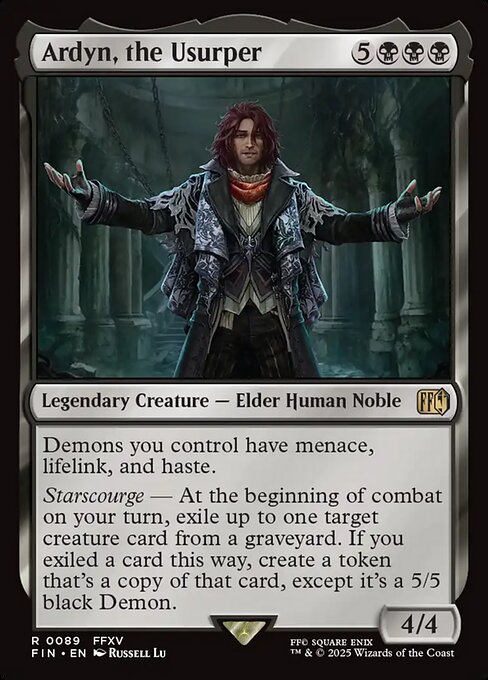
Image courtesy of Scryfall.com
How templating shapes our understanding of Ardyn, the Usurper
Templating in Magic: The Gathering isn’t just about flashy words on a card; it’s a discipline that guides how players parse a card under pressure, across dozens of games, and through a thousand decisions. Ardyn, the Usurper from the Final Fantasy crossover is a compelling lens into how careful wording, dash marks, and ability blocks can tilt perception as decisively as a five-molded mana cost. 🧙♂️🔥 In the language of templating, every symbol is a cue, every line break a hint, and every bolded keyword a beacon for what you should do next on the battlefield. 💎
To begin, look at Ardyn’s mana cost: {5}{B}{B}{B}. That eight-mana commitment CMC 8 sits at the crossroads of “powerful, but careful” and “board-impacting in the long game.” The color identity is black, and with a Legendary Elder Human Noble frame, Ardyn immediately signals a certain flavor: political power, graveyard tricks, and demon-backed ambitions. The card’s typeline and rarity—the rare in the Final Fantasy set—further push players to anticipate game-defining plays rather than simple beatdown. ⚔️
Demons you control have menace, lifelink, and haste
The first templating flourish players encounter is a global static ability. “Demons you control have menace, lifelink, and haste.” It’s compact, but its impact is seismic. The sentence structure makes the buff feel like a natural extension of Ardyn’s rule—your demon swarm becomes more aggressive, more survivable, and more urgent to push damage before opponents can stabilize. The templating keeps this line short, avoiding awkward parentheses or multi-line interruptions, so players can internalize the effect quickly. The result is a tactile sense of inevitability as your board grows into a menacing, lifegaining army that refuses to sit back. 🧙♂️⚔️
The trick, of course, is recognizing the scope: this buff applies to all Demons you control, including any token copies spawned by Ardyn’s Starscourge ability. The succinct wording helps you visualize a cascading effect—every demon benefits from menace, lifelink, and haste, turning every swing into a potential game-turning moment. It’s a masterclass in how a single static line can reshape a deck’s entire subtheme and tempo. 🎲
Starscourge — the exiled graveyard trick that creates a demon mirror
“Starscourge — At the beginning of combat on your turn, exile up to one target creature card from a graveyard. If you exiled a card this way, create a token that’s a copy of that card, except it’s a 5/5 black Demon.” This is where templating becomes a narrative tool as well as a rules tool. The em dash after the ability name signals a brisk, cinematic pause—Starscourge is not just a line of text; it’s a signature ability that defines Ardyn’s battlefield tempo.
Templating here is deliberate: you exile from a graveyard, you copy the exiled card, and you reframe it as a 5/5 Demon. The token’s power and toughness are fixed, even if the copied card’s original stats would have been different. The color identity shifts the token into Demon territory, and the static buff from Ardyn’s control-granted demon tag applies to it as well. The result is a dynamic, synergy-rich loop: you remove a threat from the graveyard, conjure a demon threat in its place, and push your demon army into combat with added haste. The text makes this feel almost cinematic rather than a dry mechanical effect. 🎨🧙♂️
“In templating, clarity and ambition walk hand in hand. Ardyn demonstrates how a compact paragraph can unlock expansive strategy—grind the graveyard, spawn a demon army, and let your Demons rule the battlefield.”
Reading the whole package: a learning curve that rewards patience
Ardyn’s templating isn’t merely about word economy; it’s about presenting a multi-step plan in a way that players can parse under pressure. The “exile up to one target creature card” clause is the tiny doorway to a larger strategy (graveyard recursions, token synergies, and demon tribal power). The token’s modified form—“a copy of that card, except it’s a 5/5 black Demon”—is a neat fuse of a copied card’s potential with a new identity that you can leverage via the demon buff. This richness is precisely what templating aims to deliver: a card that rewards familiarity, careful reading, and long-term planning. 🧠💎
However, the complexity also requires players and opponents alike to adjust their expectations. Because Ardyn’s triggered ability starts at the beginning of combat on your turn, timing becomes critical. You may exile a large threat or a crucial blocker, yet the token arrives en route to the next combat phase, and its power is measured against the present state of the battlefield. The templating nudges players to think in terms of “prep, recast, swing” rather than a single decisive play, which is exactly the kind of depth modern sets strive for. 🧭
Design, flavor, and collector resonance
From a design perspective, Ardyn blends flavor with mechanical rhythm. Thematically, a usurper kingpin who commands demons and manipulates the graveyard sits squarely at the intersection of black’s bread-and-butter motifs: discard, reanimation, and inevitably, domination of the board. The Star-scourge naming, the heavy mana requirement, and the demon-wide buff all reinforce a lore-driven identity that resonates with players who enjoy a well-woven narrative in their games. The Final Fantasy set’s cross-franchise flair adds a layer of collector interest, making Ardyn appealing to both narrative readers and value-seekers alike. And if you’re chasing foil richness or alternative art, the card’s rare status in this cross-release points to a certain shelf presence that collectors notice. ⚔️💎
For players who enjoy the puzzle of templating, Ardyn offers a durable, repeatable problem to solve on every game night. The more you play with it, the more you’ll appreciate how the text is sculpted to guide decisions without spoon-feeding outcomes. It’s a reminder that great templating isn’t just about what a card does; it’s about how the card teaches you to think about your turns. 🧙♂️
Neon Gaming Mouse Pad (Rectangular, 1/16in Thick, Non-slip)More from our network
- https://blog.crypto-articles.xyz/blog/post/nft-data-ryujin-2422-from-ryujin-collection-on-magiceden/
- https://crypto-acolytes.xyz/blog/post/nft-stats-it-kids-06300-from-it-kids-collection/
- https://crypto-acolytes.xyz/blog/post/nft-stats-geek-2358-from-geeks-collection/
- https://articles.zero-static.xyz/blog/post/metro-exodus-essential-tips-for-solo-survival-in-the-wasteland/
- https://blog.crypto-articles.xyz/blog/post/nft-data-nuddies-255-from-nuddies-collection-on-magiceden/
Ardyn, the Usurper
Demons you control have menace, lifelink, and haste.
Starscourge — At the beginning of combat on your turn, exile up to one target creature card from a graveyard. If you exiled a card this way, create a token that's a copy of that card, except it's a 5/5 black Demon.
ID: 4627072e-9c72-4084-8021-690777342548
Oracle ID: 9ae13026-960a-4d31-b775-d47209a1e313
TCGPlayer ID: 630930
Cardmarket ID: 824133
Colors: B
Color Identity: B
Keywords: Starscourge
Rarity: Rare
Released: 2025-06-13
Artist: Russell Lu
Frame: 2015
Border: black
EDHRec Rank: 6100
Set: Final Fantasy (fin)
Collector #: 89
Legalities
- Standard — legal
- Future — legal
- Historic — legal
- Timeless — legal
- Gladiator — legal
- Pioneer — legal
- Modern — legal
- Legacy — legal
- Pauper — not_legal
- Vintage — legal
- Penny — not_legal
- Commander — legal
- Oathbreaker — legal
- Standardbrawl — legal
- Brawl — legal
- Alchemy — legal
- Paupercommander — not_legal
- Duel — legal
- Oldschool — not_legal
- Premodern — not_legal
- Predh — not_legal
Prices
- USD: 1.10
- USD_FOIL: 1.54
- EUR: 0.86
- EUR_FOIL: 1.01
- TIX: 0.03
More from our network
- https://blog.rusty-articles.xyz/blog/post/how-roblox-crossplay-works-and-what-it-means-for-players/
- https://donation.digital-vault.xyz/donation/post/support-open-inclusive-ai-that-serves-everyone-worldwide/
- https://crypto-acolytes.xyz/blog/post/nft-stats-solgod-57-from-solgods-collection/
- https://crypto-acolytes.xyz/blog/post/nft-stats-trench-warriors-345-from-trench-warriors-collection/
- https://wiki.digital-vault.xyz/wiki/post/pokemon-tcg-stats-swampert-card-id-xy5-35/