
Image courtesy of TCGdex.net
How Talonflame Artwork Shapes Perception in the Pokémon TCG
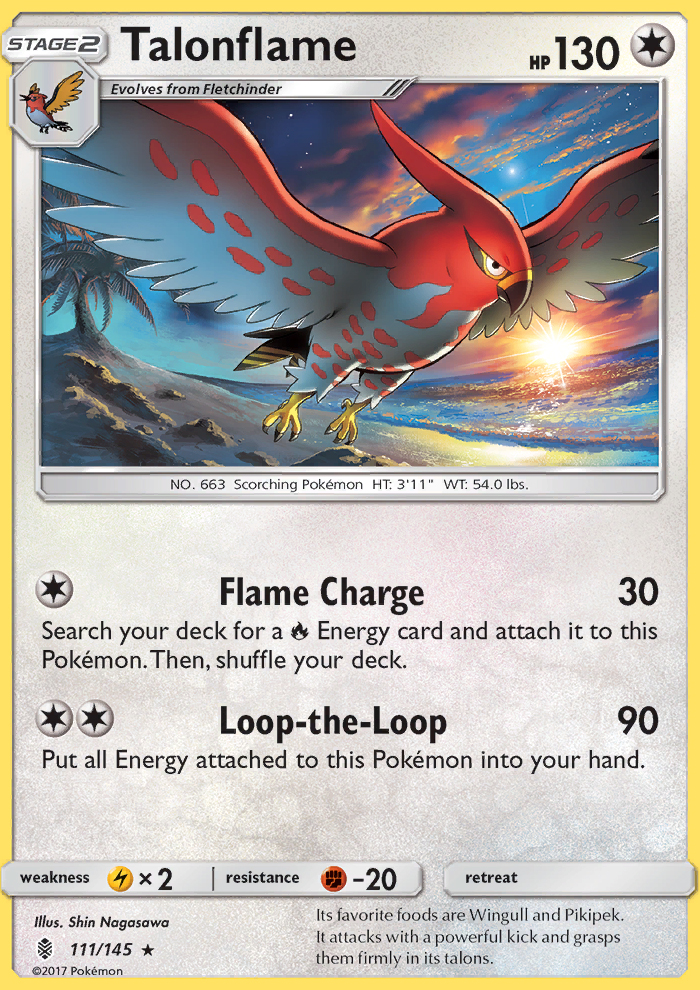
Art in the Pokémon Trading Card Game does more than decorate a card; it frames the story you tell as you play, influences how you perceive a card’s power, and even nudges you toward certain strategies. Talonflame from the Guardians Rising set is a prime example of how visual design can amplify gameplay ideas and collectability at the same time ⚡🔥. Shin Nagasawa’s skillful illustration captures a blazing, mid-swoop moment that feels almost kinetic on a tabletop—there’s a sense of momentum and risk that mirrors the card’s tempo-based toolkit.
Visual language that sells speed and heat
Nahasawa’s Talonflame is a colorless Pokémon, a rarity that stands out in a world often defined by Fire or Water typing. The color palette choices—rich ambers, scorching oranges, and deep shadows—lend the artwork an almost infernal presence. The flame motifs aren’t just decorative; they function as a visual shorthand for the card’s two key mechanics: energy acceleration and energy recapture. The dynamic wings and trailing embers draw the eye along a path of forward motion, inviting players to consider tempo and resource management before the first card is drawn in a match.
The holo variant often elevates that perception even further. The reflective sheen catches the light, turning fleeting glints into a visible cue for power—much like a well-timed Flame Charge can escalate a turn from cautious to explosive. In collectible terms, the holo treatment signals rarity and desirability, pulling players toward a card that looks as fast as it feels to play. It’s a visual cue that the card has a role in aggressive, tempo-forward decks, even when its type is listed as Colorless rather than a primary Fire motif.
“Good art makes you feel the burn before you play it.” — a sentiment many players share when a Talonflame card hits the table, as if the illustration themselves whispers, “you’re about to accelerate.”
From brushwork to battlemind: decoding the card’s mechanics through the art
Beyond the glittering surface, Talonflame SM2-111 carries a careful balance of strengths and constraints that are echoed in its artwork. The card is a Stage 2 evolution, evolving from Fletchinder, with an impressive 130 HP. The choice to render Talonflame as a colorless Pokémon—rather than tying it to a Fire typing—aligns with its two primary attacks: Flame Charge and Loop-the-Loop. The first attack costs a single Colorless energy and lets you search your deck for a Fire Energy to attach to Talonflame, then shuffle. The art’s heat motif reinforces this energy-into-fire synergy, even as the energy type remains colorless from a gameplay perspective. The second attack, Loop-the-Loop, costs two Colorless energy and delivers 90 damage, while its effect reads like a tempo mechanic: put all Energy attached to Talonflame into your hand. The artwork’s implied motion—Talonflame arcing through the air—mirrors this abrupt energy reset, inviting players to imagine the wheel turning as energy returns to your hand for another push. It’s a design that rewards planning: you set up a temporary advantage with Flame Charge, then recoup your resources to stay on the offensive. The card’s vulnerabilities and resistances also shape a player’s perception of its role. With a Lightning-type weakness and a −20 resistance to Fighting, Talonflame sits in a battleground where fast-paced Electric decks and Fighting-heavy lines are common. The art, with its heat-forward focus, subtly primes you for a risk-reward mindset: you’re leaning into speed and disruption, but you’ll need to protect your tempo against the right counters. The rarity tag—Rare—combines with the holo texture to communicate value, not just in power, but in collector appeal.
Strategic takeaways a painter’s-eye view of tempo and energy
- Tempo over raw damage: Flame Charge acts as a built-in engine to accelerate Fire Energy into play, even though the attack costs are colorless. This makes Talonflame a tempo enabler in decks that want to propel early aggression and then pivot into big plays with Loop-the-Loop.
- Resource shuffling as a strategic tool: Loop-the-Loop isn’t just a safety valve; it’s a rhythm changer. Returning attached Energy to your hand gives you the choice to reapply pressure—either restarting a Flame Charge chain or pressuring a defensive setup your opponent has built.
- Matchup-aware design: Weakness to Lightning plus a −20 Fighting resistance invites you to pair Talonflame with strategies that cover those angles—think supportive tools and other attackers that can threaten Lightning-types or exploit your opponent’s energy setup.
- Evolving in the Guardians Rising era: As a Stage 2, Talonflame’s place in Expanded format emphasizes mid- to late-game board presence. The artwork’s sense of forward motion pairs nicely with decks that aim to outpace opponents before they can consolidate their own game plan.
Collector’s lens: price, rarity, and the art’s lasting value
From a market perspective, Talonflame SM2-111’s Rare status and holo option contribute to a steady collector interest. Data from CardMarket shows holo copies carrying higher price points on average (roughly around €0.28 on average, with notable spikes up to €2.26 in some listings), while non-holo versions tend to sit lower (averages near €0.18 or less). TCGPlayer mirrors that trend in USD, where the holo variant often commands a higher market price than the non-holo, depending on condition, printing, and demand. For players, this is a reminder that collecting the holo version is not just about aesthetics—it’s also about long-term value in a rotating format where certain sets become nostalgic time capsules for the game’s history.
Guardians Rising itself is remembered for its balance of powerful evolutions and clever energy interactions, and Talonflame embodies that spirit. The card’s layout—the subtle contrast between the bright flames and the dark backdrop, the clear silhouette of the talon, and the glossy foil—helps it pop in a binder and on the table. For newcomers and veterans alike, the art communicates a narrative of momentum and risk, a vibe that aligns with players who enjoy pushing tempo and pressuring opponents with calculated risk-taking. It’s a reminder that a card’s value isn’t only in its stats, but in the story the art tells as the game unfolds 🎴🎨.
As you admire the fiery energy of this piece, you might also be thinking about practical ways to protect your everyday gear while you travel between tournaments or local meetups. If you’re in the market for a stylish accessory that nods to a tech-forward mindset, consider this slim, glossy phone case—designed for iPhone 16 with Lexan PC construction—that travels as smoothly as Talonflame herself soars across the card art flame. It’s a small, real-world parallel to the way Pokémon cards fuse artistry with strategy.
Product spotlight — Slim Glossy Phone Case for iPhone 16 Lexan PC
Protect your device in style with a case that mirrors the crisp, glossy finish you love in holo cards. Learn more and pick one up here:
Slim Glossy Phone Case for iPhone 16 Lexan PCMore from our network
- https://transparent-paper.shop/blog/post/stable-diffusion-xl-prompt-noir-graphic-neon-cyberpunk-labyrinth-motif-stalactite-texture-amber-aztec-gold-palette-mythic-hydra/
- https://blog.rusty-articles.xyz/blog/post/spider-man-miles-morales-community-creations-spotlight-mods/
- https://blog.crypto-articles.xyz/blog/post/nft-data-monkey-biz-903-from-monkey-business-collection-on-magiceden/
- https://transparent-paper.shop/blog/post/stable-diffusion-xl-prompt-neoclassical-sculpture-holographic-finish-spider-motif-phoenix-flame-snake-skin-texture-iridescent-high-contrast/
- https://wiki.digital-vault.xyz/wiki/post/pokemon-tcg-stats-cresselia-card-id-a2-079/
Talonflame
Set: Guardians Rising | Card ID: sm2-111
Card Overview
- Category: Pokemon
- HP: 130
- Type: Colorless
- Stage: Stage2
- Evolves From: Fletchinder
- Dex ID: 663
- Rarity: Rare
- Regulation Mark: —
- Retreat Cost: 0
- Legal (Standard): No
- Legal (Expanded): Yes
Description
Attacks
| Name | Cost | Damage |
|---|---|---|
| Flame Charge | Colorless | 30 |
| Loop-the-Loop | Colorless, Colorless | 90 |
Pricing (Cardmarket)
- Average: €0.18
- Low: €0.02
- Trend: €0.11
- 7-Day Avg: €0.17
- 30-Day Avg: €0.17
Support Our Decentralized Network
Donate 💠More from our network
- https://transparent-paper.shop/blog/post/stable-diffusion-xl-prompt-noir-graphic-neon-cyberpunk-labyrinth-motif-stalactite-texture-amber-aztec-gold-palette-mythic-hydra/
- https://blog.rusty-articles.xyz/blog/post/spider-man-miles-morales-community-creations-spotlight-mods/
- https://blog.crypto-articles.xyz/blog/post/nft-data-monkey-biz-903-from-monkey-business-collection-on-magiceden/
- https://transparent-paper.shop/blog/post/stable-diffusion-xl-prompt-neoclassical-sculpture-holographic-finish-spider-motif-phoenix-flame-snake-skin-texture-iridescent-high-contrast/
- https://wiki.digital-vault.xyz/wiki/post/pokemon-tcg-stats-cresselia-card-id-a2-079/