
Image courtesy of TCGdex.net
The ripple effects of reprint cycles on Pokémon TCG competitiveness
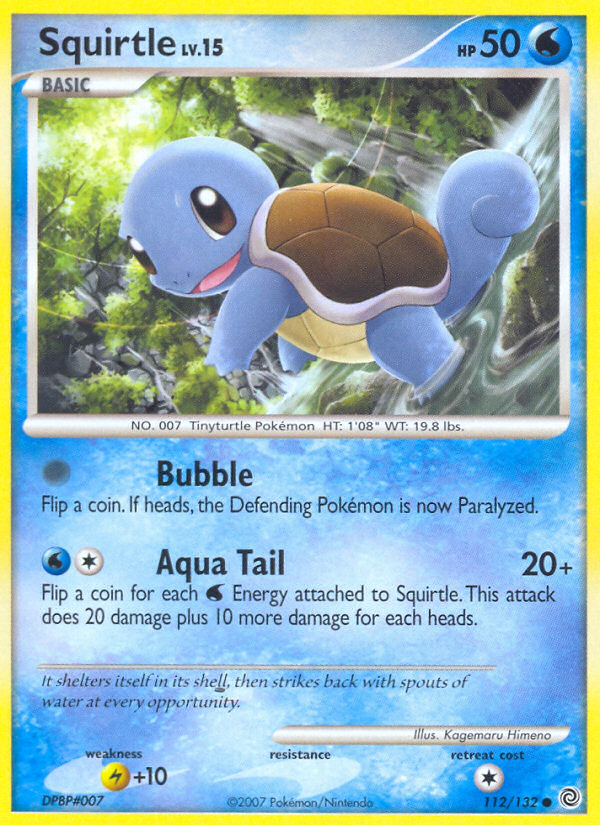
Reprint cycles are the quiet engine behind how accessible, flavorful, and strategically rich the Pokémon Trading Card Game stays year after year. When a card reappears in a new release, it does more than fill a shelf with a familiar name—it reshapes budgets, deck-building options, and even the way players assess risk in the heat of a match. To explore this idea, let’s look at a humble yet telling example: Squirtle from the Secret Wonders set (dp3-112). This Basic Water-type, with a modest 50 HP, arrives in a common rarity and offers two distinct attacks—Bubble and Aqua Tail—that lean into probability as much as raw numbers. Through Squirtle’s lens, we can understand how reprints influence both playability and collectibility in meaningful, tangible ways. ⚡🔥
Card snapshot: Squirtle (Secret Wonders, dp3-112)
- Stage: Basic
- Type: Water
- HP: 50
- Attacks: Bubble (Flip a coin. If heads, the Defending Pokémon is Paralyzed); Aqua Tail (20 damage + 10 more for each heads if you have Water Energy attached to Squirtle)
- Weakness: Lightning (+10)
- Retreat: 1
- Rarity: Common
- Set: Secret Wonders (dp3) — 132 cards in the official print run
- Illustrator: Kagemaru Himeno
- Variants in the set: Normal and Reverse Holo listed in Secret Wonders (the dp3 entry notes no holo variant for this particular print, but reverse print exists)
Squirtle’s power curve is modest by modern standards, but its presence in a set saturated with core Water-type options illustrates a fundamental truth about reprints: they democratize access. In Secret Wonders, the dp3 line-up includes a broad swath of creatures, and Squirtle’s common status makes it a familiar touchstone for new players building budget-friendly decks. The two-attack structure—Bubble’s status effect and Aqua Tail’s scaling damage—also highlights how reprints can preserve classic, engaging gameplay while remaining approachable for beginners. This is especially relevant when considering format rotation and the evolving legality of older cards in Standard or Expanded. As Squirtle’s dp3 card shows, not every reprint is designed to re-enter a modern meta; some are meant to keep the learning curve gentle, while others spark nostalgia-driven buys.
Reprint cycles and competitiveness: the broad strokes
When a reprint cycle lands, several dynamics come into play. First is supply: a fresh print boosts availability, often driving down secondary market prices for already-printed copies. For beginners and budget players, that lower price point lowers the barrier to entry, broadening the pool of players who can test strategies without risking a fortune on a single card. Then there’s market visibility: a reprint can reignite interest in a card’s archetype. Water-type decks have long harbored powerful potential in various eras, and a widely available Squirtle supports that narrative by providing a common, easy-to-splash piece for early-stage builds. Finally, reprint cycles interact with the collector’s market. While reprints can depress the value of earlier print runs, they can also introduce new variants, such as reverse-foil editions, that maintain desirability for collectors who chase set completion and condition. ⚡
Gameplay implications: coin-flip calculus and deck-building intuition
Squirtle’s two attacks hinge on probability. Bubble relies on a coin flip to attempt paralysis, a mechanic that can swing a game in moments by freezing a key threat. Aqua Tail scales with the number of Water Energy attached, flipping a coin for each Water Energy to determine how much extra damage lands on the Defending Pokémon. In practical terms, early-stage players can pair Squirtle with basic Water-energy acceleration to maximize the average damage from Aqua Tail while keeping risk moderate. Reprints of such cards in future cycles can shift the meta by rebalancing how often players can reliably deploy aquatic engines. When a reprint makes a once-obscure support card more accessible, you might see a wave of new decklists that lean into consistent early pressure or, conversely, into longer, “coin-flip swing” matchups that test nerve and planning. This is the magic of reprint-driven unpredictability—every reprint reshapes what counts as a “strong opening” or “safe mid-game play.” 🎴🎮
Market and collector insights: value, rarity, and accessibility
Squirtle, as a Common from a 132-card set, typically sits at the lower end of the price spectrum, which makes it a bellwether for price trends in reprint-informed markets. Current pricing data shows a modest spread: CardMarket averages around 0.75 EUR with occasional volatility driven by supply shifts, while TCGPlayer’s figures show a broader range, from sub-$1 entries to several dollars for better-condition copies or regional demand spikes. This kind of volatility is a direct reflection of reprint cadence: when a set is popular or when a reprint flashes onto the market, you’ll see rapid price adjustments across both common and higher-rarity cards. For collectors, this translates into opportunities to curate a historically grounded, budget-friendly collection that captures the feel of multiple eras without breaking the bank. The dp3 print, with its non-holo presentation, adheres to a classic aesthetic that many fans associate with the early 2010s era of Pokémon TCG art and layout. The illustrator credit—Kagemaru Himeno—also remains a strong selling point for collectors who favor established artistry over modern, AI-inspired iterations.
Practical tips for players and collectors
- For players starting out: leverage Aqua Tail’s energy-scaling potential by pairing Squirtle with reliable Water-energy acceleration. Don’t count out Bubble—it can deter aggressive opponents by forcing early paralysis checks.
- For collectors: inspect dp3 normal and reverse variants to diversify your collection. Since this Squirtle isn’t holo in Secret Wonders, the reverse variant often remains a cost-effective path for completionists seeking set diversity without paying holo-premium prices.
- Watch reprint cycles as a budget-conscious strategy. When a reprint announces, expect prices to equalize across the market, presenting both buying opportunities and trade-value shifts for established players with a long-term perspective.
- Keep an eye on format legality. While this Squirtle from Secret Wonders isn’t currently legal in Standard or Expanded by the data, reprints in upcoming special sets or curated reprint releases can reintroduce beloved mechanics to new audiences. Always verify current legality before building tournament decks.
- Appreciate the artwork and lore. Even as prices and formats change, the enduring charm of Squirtle’s art by Kagemaru Himeno and the tactile joy of a well-worn card contribute to Pokémon’s storytelling, which often fuels renewed interest during reprint cycles. 🎨💎
More from our network
Squirtle
Set: Secret Wonders | Card ID: dp3-112
Card Overview
- Category: Pokemon
- HP: 50
- Type: Water
- Stage: Basic
- Dex ID: 7
- Rarity: Common
- Regulation Mark: —
- Retreat Cost: 1
- Legal (Standard): No
- Legal (Expanded): No
Description
Attacks
| Name | Cost | Damage |
|---|---|---|
| Bubble | ||
| Aqua Tail | Water, Colorless | 20+ |
Pricing (Cardmarket)
- Average: €0.75
- Low: €0.02
- Trend: €0.57
- 7-Day Avg: €0.66
- 30-Day Avg: €0.88
Support Our Decentralized Network
Donate 💠More from our network
- https://blog.rusty-articles.xyz/blog/post/machine-learning-clustering-of-mtg-mana-costs-foil-focus/
- https://articles.digital-vault.xyz/blog/post/console-vs-pc-pokemon-sword-and-shield-performance-showdown/
- https://blog.digital-vault.xyz/blog/post/gideon-juras-legacy-why-he-truly-matters-in-mtg-canon/
- https://crypto-acolytes.xyz/blog/post/solidskulls-1257-solidskulls-nft-stats/
- https://blog.crypto-articles.xyz/blog/post/nft-data-himalaya-356-from-himalaya-collection-on-magiceden/