
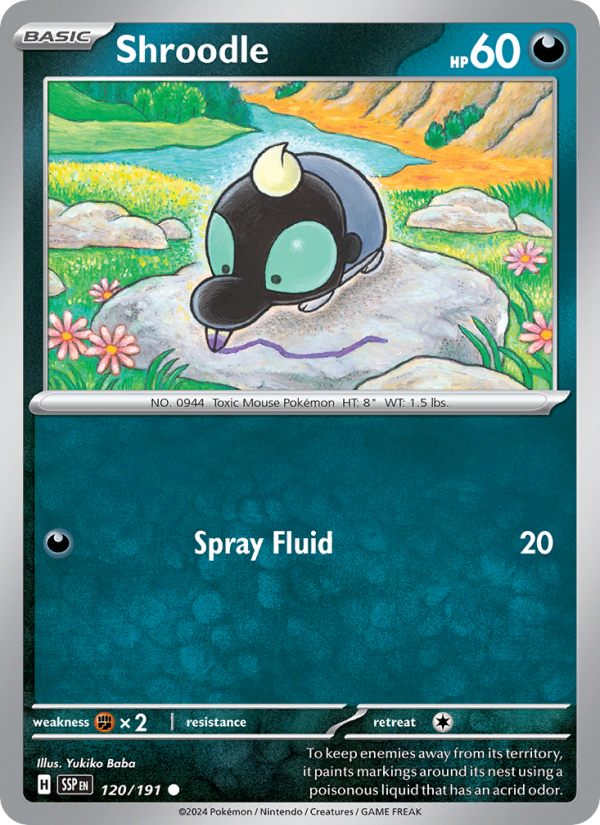
Image courtesy of TCGdex.net
Texture meets text: how holofoil texture changes the feel of Shroodle
Holofoil finishes aren’t just pretty decorations; they alter how a card communicates its identity in your hand, on the table, and in display cases. The Shroodle you find in the Surging Sparks set (SV08) is a Basic Darkness Pokémon with a modest 60 HP, but the holofoil treatment—especially in reverse holo variants—can shift the viewer’s focus from the artwork to the card’s edges, numbers, and typography. When you tilt the card under light, the rainbow arcs sweep across Yukiko Baba’s neat illustration, bringing out subtle fur textures and the glint of Shroodle’s mischievous grin in ways that a standard print can’t. This is the sugar-rush moment for collectors and a tactical signal for players: the foil read you get from a reverse variant often reveals more about card stock and printing quirks than the naked eye ever does. ⚡🔥
What changes visually when holofoil is added?
The Surging Sparks SV08 line shows a compelling case study: a card that is officially listed as Common may appear dramatically different when printed as reverse holo. The reverse foil places the glint along the primary illustration while leaving the text box relatively quiet. That contrast emphasizes Shroodle’s silhouette and the set’s energy motif, inviting the eye to travel from the HP stat box at the top through the attack text and toward the retreat cost. The texture in holo cards often blends with the dark palette of “Darkness” typing, producing a signature shimmer as you angle the card, which can both flatter the artwork and complicate quick reads during a fast-paced match. This is why some players prize holo variants as much for aesthetics as for potential slight gameplay psychology—the way a holo card looks as you shuffle or fan your deck can affect decisions and rhythm. 🎴🎨
How the card’s mechanics ride alongside the foil read
Shroodle’s stat line is humble: 60 HP, a single attack, and a fast retreat cost. Its attack, Spray Fluid, costs Darkness and deals 20 damage. In practice, that means you’re looking at a low-energy commitment with a modest payoff, perfect for early-game pressure or as a filler in a Darkness-themed deck that uses other co-specialists to set up bigger plays. The holo texture doesn’t change the attack’s damage or cost, but it does influence how you perceive the card’s potential: the foil can make the attack text feel bolder and the numeric readouts more compact under bright light. For collectors, the novelty is amplified when you find the reverse holo variant in a pack, signaling a different print run and slightly different market dynamics than the standard print. The card’s evolution line—Shroodle evolving into Grafaiai—adds another layer of narrative depth for fans who prize lore as much as gameplay. 🧬
Art, lore, and the signature of Yukiko Baba
Yukiko Baba’s illustration for Shroodle captures the character’s sly personality with a confident, stylized charm. In holofoil, Baba’s lines catch the light in a way that accentuates the creature’s eyes and whiskers, while the background elements—perhaps hinting at the Surging Sparks energy—become a field of shifting color. The foil texture foregrounds the art while the typography remains readable, a balance that artists and printers chase across the line. For fans of the set’s aesthetic, holofoil is a storytelling device as much as a collectible feature, inviting you to replay the moment you first noticed Shroodle’s mischievous expression in a rainbow-prismatic glow. 💎🎨
Market signals: rarity, pricing, and why holo matters
Even though Shroodle is a Common Pokémon, the holofoil (especially reverse holo) print can command a premium in collector markets. Data from CardMarket around late 2025 shows holo variants with an average price around €0.07, with occasional spikes pushing near €0.08 for the best-reads—while non-holo copies sit closer to €0.02. This spread illustrates a classic holo premium effect: the same card, different surface treatment, different perceived value. For players, holo variants may be priced higher, but their gameplay remains identical; for collectors, the foil adds display value and a sense of “ownership” over a unique print run in Surging Sparks. If you’re building a holo-focused binder, consider how this small 60 HP pet might anchor an entry-level Darkness deck or serve as a nostalgic piece from the SV08 era. 🔥💎
Design takeaway: reading, collecting, and using Shroodle in decks
From a design perspective, holofoil texture is a language. It communicates rarity, lineage, and the tactile experience of opening a new booster pack. For Shroodle, the reverse holo read emphasizes the creature’s silhouette and subtle details that might be overlooked on a plain print. For deck builders, the card’s simple, reliable performance—60 HP, a single 20-damage attack, and a modest retreat—is a reminder that not every powerful tool must scream in bold numbers. Sometimes the charm lies in the quiet, shimmering certainty of a card that looks at you with a playful glint across the foil. And in a market where holo variants fetch premium even for Common cards, it’s worth appreciating how a small texture can transform a familiar design into something that feels new again. ⚡🎴
Neon Phone Case with Card Holder MagSafe – Impact ResistantMore from our network
- https://blog.digital-vault.xyz/blog/post/luminosity-recalibration-sheds-light-on-a-hot-blue-giant/
- https://blog.digital-vault.xyz/blog/post/gaeas-protector-crafting-custom-proxies-and-art-variants/
- https://wiki.digital-vault.xyz/wiki/post/pokemon-tcg-stats-togepi-card-id-a4-173/
- https://articles.digital-vault.xyz/blog/post/luigis-mansion-3-co-op-overview-local-play-and-scarescraper/
- https://blog.rusty-articles.xyz/blog/post/oracle-card-design-secrets-for-mtg-builders/
Shroodle
Set: Surging Sparks | Card ID: sv08-120
Card Overview
- Category: Pokemon
- HP: 60
- Type: Darkness
- Stage: Basic
- Dex ID: 944
- Rarity: Common
- Regulation Mark: H
- Retreat Cost: 1
- Legal (Standard): Yes
- Legal (Expanded): Yes
Description
Attacks
| Name | Cost | Damage |
|---|---|---|
| Spray Fluid | Darkness | 20 |
Pricing (Cardmarket)
- Average: €0.02
- Low: €0.02
- Trend: €0.02
- 7-Day Avg: €0.02
- 30-Day Avg: €0.02
Support Our Decentralized Network
Donate 💠More from our network
- https://blog.digital-vault.xyz/blog/post/luminosity-recalibration-sheds-light-on-a-hot-blue-giant/
- https://blog.digital-vault.xyz/blog/post/gaeas-protector-crafting-custom-proxies-and-art-variants/
- https://wiki.digital-vault.xyz/wiki/post/pokemon-tcg-stats-togepi-card-id-a4-173/
- https://articles.digital-vault.xyz/blog/post/luigis-mansion-3-co-op-overview-local-play-and-scarescraper/
- https://blog.rusty-articles.xyz/blog/post/oracle-card-design-secrets-for-mtg-builders/