
Image courtesy of TCGdex.net
Balancing Act: How Scyther's Attack Cost Shapes Pokémon TCG Design
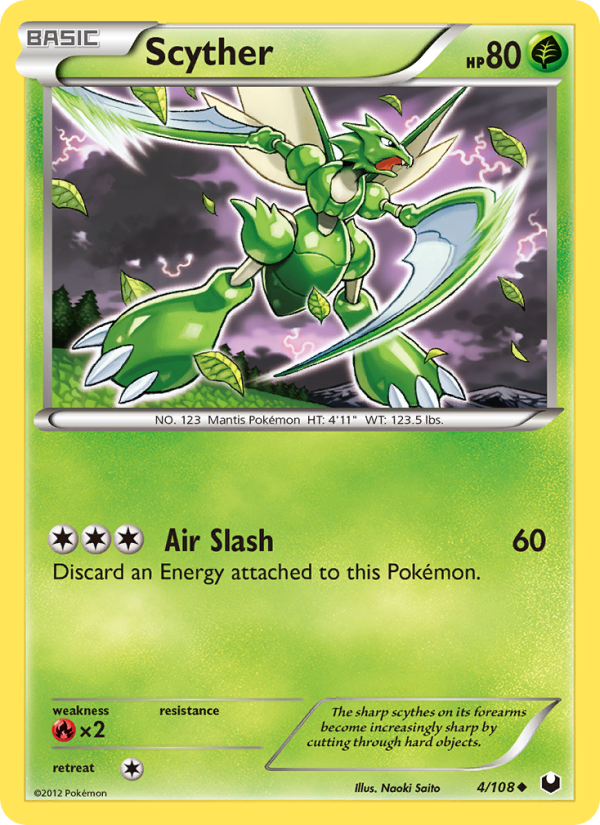
In the Pokémon Trading Card Game, every attack cost is a deliberate design choice that ripples through tempo, risk management, and deck archetypes. Scyther, a Basic Grass-type from the Dark Explorers set (BW5), serves as a crisp case study. With 80 HP, a three-Colorless-energy requirement for Air Slash, and a self-imposed energy discard effect, this little blade-wielder embodies how cost and payoff co-author balance in a dynamic meta. ⚡🔥
Card snapshot: what Scyther brings to the table
- Name: Scyther
- Set: Dark Explorers (BW5)
- Rarity: Uncommon
- Type: Grass
- Stage: Basic
- HP: 80
- Attack: Air Slash — Cost: Colorless, Colorless, Colorless; Effect: Discard an Energy attached to this Pokémon; Damage: 60
- Weakness: Fire ×2
- Retreat Cost: 1
- Illustrator: Naoki Saito
- Legal formats: Expanded only (Standard listing not legal at the time of this article's context)
The art by Naoki Saito complements the card’s rugged, precision-focused vibe. In the Dark Explorers era, Scyther’s blade-like silhouettes and the moody palette align with a broader theme of calculated risk—an echo of the attack’s own cost. The holo and reverse-holo variants in this set add extra collectability, ensuring that even if Air Slash isn’t top-tier in every deck, Scyther remains a cherished piece for both players and collectors. 🎴🎨
Why three Colorless energy for Air Slash matters
The core design question is straightforward: why require three Colorless energy to deal 60 damage, when many early attacks offered similar power for fewer resources? The answer lies in balance through cost. A 60-damage output on a Basic Pokémon with 80 HP is a delicate tempo proposition. It pressures the opponent to accelerate damage faster than Scyther can with a single commitment, and it makes Scyther vulnerable to common two-hit knockouts from aggressive Grass- or Fire-type matchups once the attack energy is committed and a crucial energy is discarded. The self-discard clause—discard an Energy attached to this Pokémon after the attack hits—amplifies the risk: you’re paying a price not only in the current turn’s energy but potentially in subsequent turns when Scyther can't “reload” as quickly. This interplay keeps aggressive early-game pressure in check and rewards smarter sequencing, energy accounting, and timing. 🔋🗡️
Balance logic in context: HP, types, and tempo
HP 80 places Scyther in a middle ground where it can threaten softly but isn’t an unassailable wall. Its Grass typing can be a blessing or a curse depending on the broader meta, but the real choke point is the attack’s energy cost. Three Colorless energy is flexible—any energy type can be used to pay it—but the requirement to discard energy afterward introduces a latent cost that scales with how a deck handles energy recovery and resource management. In practical terms, Scyther asks: do you want to commit three energy to threaten 60 damage this turn, knowing you’ll have to rebuild energy supply to mount another attack or chase a safer option? It’s a test of tempo: who can better bend the pace of the game to their advantage while managing their own resource pool? ⚡🎯
Strategic takeaways for players
- Air Slash punishes stall tactics by turning a three-energy commitment into a meaningful threat, but you must anticipate the energy you’ll need for future turns. Use Scyther when you can weather the next onslaught and have a plan to replenish energy or swap to a safer attacker.
- Fire-type decks loom as natural counters, given the ×2 weakness. If you see your opponent priming a fire-led strategy, you’ll want to time Scyther’s attacks or pivot to a more energy-efficient option in your lineup.
- Three-attachment requirements make Scyther an excellent drill for energy pacing. Don’t let the discard mechanic become a one-way trade that leaves you open on the next turn.
- In decks that prize early game tempo with egress options or simple draw power, Scyther can serve as a bridge between your first couple of turns and a smoother midgame pivot—they’re cold steel with a calculated edge. 💎
Collector insights: rarity, pricing, and niche value
As an Uncommon, Scyther from Dark Explorers sits in a mid tier within set collectability. The card’s value is shaped not only by its gameplay viability but also by the broader nostalgia and art appeal of a classic blade-wielder. Market dynamics show a spectrum: non-holo copies tend to hover around a few dollars on Cardmarket (average around 1.24 EUR, with lower end near 0.02 EUR and a healthy upward trend), while holo and reverse-holo versions fetch higher price brackets due to limited print runs and the shine factor that collectors adore. On the U.S. market, TCGPlayer indicates mid prices around a few dollars for standard printings, with holo variants climbing higher, sometimes reaching into the teens or more for pristine editions. For players building budget-friendly decks or collectors chasing condition, Scyther’s value is a reminder that even “modest” cards can hold a steady niche. 🔎💰
Art, lore, and the tactile joy of the Dark Explorers era
Dark Explorers spins a moodier edge on the classic Scyther silhouette. The set’s artwork and layout highlight the elegance of Scyther’s blade-wielding form, pairing with Naoki Saito’s precise linework to evoke a sense of speed and precision. Collectors often appreciate how the card’s physical rarity and set branding enrich a binder—especially when a holo variant shines under the right light. This atmosphere of polish and care is a big part of why players rally around Uncommons like Scyther: they deliver meaningful gameplay while carrying a strong visual and collector story. 🎴🖼️
Putting Scyther in the larger balance conversation
From a design perspective, Scyther’s Air Slash exemplifies how attack cost, HP, type, and special text coalesce to shape a card’s role in the game. The three-energy requirement elevates the importance of energy curves in a given deck, while the discard clause adds a built-in cost that prevents the attack from running away with a one-turn win. When designers think about balance across a set or rotation, Scyther serves as a reminder that every number—HP, retreat, weakness, and even the decision to make an attack discard energy—reframes the field. It nudges players toward thoughtful build decisions and keeps the meta dynamic, ensuring even older cards remain relevant conversation pieces in a continually evolving game. ⚡🎮
Custom Rectangular Mouse Pad 9.3x7.8 Non-Slip BackingMore from our network
- https://crypto-acolytes.xyz/blog/post/nft-stats-nft-351-from-unipcs-bots-collection/
- https://crypto-acolytes.xyz/blog/post/nostalgia-unboxed-the-rise-of-gaming-collectibles/
- https://articles.zero-static.xyz/blog/post/cyberpunk-2077-vr-setup-and-performance-overview-for-pc/
- https://crypto-acolytes.xyz/blog/post/nft-stats-a51-flame-thrower-scorcher-from-haste-weapon-collection/
- https://blog.rusty-articles.xyz/blog/post/how-trapinch-card-art-elevates-pokemon-tcg-immersion/
Scyther
Set: Dark Explorers | Card ID: bw5-4
Card Overview
- Category: Pokemon
- HP: 80
- Type: Grass
- Stage: Basic
- Dex ID: 123
- Rarity: Uncommon
- Regulation Mark: —
- Retreat Cost: 1
- Legal (Standard): No
- Legal (Expanded): Yes
Description
Attacks
| Name | Cost | Damage |
|---|---|---|
| Air Slash | Colorless, Colorless, Colorless | 60 |
Pricing (Cardmarket)
- Average: €1.24
- Low: €0.02
- Trend: €1.83
- 7-Day Avg: €1.14
- 30-Day Avg: €1.45
Support Our Decentralized Network
Donate 💠More from our network
- https://crypto-acolytes.xyz/blog/post/nft-stats-nft-351-from-unipcs-bots-collection/
- https://crypto-acolytes.xyz/blog/post/nostalgia-unboxed-the-rise-of-gaming-collectibles/
- https://articles.zero-static.xyz/blog/post/cyberpunk-2077-vr-setup-and-performance-overview-for-pc/
- https://crypto-acolytes.xyz/blog/post/nft-stats-a51-flame-thrower-scorcher-from-haste-weapon-collection/
- https://blog.rusty-articles.xyz/blog/post/how-trapinch-card-art-elevates-pokemon-tcg-immersion/