
Image courtesy of TCGdex.net
Design Philosophy in Practice: How Sandshrew’s Mechanics Reflect Pokémon TCG Design Philosophy
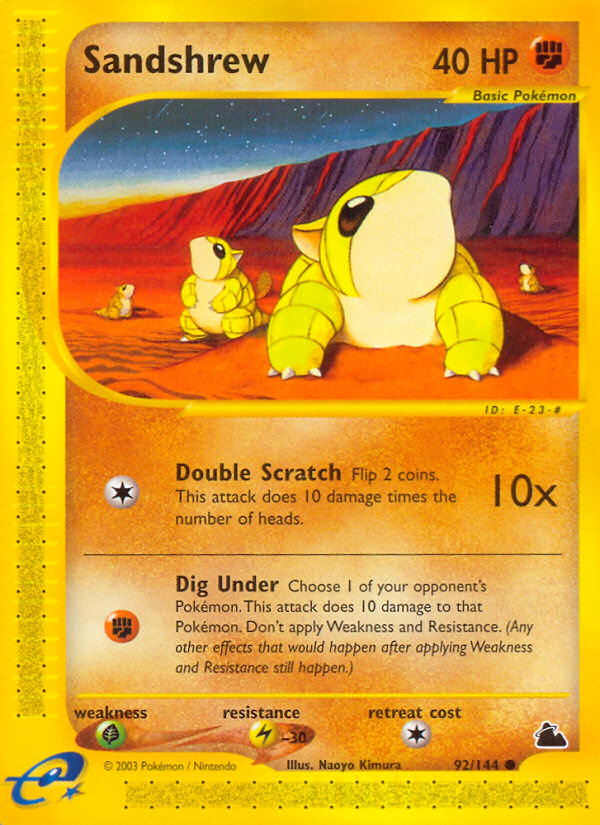
In the long arc of the Pokémon Trading Card Game, certain cards whisper the designers’ guiding principles more clearly than others. Sandshrew, a Common Basic Fighting Pokémon from the Skyridge era, offers a compact, traditional microcosm of how early-2000s design balanced accessibility with strategic depth. At first glance, this Sandshrew looks like a simple, inexpensive drop for a new deck—but its two attacks unfold a deliberate philosophy: give players a choice between risky randomness and targeted disruption, all while keeping the mechanics approachable for beginners and veterans alike ⚡🔥.
Skyridge, with its desert theme and a mix of classic and experimental mechanics, prized clarity in how a card interacts on the table. Sandshrew’s first attack, Double Scratch, costs Colorless energy and relies on a coin-flip mechanic: flip two coins, and you deal 10 damage for each heads. The result is a tiny arithmetic gamble baked into every use. This is not just random luck for luck’s sake; it’s a design choice that teaches the player to weigh probability, risk, and timing. If you connect with both coins on a given draw, you’ve earned up to 20 damage for a single attack. If you miss, you’ve spent an energy for no immediate payoff. The engine behind this is educational in nature—an invitation to experiment with probability as a real, visible factor in a turn’s outcome 🎲.
The second attack, Dig Under, introduces a contrasting flavor of control. For a Fighting energy, you can target one of your opponent’s Pokémon and deal 10 damage to that Pokémon, explicitly not applying Weakness and Resistance. Even if the targeted Pokémon is heavily armored by resistances or defenses, the attack lands as a precise, clean 10-point poke. This is a design signal: the game rewards deliberate, situational disruption rather than sheer brute force. In a meta where broad-sweep strategies can dominate, the ability to directly hamper a single threat—without the usual deficits imposed by type math—embodies a core philosophy of flexible, tactical play. It’s the designer’s way of saying, “Pick your battles, and pick them with intention.”
Sandshrew’s basic, non-evolving status amplifies this philosophy. As a Basic Fighting Pokémon with 40 HP, it’s meant to be accessible and easy to slot into a deck, especially for players who are learning how to balance energy costs and matchup dynamics. Its Grass weakness x2 and Lightning resistance -30 aren’t designed to overyield the card in a vacuum; instead, they ground it in a recognizable ecosystem where type matchups and resistances matter, but aren’t the sole determining factor. The card’s simple statline and small footprint make it a reliable teaching tool for how the game rewards planning, sequencing, and sometimes bold risk-taking, all within a familiar framework that players can grow with over time 🔧🎨.
Unpacking the Philosophy in Practice
- Two-attack design with varied risk profiles: Double Scratch invites probabilistic thinking, while Dig Under provides a measured, precise option to influence the board. This duality mirrors the broader TCG design goal of balancing luck with skill, challenge with approachability, and variety with consistency ⚡.
- Targeted disruption without overreach: The second attack’s "don’t apply Weakness and Resistance" clause is a deliberate choice to empower strategic play without overwhelming players with instant KO power. It teaches timing and threat assessment—decisions that are central to deck-building and in-game planning 💎.
- Accessible baseline for beginners, with room for growth: As a Common Basic, Sandshrew is a card that players can learn with before they advance to more complex interactions. Its modest HP and straightforward attacks make it a reliable starting point for understanding energy costs, coin flips, and the value of targeted hits 🎴.
- Art and identity as teaching tools: Naoyo Kimura’s crisp illustration and the crisp presentation of Sandshrew reflect the era’s emphasis on clear, legible art that reinforces thematic identity—desert-adapted wildlife and the tactile feel of a real-world card game experience 🎨.
“The design philosophy behind this card emphasizes that a single Pokémon can teach a player to balance randomness with precision, risk with reward, and tempo with planning—a microcosm of the game’s larger strategic design.”
From a collector’s perspective, Sandshrew’s Skyridge printing offers a snapshot of an era where set design embraced mixed pacing: quick, punchy offense, and deliberate, surgical disruption. The card’s Common rarity and basic form make it an accessible entry point for new collectors, while the nuanced interplay between its two attacks gives seasoned players respect for how early Pokémon TCG design threaded probability and control into each turn. For fans of Naoyo Kimura’s art, the card also stands as a testament to the era’s aesthetic: clean lines, desert-swept mood, and a sense of motion that feels as if Sandshrew could vanish into a dune at any moment 🌵✨.
Market data from recent periods shows Sandshrew (ecard3-92) sits comfortably within collector and player communities as a modestly valued piece. CardMarket pricing for the non-holo printing has shown average values around a few euros, while US-focused listings on TCGPlayer place the normal (non-holo) Sandshrew in a broader range—roughly the mid-teens to mid-twenties in USD, with holo versions commanding higher premiums. This aligns with the card’s common rarity and the enduring appeal of Skyridge’s distinctive era. Even as modern sets push toward more complex mechanics, Sandshrew remains a courteous reminder of a design philosophy that prizes clarity, choice, and balance over sheer power 🪙💎.
Non-Slip Gaming Mouse Pad 9.5x8in Anti-Fray Rubber BaseMore from our network
- https://articles.zero-static.xyz/blog/post/how-to-master-alan-wake-remastered-combat-playstyles/
- https://blog.digital-vault.xyz/blog/post/counterspells-and-removal-against-the-creation-of-avacyn/
- https://crypto-acolytes.xyz/blog/post/demian-1145-dems-empire-nft-stats/
- https://crypto-acolytes.xyz/blog/post/pfp-785-pumpfun-pepe-nft-stats/
- https://wiki.digital-vault.xyz/wiki/post/pokemon-tcg-stats-roller-skater-card-id-sm12-235/
Sandshrew
Set: Skyridge | Card ID: ecard3-92
Card Overview
- Category: Pokemon
- HP: 40
- Type: Fighting
- Stage: Basic
- Dex ID: 27
- Rarity: Common
- Regulation Mark: —
- Retreat Cost:
- Legal (Standard): No
- Legal (Expanded): No
Description
Attacks
| Name | Cost | Damage |
|---|---|---|
| Double Scratch | Colorless | 10x |
| Dig Under | Fighting |
Pricing (Cardmarket)
- Average: €2.29
- Low: €0.6
- Trend: €2.18
- 7-Day Avg: €2.49
- 30-Day Avg: €2.06
Support Our Decentralized Network
Donate 💠More from our network
- https://articles.zero-static.xyz/blog/post/how-to-master-alan-wake-remastered-combat-playstyles/
- https://blog.digital-vault.xyz/blog/post/counterspells-and-removal-against-the-creation-of-avacyn/
- https://crypto-acolytes.xyz/blog/post/demian-1145-dems-empire-nft-stats/
- https://crypto-acolytes.xyz/blog/post/pfp-785-pumpfun-pepe-nft-stats/
- https://wiki.digital-vault.xyz/wiki/post/pokemon-tcg-stats-roller-skater-card-id-sm12-235/