
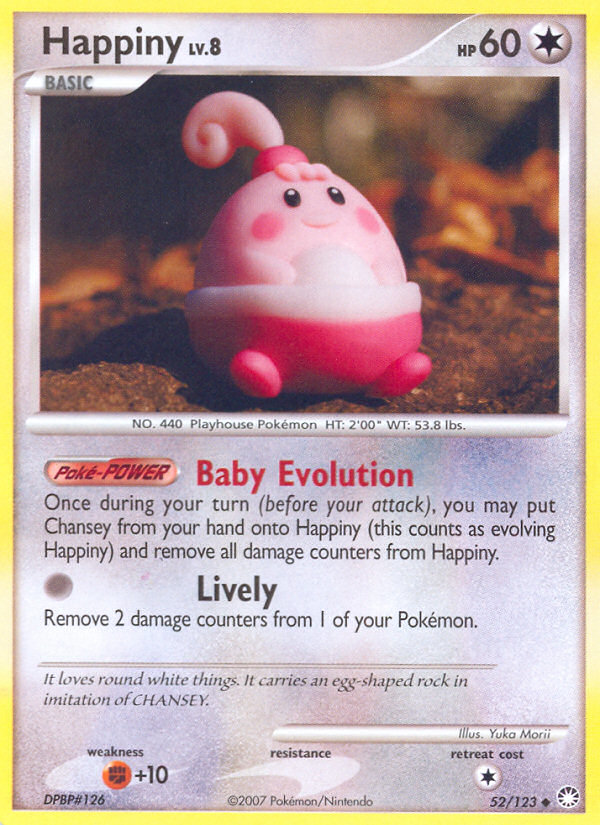
Image courtesy of TCGdex.net
Rotation and Happiny’s Place in the Standard Meta
As the Pokémon TCG landscape continually rearranges itself with new sets and rebalanced formats, the impact of rotation on a single card often reveals the deeper story of how a deck is built, and what strategies survive the test of time. Happiny, a Basic Colorless Pokémon from the Mysterious Treasures era, offers a striking case study in how rotation redefines value, play patterns, and even collector interest. In the colorless, low-HP world of dp2-52, the tiny baby Pokémon wields a surprisingly strategic edge if you remember what it truly enables: evolution with a built‑in reset and a way to keep momentum on a stalled bench.
With the standard rotation absorbing older sets into legacy or expanded play, Happiny’s exact toolset—specifically its Poke-POWER Baby Evolution and its Lively attack—ceases to be legal for standard tournaments after the cutoff. In practice, that means you won’t see Happiny in top-tier standard lineups built on today’s staple energies, boss-like Supporters, and modern draw engines. Instead, the card becomes a nostalgic lens into how early format mechanics shaped the tempo of play: a tiny, eager baby Pokémon that could morph into Chansey mid-game, cleansing itself of damage and opening the door to larger threats. The evolution mechanic itself—placing Chansey from hand onto Happiny to count as evolving Happiny while removing all damage counters—remains a memorable example of how simple ideas can create unique tempo swings in the pre-rotation era.
For players who chase strategic clarity, the Happiny‑to‑Chansey dynamic was all about tempo, stall, and controlled escalation. In dp2’s world, where the HP total for such baby Pokémon hovered around a lean 60, the decision to evolve immediately or wait for a safer moment could dictate the course of a round. The Lively attack, capable of removing two damage counters from a single Pokémon, offered a tiny, consistent form of sustain that could prop up a fragile front line while you prepared the bigger payout from a Chansey that followed. In modern standard formats, those mechanics don’t directly transfer, but the mindset—using an evolution to reset damage and secure a temporary shield—still resonates with players who enjoy tempo grinds and deliberate, stepwise advancement toward victory.
Card snapshot: what Happiny brings to the table
- Name: Happiny
- Set: Mysterious Treasures (dp2)
- Rarity: Uncommon
- Type: Colorless
- Stage: Basic
- HP: 60
- Ability (Poke-POWER): Baby Evolution — Once during your turn (before your attack), you may put Chansey from your hand onto Happiny (this counts as evolving Happiny) and remove all damage counters from Happiny.
- Attack: Lively — Remove 2 damage counters from 1 of your Pokémon.
- Weakness: Fighting, +10
- Illustrator: Yuka Morii
In practice, this card’s practical ceiling is tempered by its era. A 60 HP frontliner is fragile against the later, beefier attackers that dominate standard today. Its colorless typing is a double-edged sword: it’s flexible for turn-by-turn play but lacks the specialized synergy to outlast tougher opponents once rotation shifts the meta into heavier hitters. Still, the artful simplicity and the baby-to-chansey evolution hook make Happiny a beloved relic for fans who appreciate the early design philosophies of the TCG—the elegance of a clean tempo engine that pivots on a single, well-timed evolution.
From a gameplay strategy vantage point, rotation compels us to reframe how we evaluate “fit.” In a current standard environment, you won’t slot Happiny into a winning lineup, but this card teaches timeless lessons: manage damage, leverage evolutions to reset your board state, and use your bench as a staging ground for the eventual payoff. It also reminds collectors that every era had its own heartbeat—one where a small, scrappy Pokémon could stall the opponent just long enough to tip the match in your favor with the right evolution at the right moment. ⚡
Collector insight and market vibes
Beyond playability, a card like Happiny dp2-52 is a window into a broader collecting arc. The dp2 set sits within the Diamond & Pearl generation, a period renowned for introducing many of the iconic baby Pokémon evolutions that later defined entire strategies. Rarity at Uncommon means a steady trickle of copies in circulation, but condition matters more than ever for non‑holo examples when you’re chasing the reverse-holo gloss variants that surfaced later in the era.
Market data from recent years places Happiny’s value in the modest range for non-foil copies, with the standard non‑holo listings frequently landing around a couple of dollars in market activity. The reverse-holo versions, stable around higher figures, reveal the common collector’s delta for variations within the same card. As of late 2025, you might see non-holo copies averaging roughly $2–$3 in typical listings, while reverse‑holo copies can climb into the mid‑range tens, and in some cases into the $20s or $30s depending on condition and loadout (and, of course, the ever-shifting tides of vintage demand). CardMarket's euro pricing and TCGPlayer's USD estimates align with this narrative, highlighting that even in rotation, this little card resonates with collectors who chase the nostalgia of the Mysterious Treasures era and its baby-evolution gimmicks. 🔎💎
The rarity and set positioning also inform how enthusiasts weigh rotation’s impact on long-term value. Since dp2 is no longer standard-legal, Happiny’s price curve in modern tournaments is driven more by collectibility, nostalgia, and the appeal of Yuka Morii’s artwork than by meta contributions. For players who love the historical arc of the game, this is the kind of card that makes a vintage binder sing—especially with the “set logo” and the countdown calendar stamps that some variants feature. The card’s ability to catalyze an evolution pivot makes it a favorite for storytelling—narratives about how decks used to fight for tempo and survival weave nicely into modern conversations about how far the game has come, and how rotation nudges us toward different kinds of skill and patience. 🎴🎨🎮
Art, lore, and the joy of collecting
Happiny’s art, bright and approachable, is a reminder that even a low-HP Pokémon can hold a big personality when paired with a strong illustrator’s vision. Yuka Morii’s work on dp2 captures a playful, childlike innocence that contrasts with the strategic seriousness of “Baby Evolution” in play. The Mysterious Treasures set, with its soft palette and gentle expressions, invites fans to revisit a period when card design favored charm over brute power—an aesthetic that endures in fan galleries and collector shelves. The lore of these games—about the relationships between baby Pokémon and their evolving forms—offers a sense of continuity that makes rotation feel less like an abrupt break and more like a transition that invites new players to explore the history beneath today’s metagame. 🔮🧩
Five important notes on rotation and Happiny
- Rotation shifts dp2-52 out of Standard, making it a historical reference rather than a current-taction tool in tournament play.
- The Poke-Power Baby Evolution represents a classic tempo mechanism—evolving on the fly and clearing damage to stabilize the board, a concept with echoes in modern, more resilient evolution strategies.
- Market values reflect rarity and demand for vintage non-foil and reverse-holo cards, with price vectors showing modest non-holo prices and higher demand for holo/foil variants.
- Collectors benefit from understanding set composition: Mysterious Treasures’ artwork, stamps, and the dp2 logo contribute to the card’s aura and potential value driver for graders and collectors alike.
- Even when rotation reduces playability, the card remains a charming artifact of early baby-evolution design and a favorite among vintage binder fans and Yuka Morii admirers. ⚡💎
More from our network
- https://blog.crypto-articles.xyz/blog/post/nft-data-clippy-343-from-clippy-collection-on-magiceden/
- https://blog.crypto-articles.xyz/blog/post/nft-data-pumpyo-134-from-pumpyo-collection-on-magiceden/
- https://wiki.digital-vault.xyz/wiki/post/pokemon-tcg-stats-bellibolt-card-id-sv03-201/
- https://blog.crypto-articles.xyz/blog/post/nft-data-bpw-1018-from-bonk-puppets-collection-on-magiceden/
- https://transparent-paper.shop/blog/post/stable-diffusion-xl-prompt-voidpunk-neon-noir-labyrinth-motif-velvet-texture-mythic-hydra-gunmetal-palette/
CTA: Explore the product that inspired the pairing of strategy and nostalgia with a desk accessory that truly snaps to today’s desk aesthetics. Neon Desk Mouse Pad (Customizable, One-Sided Print, 0.12in Thick)
Happiny
Set: Mysterious Treasures | Card ID: dp2-52
Card Overview
- Category: Pokemon
- HP: 60
- Type: Colorless
- Stage: Basic
- Dex ID: 440
- Rarity: Uncommon
- Regulation Mark: —
- Retreat Cost:
- Legal (Standard): No
- Legal (Expanded): No
Description
Abilities
-
Baby Evolution — Poke-POWER
Once during your turn (before your attack), you may put Chansey from your hand onto Happiny (this counts as evolving Happiny) and remove all damage counters from Happiny.
Attacks
| Name | Cost | Damage |
|---|---|---|
| Lively |
Pricing (Cardmarket)
- Average: €2.27
- Low: €0.02
- Trend: €2.6
- 7-Day Avg: €1.28
- 30-Day Avg: €1.62
Support Our Decentralized Network
Donate 💠More from our network
- https://blog.crypto-articles.xyz/blog/post/nft-data-clippy-343-from-clippy-collection-on-magiceden/
- https://blog.crypto-articles.xyz/blog/post/nft-data-pumpyo-134-from-pumpyo-collection-on-magiceden/
- https://wiki.digital-vault.xyz/wiki/post/pokemon-tcg-stats-bellibolt-card-id-sv03-201/
- https://blog.crypto-articles.xyz/blog/post/nft-data-bpw-1018-from-bonk-puppets-collection-on-magiceden/
- https://transparent-paper.shop/blog/post/stable-diffusion-xl-prompt-voidpunk-neon-noir-labyrinth-motif-velvet-texture-mythic-hydra-gunmetal-palette/