
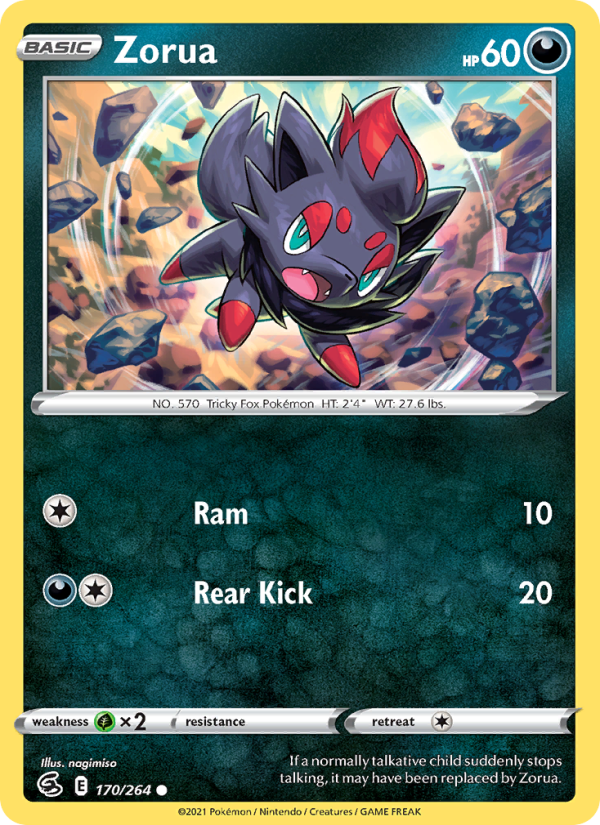
Image courtesy of TCGdex.net
Rotation reshapes Zorua's place in the Standard deckbuilding landscape
In the ever-shifting world of the Pokémon TCG, rotation acts like a giant tide that carries away older families of cards and makes room for the newest, shinier options. The small, shadowy Zorua from Fusion Strike (SwSh8-170) embodies this dynamic beautifully. Classified as a Basic Darkness-type with a modest 60 HP, Zorua is a nimble snapshot of an era when affordable, two-attack basics could spearhead cheeky tempo plays. Yet in today’s Standard format, this particular entry isn’t legal, having a regulation mark of E while the Standard pool has rotated forward to newer marks. That means savvy players must rethink how such a card would fit—or if it even belongs—in their Standard decks. ⚡
Rotation doesn’t just erase cards from the pool; it reshapes how we think about what a deck should try to do on turn one, two, and three. Zorua’s Ram (Colorless) for 10 and Rear Kick (Darkness, Colorless) for 20 paint a very particular picture: a starter or fringe tech that aims to poke through with speed and a bit of pressure, leveraging the element of surprise rather than raw power. In Standard, you’re likely seeing a shift toward cards that accelerate draw, tempo, and reach—tools that scale into mid- and late-game matches with efficient energy costs and consistent damage. Zorua, with its tiny HP and two modest attacks, would struggle to survive in a metagame dominated by more robust early-game threats and aggressive closure strategies. It’s a reminder that in rotation, survivability matters as much as speed. 🔥
From a collector and market perspective, this shift also influences how players view the Fusion Strike-era Zorua. The card’s rarity is Common, and its non-holo versions sit at budget-friendly price points—often around a few cents to a few tenths of a euro in the right market, with reverse-holo variants trending higher. The data shows cardmarket averages around 0.05 EUR for the standard print, with reverse-holo counterparts climbing toward the 0.2–0.3 EUR range in many markets. In the current Standard-only environment, that value becomes a talking point for collectors who are chasing vintage display pieces and early-rotation curiosities, rather than competitive staples. The contrast between playability in Expanded versus market interest in Standard makes Zorua an appealing, affordable piece for the binder and the casual battle deck alike. 💎
To understand where Zorua fits in a contemporary strategy, it helps to think about the broader Dark-type sandbox in Standard. Even though this specific Zorua isn’t legal in Standard, the character’s flavor—deception, quick exchanges, and back-alley mischief—resonates with fans who enjoy shadowy, tempo-based plays. In rotations, players often pivot toward newer Dark-type basics or evolutions that come with more reliable energy costs, better HP, or built-in disruption. The lesson here is clear: rotation rewards flexible playstyles that can adapt to the evolving energy economy and draw support found in the latest sets. And for collectors, it’s a chance to revisit a familiar silhouette with fresh admiration for Nagimiso’s art and the Fusion Strike era’s playful flavor. 🎨
Speaking to the artistry, Zorua’s card captures a mischievous grin and a sense of illusion that aligns with the Pokémon’s lore—an illusionist capable of slipping away just when you think you’ve cornered it. Nagimiso’s illustration adds character and charm, inviting players to imagine the sneaky tactics this little Fox Pokémon embodies. In a world where rotation can strip away the most dominant decks, the art remains a constant—an anchor for nostalgia and a beacon for collectors who appreciate the storytelling woven into every card. 🎴
Strategic takeaways for today’s deck builders
- Understand your format,” know which cards are legal and which are not. Zorua’s standard-ineligible status serves as a reminder to prioritize currently supported engines, even as you admire or collect older pieces.
- Budget-friendly options still matter. In Expanded or casual play, Zorua’s low-cost attacks—Ram for 10 and Rear Kick for 20—can shine in a meta that rewards tempo and pressure rather than bulky power. Packaging a couple of cheap threats can help you force early defensive errors from an opponent.
- Energy strategy matters. The two-attack cost spread (Colorless, and Darkness plus Colorless) highlights how basic attackers must align with available energy acceleration and draw support. In Standard, modern evolutions and energy acceleration cards often redefine the optimal energy curve or reward speed with draw starts and quick hits.
- Value beyond playability. Even if Zorua isn’t standard-legal, it remains a collectible entry with an appealing reverse-holo variant and a representation of the Fusion Strike era’s design language. For collectors, the price trajectory—low on non-holo prints, higher for reverse holo—reflects both supply and the era’s enduring nostalgia. ⚡
- Art and lore as a bridge to the present. The flavor text and Nagimiso’s art provide continuity with the broader Pokémon universe, offering a tactile tie-in for fans who want to explore how a card’s story resonates with modern gameplay and collection goals. 🎨
As players pivot to the current Standard rotation, the spirit of Zorua—its curiosity, its cleverness, and its willingness to sprint across the board in a single turn—remains a touchstone for the archetypes fans love. While rotation reshapes what’s on the battlefield, it also opens doors: new combinations to explore, new art to admire, and new stories to tell as the TCG community continues to chase the thrill of a well-timed Ram or the misdirection of a well-timed escape. 🔥🎮
For readers who want a tangible link to their everyday gear, the practical accessory that sparked this exploration—the phone case with card holder magsafe—offers a small nod to how collectors blend lifestyle with play. It’s a reminder that the Pokémon journey isn’t just about the cards we duel with, but the experiences we shelf and share along the way. 🛡️⚡
If you’re curious to dive deeper into the evolving landscape of card pricing and rotation, the following reads from our network offer a spectrum of perspectives—from statistics and market trends to practical guidance for naming and valuing digital products within the collector community.
Phone case with card holder magsafeMore from our network
- https://wiki.digital-vault.xyz/wiki/post/pokemon-tcg-stats-appletun-card-id-sv08-211/
- https://blog.crypto-articles.xyz/blog/post/nft-data-imperia-3334-from-imperia-rome-citizens-collection-on-magiceden/
- https://crypto-acolytes.xyz/blog/post/devil-2141-de-evils-nft-stats/
- https://blog.digital-vault.xyz/blog/post/how-to-name-your-digital-product-a-practical-guide/
- https://blog.rusty-articles.xyz/blog/post/how-grading-clemont-cards-impacts-pokemon-tcg-value-and-resale/
Zorua
Set: Fusion Strike | Card ID: swsh8-170
Card Overview
- Category: Pokemon
- HP: 60
- Type: Darkness
- Stage: Basic
- Dex ID: 570
- Rarity: Common
- Regulation Mark: E
- Retreat Cost: 1
- Legal (Standard): No
- Legal (Expanded): Yes
Description
If a normally talkative child suddenly stops talking, it may have been replaced by Zorua.
Attacks
| Name | Cost | Damage |
|---|---|---|
| Ram | Colorless | 10 |
| Rear Kick | Darkness, Colorless | 20 |
Pricing (Cardmarket)
- Average: €0.05
- Low: €0.02
- Trend: €0.07
- 7-Day Avg: €0.05
- 30-Day Avg: €0.06
Support Our Decentralized Network
Donate 💠More from our network
- https://wiki.digital-vault.xyz/wiki/post/pokemon-tcg-stats-appletun-card-id-sv08-211/
- https://blog.crypto-articles.xyz/blog/post/nft-data-imperia-3334-from-imperia-rome-citizens-collection-on-magiceden/
- https://crypto-acolytes.xyz/blog/post/devil-2141-de-evils-nft-stats/
- https://blog.digital-vault.xyz/blog/post/how-to-name-your-digital-product-a-practical-guide/
- https://blog.rusty-articles.xyz/blog/post/how-grading-clemont-cards-impacts-pokemon-tcg-value-and-resale/