

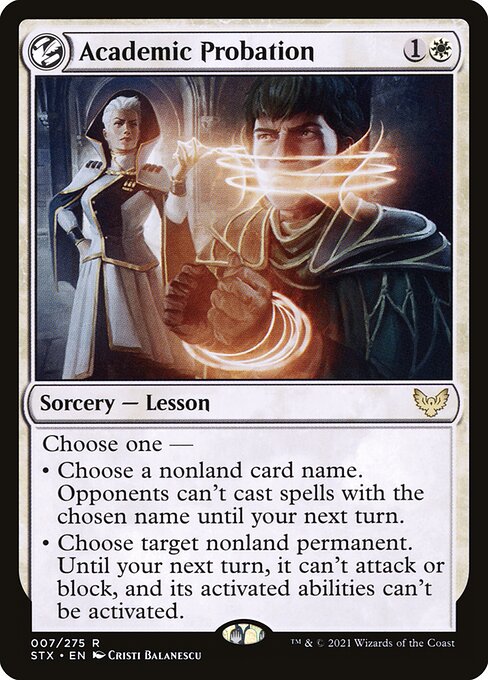
Image courtesy of Scryfall.com
Predictive Data and the Art of Deckbuilding
In the world of Magic: The Gathering, intuition and theory have always guided how we assemble a deck. But today, predictive data is turning guesswork into a disciplined craft 🧙♂️. Crafting a list that can answer a shifting metagame—while keeping card advantage and tempo intact—has become a blend of art and analytics 🔥. When you pair a Strixhaven classic like Academic Probation with thoughtful data pipelines, you unlock a two-mode toolkit that mirrors how modern deckbuilders think about disruption and tempo.
Academic Probation, a rare white Lesson from Strixhaven: School of Mages (STX), costs {1}{W} and offers two high-leverage avenues of play. You can name a nonland card, preventing opponents from casting spells with that name until your next turn, or you can exile a crucial nonland permanent from the battlefield’s rhythm by ensuring it can’t attack, block, or activate its abilities until your next turn. That two-pronged design is a perfect match for predictive tooling: one mode leans into limiting options, the other into locking down critical threats—each with a precise forecast window. It’s a little like giving your AI a choice between a veto and a tempo lock, two levers that often decide whether you’re in control of the battlefield or chasing it 🧠🎯.
What Academic Probation Brings to the Table
With mana cost {1}{W} and the sorcery’s “Lesson” subtype, Academic Probation sits at the intersection of tempo and permission—a rare card that invites you to model not just what your opponent might do, but what you can stop them from doing next. The first mode (ban a named spell) is a proactive denial that data-driven decks can time to maximize disruption just before crucial turns. The second mode (neutralize a nonland permanent) provides a tempo-friendly answer to a key creature or artifact in a control-heavy meta. When you combine this with predictive insights, you can forecast the exact turns where blocking, tapping out, or stacking mana becomes too risky for your opponent 🔥⚔️.
“In Strixhaven’s halls, knowledge is power—and the best deckbuilders are those who forecast the future with a meticulous, playful wink.”
Academic Probation also shines a light on how predictive deckbuilding tools should handle uncertainty. A data-informed approach might weigh the probability of your opponent drawing a named spell versus deploying a threatening permanent, then rank each mode by expected value. If a metagame leans heavily on a few potent nonland permanents, the second option might offer a better tempo hedge; if a critical spell is widely played, the name-ban can derail linear combos before they even begin. The result is a deckbuilding workflow that treats predictive signals as actionable signals rather than abstract numbers 🧩🎲.
From Data to Deck Craft: A Practical Workflow
Here’s a practical way to weave predictive data into decisions around Academic Probation and similar tools:
- Metagame modeling: Use historical data to estimate the prevalence of particular nonland spells and permanents in their expected windows. The model suggests when the name ban will reduce opponent lines most effectively, or when tempo locking a threat yields a favorable exchange 🧠💎.
- Synergy scoring: Rank potential uses of Academic Probation by how well they align with your deck’s strategy and the predicted threats of the field. For example, a control-heavy build might value the tempo-lock mode to slow a top-end finisher, while a midrange plan might favor denying a critical removal spell to preserve your own threats 🎯.
- Takedown timing: The forecast horizon matters. Since the effect lasts until your next turn, predictive tooling should look two turns ahead to gauge whether the disruption pays off before your own crucial plays land on the stack 🕰️.
- Tempo vs. value balance: Predictive scores should account for mana efficiency. A 2-mana sorcery that can swing two turns of advantage may trump a slower, more brittle option in many matchups—especially in formats where card advantage is king 🔎⚖️.
- Player-facing explanations: Translating model output into deckbuilding decisions helps players trust the tool. Clear confidence scores and readable rationale for choosing mode A over mode B keep human intuition at the helm with data doing the heavy lifting 🧭.
When you implement these steps, Academic Probation becomes more than a spell—it's a case study in how predictive mechanics can translate into real-world deck design, helping you explain why certain lines are favored in a given metagame. It’s a reminder that the best tools in MTG aren’t just clever; they’re explainable, maintainable, and endlessly adaptable. And yes, a little bit of magic helps too 🪄🎨.
Art, Design, and the MTG Ecosystem
Credit goes to Cristi Balanescu for the evocative illustration that captures the scholarly, slightly irreverent mood of Strixhaven. The card’s Art, combined with its two-mode design, invites players to imagine a classroom where decision points are as crisp as a freshly sharpened quill. It’s a nod to why we love these lessons: they teach more than mechanics; they teach how to think under pressure in a blooming multiverse filled with dragons, detectives, and droll professors alike 🎨⚔️.
As predictive data tools become more prevalent in MTG coverage—whether for constructed, limited, or even drafting—Academic Probation stands as a blueprint for how to balance disruption with tempo, and how to explain the journey from numbers to board states. If you’re building the future of deckguides, this is the kind of card that makes you smile when the forecast lines up perfectly with the plays you imagined during a long, coffee-fueled testing session ☕🧪.
Curious to see how predictive data could reshuffle your own practice? The shop below has something you might not expect but will definitely enjoy: a sleek, slim case to protect your device as you travel to your next tournaments, drafting session, or casual Friday night gaming. It’s a small accessory, but it’s a reminder that even the best data needs a sturdy home in the real world 🌟.
Slim Glossy Phone Case for iPhone 16 Lexan PC
More from our network
- https://blog.digital-vault.xyz/blog/post/tracking-rapid-proper-motion-of-a-hot-blue-giant/
- https://blog.digital-vault.xyz/blog/post/clustering-falkenrath-gorger-and-similar-mtg-cards-with-embeddings/
- https://articles.digital-vault.xyz/blog/post/tech-cards-to-counter-spidops-weaknesses-in-pokemon-tcg/
- https://crypto-acolytes.xyz/blog/post/crypto-philanthropy-how-blockchain-is-changing-charity/
- https://crypto-acolytes.xyz/blog/post/nft-stats-trap-star-199-from-trap-stars-collection/
Academic Probation
Choose one —
• Choose a nonland card name. Opponents can't cast spells with the chosen name until your next turn.
• Choose target nonland permanent. Until your next turn, it can't attack or block, and its activated abilities can't be activated.
ID: 05521edf-f47f-4e7a-aec5-cdc4ae7368c2
Oracle ID: 400b2e17-ee48-4e22-a8a6-a607c215d1a2
Multiverse IDs: 513484
TCGPlayer ID: 235563
Cardmarket ID: 557349
Colors: W
Color Identity: W
Keywords:
Rarity: Rare
Released: 2021-04-23
Artist: Cristi Balanescu
Frame: 2015
Border: black
EDHRec Rank: 24603
Penny Rank: 7815
Set: Strixhaven: School of Mages (stx)
Collector #: 7
Legalities
- Standard — not_legal
- Future — not_legal
- Historic — legal
- Timeless — legal
- Gladiator — legal
- Pioneer — legal
- Modern — legal
- Legacy — legal
- Pauper — not_legal
- Vintage — legal
- Penny — legal
- Commander — legal
- Oathbreaker — legal
- Standardbrawl — not_legal
- Brawl — legal
- Alchemy — not_legal
- Paupercommander — not_legal
- Duel — legal
- Oldschool — not_legal
- Premodern — not_legal
- Predh — not_legal
Prices
- USD: 0.09
- USD_FOIL: 0.10
- EUR: 0.10
- EUR_FOIL: 0.15
- TIX: 0.02
More from our network
- https://blog.rusty-articles.xyz/blog/post/new-world-online-play-with-friends-on-pc-quick-guide/
- https://transparent-paper.shop/blog/post/elevating-cinematic-poster-design-with-paper-overlays/
- https://wiki.digital-vault.xyz/wiki/post/pokemon-tcg-stats-arvens-toedscruel-card-id-sv10-110/
- https://crypto-acolytes.xyz/blog/post/nft-stats-non-fungible-token-2387-from-non-fungible-tokens-collection/
- https://wiki.digital-vault.xyz/wiki/post/pokemon-tcg-stats-bunnelby-card-id-swsh45-sv097/