
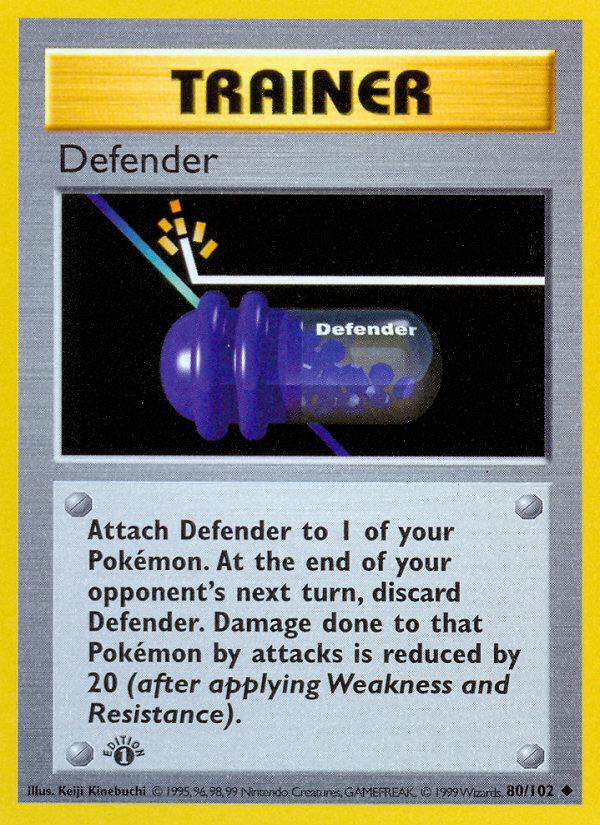
Image courtesy of TCGdex.net
Defensive design as a staple: how Pokémon TCG evolved to support sturdy, damage-resilient Pokémon
From the dawn of the Base Set era, the Pokémon Trading Card Game rewarded players who could weather the storm as much as those who could deal the damage. Defender, a modest Uncommon Trainer card illustrated by Keiji Kinebuchi, stands as a pivotal artifact in that evolution. Its core idea—protect a single Pokémon by dampening incoming damage—was one of the earliest step-changes in how the game treated defense. It didn’t rely on flashy HP totals or flashy attacks; it offered a surgical, tempo-preserving tool that allowed players to invest in bulky, defensive propositions like Snorlax or other HP-rich monsters and keep them in play longer. In this sense, Defender wasn’t just a card; it was a design statement about the game’s growing appetite for strategic durability. ⚡
A snapshot from Base Set: Defender and the era of Trainer cards
- Category and rarity: Defender is a Trainer card from the Base Set, listed as Uncommon, a sign of its value in gameplay without dominating the meta.
- Illustration and vibe: Keiji Kinebuchi’s art anchors the card in late-90s nostalgia, a time when many Trainer cards carried bold, bold-and-simple messaging rather than the multi-layered toolkits of later years.
- How it works: The card text grants damage reduction: the Pokémon equipped with Defender takes 20 less damage from attacks, after applying Weakness and Resistance. This simple line—“Damage done to that Pokémon by attacks is reduced by 20 (after applying Weakness and Resistance)”—made Defender a go-to for early players chasing survivability in a world of quick knockouts.
- Temporal flavor: As a Base Set card, Defender exists in an era before modern staples like energy acceleration or myriad tool cards, making its defensive utility feel more like a strategic surprise than a standard play.
- First Edition and shadows: The set’s variants include Unlimited, Shadowless, and 1st Edition versions, with 1st Edition/Shadowless status often elevating collector interest and value for the keen mind of the checklist hunter.
Why that Defender design mattered for the broader defensive strategy
Defender’s design nudged players to think beyond “KO and move on.” It rewarded commitment to a defensive line by extending the stay power of a single, well-chosen Pokémon. This is where the game’s evolving toolbox begins to show its edges:
- Damage mitigation as tempo: By reducing damage taken, you could allocate energy and resources to other threats while your defender tanked hits, buying turns for stacking a late-game win condition.
- Targeted versus global effects: Early on, a lot of defensive power was seen through targeted effects on a single Pokémon. Defender demonstrated a deliberate design choice: allow a player to protect a centerpiece while threats swirled around the board.
- Story and emotion: The art and flavor of defense add a storytelling layer—the idea that a Pokémon can stand its ground while allies react or regroup, a concept that resonates with nostalgia and long-term strategy alike. 🎴
How design evolved in later sets: tools, stadiums, and the language of defense
As the game matured, Pokémon TCG expanded its defensive toolkit in several meaningful ways. The introduction of Pokémon Tools—attachments that stay with a Pokémon to buoy its durability—gave players a reliable, reusable way to tilt battles in favor of the defensive line. Stadium cards created a shared battlefield where environmental effects could shape outcomes for all players, not just a single defender. And the text language around damage and mitigation grew tighter and broader, capturing nuanced interactions that Defender first hinted at in a simpler era.
One notable milestone in wording came with an errata during the Black & White era: Defender’s line was adjusted to reflect that the damage reduction applied to “attacks” in a broader sense, not just “an opponent’s attack.” This small but meaningful update clarified that the shield could help against multiple hits in a given turn or across successive turns, aligning the card with a more dynamic, multi-hit environment. For collectors and historians, that errata illustrates how the game evolves while honoring its earliest design philosophies. 🔎
Collector and market snapshot: Defender in today’s market
Defender remains a fixture for players who love classic design and for collectors who chase Base Set staples. The provided pricing snapshot offers a snapshot of its market stance as of 2025:
- CardMarket (standard, non-holo/unlimited): average around €1.3, with a broad range from as low as €0.02 to about €1.24 over 30 days, and a steady growth signal (trend around 0.8). This places Defender as an accessible entry into Base Set collecting, especially for non-holo variants.
- TCGPlayer (normal): prices show a low around $0.38, a mid around $0.76, and highs up to about $5.29. Market dynamics can nudge these figures up for sought-after print runs or when demand aligns with nostalgia for the era.
- Edition nuance: First Edition and Shadowless variants carry the allure of scarcity, with the potential for premium pricing in the right market conditions.
For players, Defender remains a pragmatic reminder: even in a game defined by big attacks and flashy evolutions, a well-timed bit of defense can swing the tide. For collectors, its place in the Base Set palette—signed by Keiji Kinebuchi and stamped by history—offers a tangible link to the game’s earliest days. And for fans of design, Defender is a bookmark in the story of how the Pokémon TCG grew from simple survivor strategies into a layered, multi-faceted battlefield where every card has a role beyond dealing damage. 💎
Curious to see how this kind of design idea threads through modern TCGs? Explore related reads and keep chasing those vintage angles and fresh perspectives.
90-Second UV Phone Sanitizer & Wireless Charging PadMore from our network
- https://blog.crypto-articles.xyz/blog/post/nft-data-boom_1-051-from-branches-of-our-mind_1-collection-on-magiceden/
- https://crypto-acolytes.xyz/blog/post/nft-stats-koru-1879-from-koru-collection/
- https://crypto-acolytes.xyz/blog/post/efficient-loot-routes-for-rust-beginners/
- https://crypto-acolytes.xyz/blog/post/nft-stats-515-from-turtlesonsol-collection/
- https://wiki.digital-vault.xyz/wiki/post/pokemon-tcg-stats-pikachu-card-id-a2a-025/
Defender
Set: Base Set | Card ID: base1-80
Card Overview
- Category: Trainer
- HP:
- Type:
- Stage:
- Dex ID:
- Rarity: Uncommon
- Regulation Mark: —
- Retreat Cost:
- Legal (Standard): No
- Legal (Expanded): No
Description
Pricing (Cardmarket)
- Average: €1.3
- Low: €0.02
- Trend: €0.8
- 7-Day Avg: €1.15
- 30-Day Avg: €1.24
Support Our Decentralized Network
Donate 💠More from our network
- https://blog.crypto-articles.xyz/blog/post/nft-data-boom_1-051-from-branches-of-our-mind_1-collection-on-magiceden/
- https://crypto-acolytes.xyz/blog/post/nft-stats-koru-1879-from-koru-collection/
- https://crypto-acolytes.xyz/blog/post/efficient-loot-routes-for-rust-beginners/
- https://crypto-acolytes.xyz/blog/post/nft-stats-515-from-turtlesonsol-collection/
- https://wiki.digital-vault.xyz/wiki/post/pokemon-tcg-stats-pikachu-card-id-a2a-025/