
Image courtesy of TCGdex.net
Design Evolution: Octillery and the Language of Pokémon TCG Card Architecture
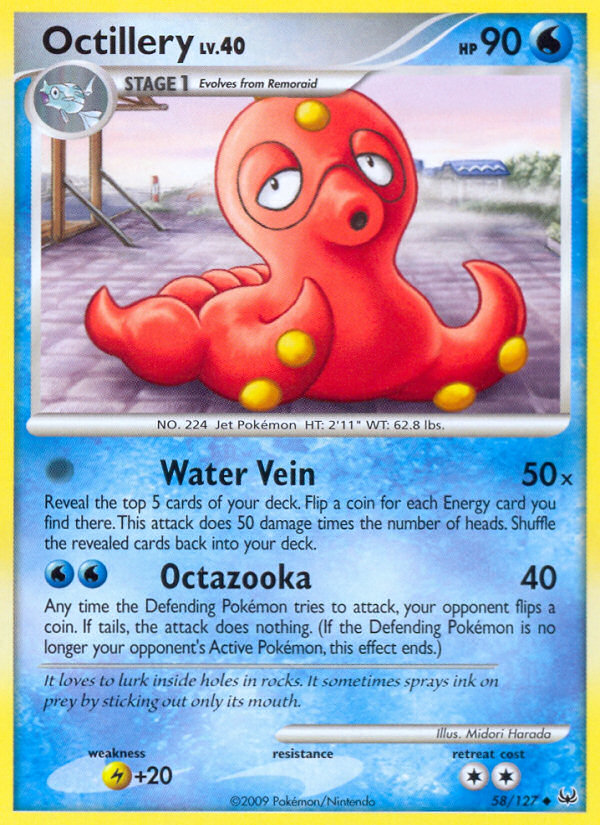
From the ripples of a Remoraid line to the more deliberate, texture-rich silhouettes of the Platinum era, Octillery embodies how Pokémon TCG design evolved to reward deeper strategy while keeping the game approachable. This particular card, a Stage 1 Water-type from PL1, is a compact study in how a few carefully chosen mechanics can influence deck-building, timing, and risk assessment. With 90 HP and an Uncommon rarity, Octillery might not shout from the top of the binder, but its layout and abilities quietly push designers toward more expressive play patterns. 🧭
Card data snapshot
- Category: Pokémon
- Name: Octillery
- Set: Platinum (PL1) — 127 official cards, 133 total
- Rarity: Uncommon
- Stage: Stage 1 (evolves from Remoraid)
- HP: 90
- Type: Water
- Attacks: Water Vein (50x) and Octazooka (40)
- Weakness: Lightning +20
- Retreat: 2
- Illustrator: Midori Harada
- Dex ID: 224
Two attacks anchor Octillery’s design philosophy: Water Vein rewards careful top-deck management, while Octazooka introduces a high-stakes, coin-flip mechanic that tests your matchup reading. Water Vein reads: reveal the top 5 cards of your deck; for each Energy card found, flip a coin; deal 50 damage times the number of heads, then shuffle the revealed cards back. Octazooka costs two Water energies and asks the opponent to flip a coin to see if the attack connects. If tails, no damage and the attack fizzles for that turn. This duality—a powerful search-and-burst option coupled with a gamble—feels like a bridge between the early, straightforward TCG days and the more nuanced, probability-aware era that followed. 🎯
Why this design mattered then, and how it resonates now
Platinum era cards began to balance raw power with probability-aware gameplay. Octillery’s Water Vein enables players to sculpt their draws: the top-deck reveal acts as a strategic mulligan, letting you tail a consistent path toward energy acceleration or perhaps a surprise surprise hit. The energy-cost mechanics for Octazooka emphasize timing and matchup awareness—two Water-types against evolving Lightning-aware metagames, for instance. The card’s 90 HP sits at a sweet spot for midgame board construction: enough survivability to threaten late-game stalls, yet not so high that it turns into an unwinnable wall. The art direction by Midori Harada, with its watery palette and dynamic posture, reinforces the sense that Octillery is a creature built for waterspouts, not mere gliding through the meta. 💎
As card design matured, multiple elements began to reinforce these ideas across sets. Readability improved: attack names, effects, and energy costs were laid out more clearly; the stage evolution line was consistently stated, making it easier for players to identify how a Remoraid line could become a formidable midgame engine. The Platinum set itself carried a distinctive, cleaner visual language that helped players parse multi-step effects without flipping back to the guidebook. In Octillery’s case, its Water Vein ability explicitly promotes deck-thinning and energy-aware planning, while Octazooka serves as a risk-reward crossroad that makes every coin flip feel consequential. ⚡
Gameplay strategy: weaving Octillery into a modern Water deck
- Master the top-deck dance: Water Vein rewards you for recognizing the energy density in your deck. If you’re running strategies that accelerate energy or recycle Energy from discarded piles, Octillery can be a late-game payoff, amplifying your overall reach. The coin-flip mechanic invites players to sculpt risk tolerance into their playstyle.
- Plan around Octazooka’s timing: With a two-Water energy cost, Octazooka isn’t a one-turn finisher—it’s a tempo tool that can stall an opponent’s aggression or give you an edge by denying a key attack. In matchups with fast Stage 2 threats, Octazooka provides a contest of control where a well-timed flip can derail your opponent’s plan.
- Remoraid synergy: Octillery’s evolution from Remoraid makes it a natural bridge in Water-focused lines. If your build uses Remoraid as a ramp to late-game pressure, Octillery becomes the principal engine—balancing draw, damage, and disruption in one package.
- Collector’s note: With Uncommon rarity in PL1, Octillery can be a solid acquisition for players aiming to round out a Water-type collection without chasing ultra-rare chase cards. The non-first-edition state and reverse-holo variants offer accessible paths to both playability and display value.
From a collector’s perspective, contemporary market data indicates Octillery PL1 remains a modest but meaningful piece. Cardmarket shows a typical July 2025 average around €0.21 for standard copies, with holo variants carrying higher ranges. On TCGPlayer, normal copies hover near the $0.25–$0.38 band, while reverse-holo copies command roughly $1.14 on the mid-range, with highs that can approach $2. These figures reflect the card’s enduring appeal as a strategic value piece rather than a powerhouse staple—precisely the kind of design that keeps players and collectors circling back to Platinum-era Water-types. 🔍
Where the design goes from here
Octillery’s design speaks to a broader trend: modern Pokémon TCG cards increasingly reward players who blend planning, probability, and tempo. The evolution line that starts with Remoraid and culminates in Octillery is more than a simple power curve—it’s a microcosm of how card text, art direction, and mechanical variety can harmonize to create a playable, collectible, and storyteller-friendly experience. The Platinum era’s emphasis on clarity and strategic depth laid groundwork that future sets would expand with new energy interactions, more nuanced coin-flip outcomes, and a broader palette of attacker archetypes. As designers continue to refine readability and deck-density, Octillery remains a reminder of a moment when a single card could shape how players thought about risk, timing, and the elegance of a well-constructed water-type deck. 🎴
90-Second UV Phone Sanitizer Wireless Charging PadMore from our network
- https://articles.digital-vault.xyz/blog/post/crustle-control-deck-guide-for-pokemon-tcg-players/
- https://blog.crypto-articles.xyz/blog/post/nft-data-bmb-community-season-2-4187-from-bmb-community-airdrop-season-2-collection-on-magiceden/
- https://transparent-paper.shop/blog/post/from-paper-to-pixel-digital-tangibility-in-paper-art/
- https://crypto-acolytes.xyz/blog/post/nft-stats-bogi-pass-559-from-bogi-pass-collection/
- https://blog.crypto-articles.xyz/blog/post/nft-data-lil-chiller-2138-from-lil-chillers-collection-on-magiceden/
Octillery
Set: Platinum | Card ID: pl1-58
Card Overview
- Category: Pokemon
- HP: 90
- Type: Water
- Stage: Stage1
- Evolves From: Remoraid
- Dex ID: 224
- Rarity: Uncommon
- Regulation Mark: —
- Retreat Cost: 2
- Legal (Standard): No
- Legal (Expanded): No
Description
Attacks
| Name | Cost | Damage |
|---|---|---|
| Water Vein | 50x | |
| Octazooka | Water, Water | 40 |
Pricing (Cardmarket)
- Average: €0.21
- Low: €0.02
- Trend: €0.17
- 7-Day Avg: €0.18
- 30-Day Avg: €0.21
Support Our Decentralized Network
Donate 💠More from our network
- https://articles.digital-vault.xyz/blog/post/crustle-control-deck-guide-for-pokemon-tcg-players/
- https://blog.crypto-articles.xyz/blog/post/nft-data-bmb-community-season-2-4187-from-bmb-community-airdrop-season-2-collection-on-magiceden/
- https://transparent-paper.shop/blog/post/from-paper-to-pixel-digital-tangibility-in-paper-art/
- https://crypto-acolytes.xyz/blog/post/nft-stats-bogi-pass-559-from-bogi-pass-collection/
- https://blog.crypto-articles.xyz/blog/post/nft-data-lil-chiller-2138-from-lil-chillers-collection-on-magiceden/