
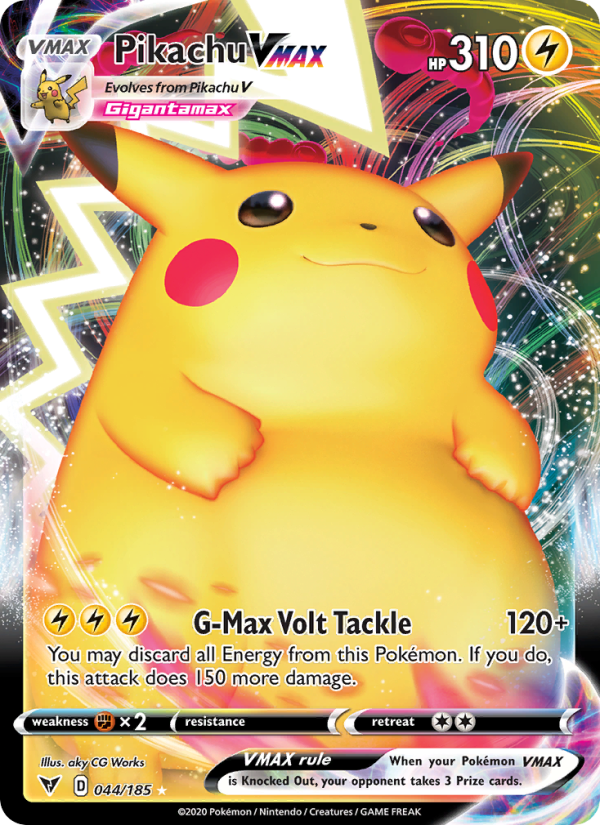
Image courtesy of TCGdex.net
How Pikachu VMAX Mirrors Evolution Mechanics in Pokémon TCG
Lightning crackles across the battlefield as Pikachu VMAX stands ready to demonstrate how the Pokémon TCG reflects the evolution journey you already know from the games. Hailing from the Vivid Voltage era, this holo rare VMAX card isn't just about raw power; it embodies the evolution mindset players love—the idea that growth comes with risk, preparation, and timing. With a formidable 310 HP, Pikachu VMAX sits at the apex of its line, evolving from Pikachu V and carrying the signature thunderclap of the stage-2 form into the competitive arena. ⚡🔥
In the video games, evolving is a patient, strategic process: a basic Pokémon becomes stronger as it unlocks new abilities and hits harder in battles. Pokémon TCG recreates that arc with a different, but equally satisfying, cadence. A Pokémon evolves by placing the next stage card on top of the current one, following the sequence: Basic → Evolution → (often) additional “V” or “VMAX” forms. Pikachu VMAX specifically evolves from Pikachu V, signaling a dramatic upgrade not just in HP, but in potential damage output and battlefield presence. The card’s G-Max Volt Tackle attack is the game’s loud exclamation point, marrying the concept of “power unlocked through evolution” with a calculated energy cost and a consequential energy discard option. 🔋🎴
“A VMAX form is not merely stronger; it redefines how you approach the entire turn—the energy economy, the timing of your attack, and the threat you pose to your opponent.”
From a rules perspective, Pikachu VMAX sits in the VMAX branch of the evolving line, a modern reinterpretation of big-boss transformations. Its type is Lightning, and the card is a standout of the Vivid Voltage set, which features a diverse roster of oversized evolutions and dazzling artwork. The set card count and rarity tell a story of a set that pushed players to explore new tempo and power curves: 185 official cards in the set, 203 in total across all printings, with Pikachu VMAX earning its holo rare VMAX treatment. The illustration, credited to aky CG Works, captures the electric charge and dynamic stance of a Pokémon that has grown beyond its common lineage. The tag team of HP, energy dynamics, and evolution is a vivid reminder of how the TCG mirrors the game’s growth arc. 💎🎨
Why the G-Max Volt Tackle Feels so Evolution-Analogous
G-Max Volt Tackle embodies the classic “grow into something greater” moment. The card requires three Lightning Energy to fire, and its base damage is 120. But here’s the twist that echoes evolution’s payoff: you may discard all Energy from Pikachu VMAX to push the attack’s damage by 150 more. That trade-off—huge damage for giving up resources—parallels the late-stage evolution burst in the games: you invest in power and pay a cost to unleash a new level of threat. The mechanics force players to consider board state, momentum, and tempo, just like planning a chain of evolutions to reach a stronger, more resilient battler. The move’s cut-and-thrust rhythm mirrors how evolving your team in the games creates new matchups and strategic opportunities. ⚡💥
Of course, the TCG demands energy economy discipline. Pikachu VMAX’s retreat cost of 2 means you must plan ahead to keep this behemoth in the active position or protected on the bench. Its weakness to Fighting-type attackers (×2) adds another layer of strategic math: you aren’t invincible, even once you’ve evolved into the mightiest form. These trade-offs—sheer HP, volatile energy costs, and a defined vulnerability—are deliberate design choices that keep the evolution model fair and dynamic within a match. Evolution, here, is a high-stakes upgrade that changes the game’s tempo rather than just its power table. 🔄🎯
Deckbuilding Strategies: Embracing the Evolution Narrative
When this VMAX arrives at the active zone, the path to victory often hinges on how efficiently you can stage the evolution and support it with the right energy acceleration. A modern Lightning-focused strategy might incorporate quick Pikachu V setups, reliable draw, and energy acceleration to reliably reach three Lightning energies by the time you need to unleash G-Max Volt Tackle. Because the attack can be amplified by discarding all attached energy, you gain a dramatic spike in power—an effect that rewards careful energy management, card selection, and tempo control. It’s a masterclass in how evolution-inspired power spikes can redefine a turn’s outcome, especially when your opponent has already stabilized their board. The variant of this line—Pikachu V moving into the VMAX form—also invites the question of when to pursue a “one-shot” finish versus a longer, attrition-based plan. The card’s expansive HP pool complements aggressive play, enabling you to weather counterattacks while you hunt for the big payoff. ⚡🎯
Collectors and players will also appreciate the aesthetic and lore vibe embedded in this evolving line. The VMAX form’s holo finish, the dramatic artwork, and the glow of the energy transfer all harken back to the iconic image of a Pokémon that has finally achieved its ultimate expression. For many fans, Pikachu VMAX is less about a single match and more about the narrative of growth—the same arc that makes the best trainer moments memorable in the video games. The set’s presence in Expanded formats keeps this card relevant for collectors who value enduring playability and a striking centerpiece card for display racks. 🧩🎴
Market Pulse: Value, Availability, and Trends
As with many marquee VMAX cards, Pikachu VMAX carries a dynamic market profile. Cardmarket shows an average around €8.64 with a spread that reflects its desirability and condition—low prices hovering near the €3 mark and higher prices driven by holo-foil scarcity and collector demand. On TCGPlayer, holofoil pricing paints a broader spectrum: low around $6.80, mid around $9.79, and high spikes that can reach into the hundreds for pristine or ultra-rare printings. The market price hovers near the mid-range for most collectors and playable decks, but the high end signals the card’s potential as a long-term store of value for fans who chase standout Pikachu artwork and iconic forms. For players, the practical takeaway is that this isn’t a budget one-off—it's a core piece for those who want to explore evolution-driven strategies with real play potential. 🔎💎
The extended look into the set and its evolution-friendly cards reveals a broader trend: modern TCG design rewards thoughtful evolution paths that reward timing, resource management, and board control. Pikachu VMAX sits at the intersection of nostalgia and power—a reminder that evolving your roster can reshape the battlefield as dramatically as any game update or new mechanic. The synergy between the card’s design, its energy requirements, and its impact on the game’s tempo makes it a compelling case study in how the Pokémon TCG mirrors the evolution mechanics that fans adore in the games. 🎮⚡
Slim Lexan Phone Case Glossy Ultra-ThinMore from our network
- https://blog.zero-static.xyz/blog/post/red-dead-redemption-2-fast-leveling-tips-and-tricks/
- https://blog.rusty-articles.xyz/blog/post/waymo-expands-autonomous-delivery-with-doordash-in-phoenix/
- https://wiki.digital-vault.xyz/wiki/post/pokemon-tcg-stats-rotom-card-id-a2a-035/
- https://wiki.digital-vault.xyz/wiki/post/pokemon-tcg-stats-gengar-card-id-sm4-38/
- https://articles.zero-static.xyz/blog/post/jolteon-and-poke-lore-integrating-the-tcg-universe/
Pikachu VMAX
Set: Vivid Voltage | Card ID: swsh4-44
Card Overview
- Category: Pokemon
- HP: 310
- Type: Lightning
- Stage: VMAX
- Evolves From: Pikachu V
- Dex ID: 25
- Rarity: Holo Rare VMAX
- Regulation Mark: D
- Retreat Cost: 2
- Legal (Standard): No
- Legal (Expanded): Yes
Description
Attacks
| Name | Cost | Damage |
|---|---|---|
| G-Max Volt Tackle | Lightning, Lightning, Lightning | 120+ |
Pricing (Cardmarket)
- Average: €8.64
- Low: €2.98
- Trend: €7.44
- 7-Day Avg: €5.78
- 30-Day Avg: €8.02
Support Our Decentralized Network
Donate 💠More from our network
- https://blog.zero-static.xyz/blog/post/red-dead-redemption-2-fast-leveling-tips-and-tricks/
- https://blog.rusty-articles.xyz/blog/post/waymo-expands-autonomous-delivery-with-doordash-in-phoenix/
- https://wiki.digital-vault.xyz/wiki/post/pokemon-tcg-stats-rotom-card-id-a2a-035/
- https://wiki.digital-vault.xyz/wiki/post/pokemon-tcg-stats-gengar-card-id-sm4-38/
- https://articles.zero-static.xyz/blog/post/jolteon-and-poke-lore-integrating-the-tcg-universe/