

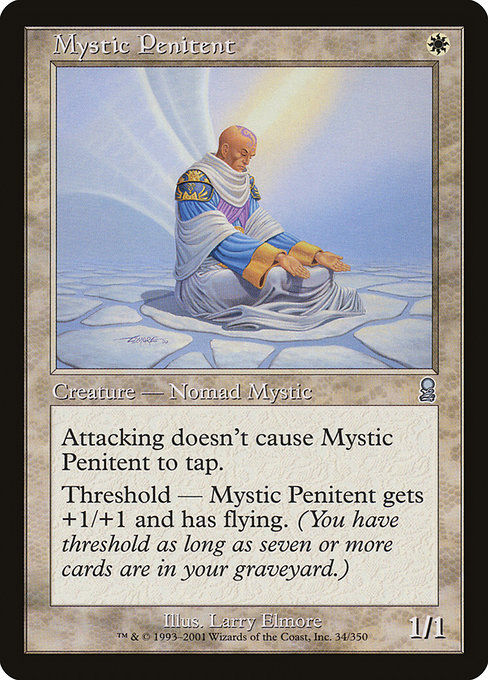
Image courtesy of Scryfall.com
Understanding the Probability Behind Mystic Penitent's Threshold
White mana only, a nimble 1/1 with vigilance, Mystic Penitent slips into the battlefield quietly, then reveals a surprising power once the graveyard swells to seven or more. That threshold turns on a subtle, almost mystical clock: as long as seven or more cards are in your graveyard, this tiny nomad grows larger and gains wings of the skies. 🧙♂️🔥 The math behind that transformation isn't flashy, but it matters—especially when you’re building around a stat line that shifts with the game state. In Odyssey’s era, threshold is a design motif that rewards deck-building discipline: you’re trading a small early body for late-game resilience and unexpected tempo shifts. ⚔️
A quick snapshot of the card
- Name: Mystic Penitent
- Mana Cost: {W}
- Type: Creature — Human Nomad Mystic
- Power/Toughness: 1/1
- Keywords: Vigilance, Threshold
- Rarity: Uncommon
- Set: Odyssey (ODY), 1997 era
- Oracle Text: Vigilance; Threshold — As long as seven or more cards are in your graveyard, this creature gets +1/+1 and has flying.
In practice, that means the creature starts as a sturdy early drop for a single white mana, but by the midgame it can become a legitimate aerial threat. Thematic for Odyssey’s flavor, the card sits at a curious crossroads between survivability and inevitability—the kind of engine card you hope to untap with exactly when your opponent forgot to count your flyers. 🧩🎨
The probability lens: framing the “how often” question
When we talk about triggering Mystic Penitent’s threshold, we’re really asking: how often will a deck reach seven cards in the graveyard by the time the Penitent matters? The truth is deck composition and game flow determine the odds more than any single formula. Still, there’s a clean way to think about it: model the number of cards moved to the graveyard as a random process, and ask what the distribution looks like for seven or more graveyard cards at key moments.
Two core ideas help anchor our intuition:
- Graveyard fill rate: Every time a spell, creature, or ability sends a card to the graveyard, you increment a counter. In a casual game, that counter rises from discards, combat damage, and any mill or self-mill effects you pack into a Threshold shell.
- Timing matters: Threshold is active whenever the graveyard count is seven or more, not just on a single moment. The probability you care about is the chance you’ve already hit seven by a given turn, or that you’ll reach seven soon enough for the Penitent to swing a turn or two later.
In formal terms, if you have N graveyard-affecting events by a given point in the game, and each event independently moves a card to the graveyard with probability p, then the number of cards in the graveyard G follows a binomial distribution: G ~ Binomial(N, p). The rough probability of having seven or more gravematter by that moment is P(G ≥ 7) = sum_k=7^N C(N,k) p^k (1-p)^(N-k). Of course, in a living game the events aren’t strictly independent and not all graveyard events are created equal—but this framing helps anchor expectations and deck-building decisions. 🧮
Practical scenarios you’ll actually feel at the table
- No dedicated graveyard fill — If your deck merely uses cheap spells that resolve to a vanilla 1/1, you’ll likely hover below seven graveyard cards through the first several turns. In this lane, Mystic Penitent remains a speedy 1/1 with vigilance for most of the early game, and the threshold buff remains dormant unless you get lucky with a discard-draw loop or a late-game miracle. The probability of hitting seven by turn 5 is small, often under 15% in a pure vanilla shell.
- Moderate mill or discard — Add a few self-discard or graveyard-to-hand interactions. Suddenly you creep into the mid-teens for G by turn 5 or 6, and the odds of having seven or more become appreciable—perhaps in the 20–40% range depending on your draw luck and the exact mix of tools. When it lands, Penitent’s bite becomes noticeably sharper as a 2/2 flyer for several turns. 🧙♂️💎
- Dedicated threshold shell — With targeted cards that deliberately fill the graveyard (and perhaps even accelerate it), you can push G past seven reliably by turns 4–6. In this lane, Mystic Penitent not only costs a mere single white but often contributes to a broad wheel of advantage: flyers, blocking resilience, and potential synergy with other threshold or graveyard-activated effects. In these games the buff is not a one-off—it’s a steady engine. 🔥⚔️
Deck-building takeaways to tilt the odds in your favor
If you’re chasing more reliable threshold trigs, consider a lightweight, purposeful graveyard package. Here are practical guidelines that respect Mystic Penitent’s flavor and Odyssey’s rhythm:
- Graveyard-fill pressure: Include a handful of cards that send cards to the graveyard or recycle them later. Even a small nudge counts—discard outlets, cheap recursion, or efficient removal that dumps cards into the graveyard helps move the needle.
- Guardrails for consistency: Balance graveyard effects with cards that keep your curve intact. You want to avoid flooding your hand with dead cards; tempo matters when you’re aiming to trigger a threshold that opens up a longer game.
- Early pressure, late payoff: Mystic Penitent shines as a midgame stabilizer or midrange finisher once the threshold is online. Plan turns 3–6 to push your graveyard count above seven and keep it there through combat phases.
- Mana efficiency in white: Since you only pay {W} for the Penitent, you can often afford a compact shell that doesn’t skol the mana base. Lean into efficient white staples that help you survive early aggression while setting up the threshold clock.
From a flavor perspective, the poem of threshold fits nicely with Odyssey’s lore: a pensive wanderer, watching as memories (and graveyard echoes) accumulate until a moment of liberated ascent arrives. The art by Larry Elmore captures that vibe—an emblem of quiet resilience and sudden rise, perfectly suited to the theme of a tiny body becoming an airborne steward of the skies. 🎨
Mystic Penitent teaches a timeless MTG lesson: small, steady advantages can compound into meaningful midgame power, especially when the game state pays you back for the patience you show. Whether you’re piloting a casual threshold shell or testing the edges of a more ambitious graveyard strategy, the question isn’t only “Will it trigger?” but also “When will it change the math of combat in my favor?” With careful play and a dash of RNG-friendly luck, that little 1/1 with vigilance can become a surprising tempo resource, a defensive anchor, and a symbol of the threshold’s enduring mystique. 🧙♂️💎
Slim Lexan Phone Case for iPhone 16 Ultra-Thin Glossy FinishMore from our network
- https://crypto-acolytes.xyz/blog/post/nft-stats-tardyo-robotics-178-from-tardyo-robotics-collection/
- https://crypto-articles.xyz/tmp2lj8842i/3574c73c.html
- https://wiki.digital-vault.xyz/wiki/post/pokemon-tcg-stats-lucario-ex-card-id-a2b-084/
- https://crypto-acolytes.xyz/blog/post/nft-stats-lion-of-liquania-2031-from-lions-of-liquania-collection/
- https://crypto-acolytes.xyz/blog/post/deep-dive-exploring-underwater-labs-in-rust/
Mystic Penitent
Vigilance
Threshold — As long as seven or more cards are in your graveyard, this creature gets +1/+1 and has flying.
ID: fb37f08b-019e-4e6b-8b15-b2971a3b5ebb
Oracle ID: d3d59704-569d-42a7-8b31-8a31b9c0395f
Multiverse IDs: 31766
TCGPlayer ID: 9309
Cardmarket ID: 2446
Colors: W
Color Identity: W
Keywords: Vigilance, Threshold
Rarity: Uncommon
Released: 2001-10-01
Artist: Larry Elmore
Frame: 1997
Border: black
EDHRec Rank: 28924
Penny Rank: 14913
Set: Odyssey (ody)
Collector #: 34
Legalities
- Standard — not_legal
- Future — not_legal
- Historic — not_legal
- Timeless — not_legal
- Gladiator — not_legal
- Pioneer — not_legal
- Modern — not_legal
- Legacy — legal
- Pauper — not_legal
- Vintage — legal
- Penny — not_legal
- Commander — legal
- Oathbreaker — legal
- Standardbrawl — not_legal
- Brawl — not_legal
- Alchemy — not_legal
- Paupercommander — not_legal
- Duel — legal
- Oldschool — not_legal
- Premodern — legal
- Predh — legal
Prices
- USD: 0.19
- USD_FOIL: 0.55
- EUR: 0.16
- EUR_FOIL: 1.05
- TIX: 0.06
More from our network
- https://blog.crypto-articles.xyz/blog/post/nft-data-25-from-bitasuar-collection-on-magiceden/
- https://wiki.digital-vault.xyz/wiki/post/pokemon-tcg-stats-morpeko-card-id-swshp-swsh031/
- https://crypto-acolytes.xyz/blog/post/nft-stats-gmfers-566-from-gaymfers-collection/
- https://blog.crypto-articles.xyz/blog/post/nft-data-lion-of-liquania-917-from-lions-of-liquania-collection-on-magiceden/
- https://wiki.digital-vault.xyz/wiki/post/minecraft-block-stats-waxed_weathered_copper/