
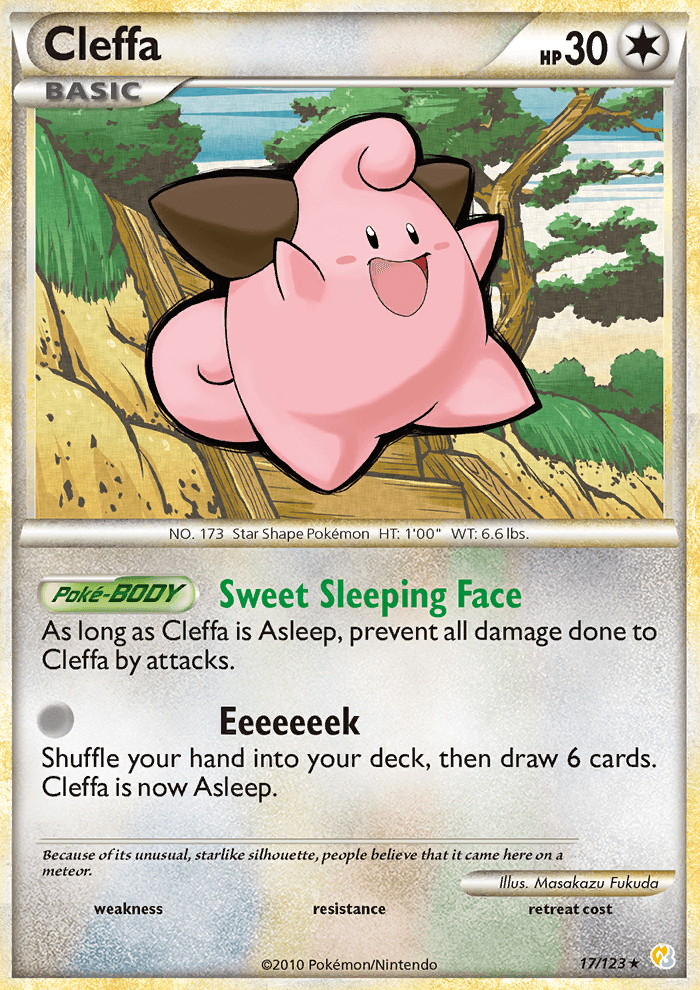
Image courtesy of TCGdex.net
Cleffa in Winning Decks: Frequency, Strategy, and Collectibility
In the sprawling tapestry of the Pokémon TCG, some cards become beloved footnotes, while others shape meta shifts through clever synergy and timing. Cleffa, a Rare Basic from the HeartGold SoulSilver era, sits intriguingly at that crossroads. With a humble 30 HP and a starry silhouette that fans adore, Cleffa isn’t the brag-worthy heavy hitter you might expect. Yet its unique combination of a Poke-BODY and a single, high-variance attack can swing early-game tempo in subtle, meaningful ways. Masakazu Fukuda’s artwork captures that whimsy perfectly, and collectors know that rare cards from hgss1 carry a nostalgic pull as well as practical value.
The core question for players and collectors alike is simple: how often does Cleffa actually show up in winning decks? The answer involves a blend of historical context, deck-building philosophy, and a pinch of luck. Cleffa’s defining mechanic is Sweet Sleeping Face, a Poke-BODY that prevents all damage to Cleffa while it’s Asleep. That protective cocoon can buy crucial time on the opening turns, especially in decks that prize rapid setup and draw acceleration. When Cleffa is asleep, the attacker’s damage simply cannot chip away at it, which can buy a turn or two to assemble a plan—whether that means evolving into a stronger threat or simply digging for energy and draw-support cards.
Its атаck, Eeeeeeek, is equally telling. For a single Colorless energy, Cleffa shuffles your hand into your deck and draws six cards, but Cleffa also becomes Asleep in the process. This is a powerful hand-refresh tool in the right context: it can turn a clunky starting hand into a streamlined set of options, accelerating the path to Clefairy or other evolutions, and helping you locate draw support, stronger attackers, or the energy needed to push through a win. However, the risk is immediate hand depletion: you’re risking losing the current set of resources you had planned to apply that turn. The decision to commit Cleffa early hinges on your deck’s speed, your access to recovery draws, and your tolerance for stalling your own momentum if the timing isn’t perfect.
In practical meta terms, Cleffa tends to appear in niche, tempo-driven decks rather than as a core pillar of top-tier lists. Its role is most visible in formats where players prize first-turn or second-turn stabilization and a rapid engine for card advantage. In HGSS-era lineups, where rapid draw engines and “setup turns” could decide match tempo, Cleffa acts as a catalyst for a quick, disruptive opening. That strategic niche is why Cleffa pops up in some winning decks, but not as a staple: the card’s high variance—relying on shuffling your hand and risking a low HP target—means it’s best placed in archetypes that can weaponize that draw-off without becoming over-reliant on a single fragile starter.
From a collector’s viewpoint, Cleffa’s rarity and the HeartGold SoulSilver designation add lasting value beyond play. The HGSS1 set, with 123 official cards (124 total), showcases Cleffa as a compact, charming piece of the era’s design language. The card’s market data—TCGPlayer’s prices for non-holo variants drifting in the modest-to-mid range, with holo versions fetching higher figures—speaks to its status as a desirable nostalgia card that still sees action in older formats and in curated deck collections. The Masakazu Fukuda artwork remains a favorite among fans who collect game art as a separate pleasure, making Cleffa a twofold treasure: a playable piece and a visual memento of the franchise’s early-2000s charm.
For players aiming to optimize Cleffa’s impact in a winning strategy, a few practical guidelines help balance the risk and reward. First, time your Cleffa plays to maximize your next moves. If you can safely invest Cleffa’s draw into a path toward Clefairy (or even Clefable) by turn two or three, the payoff is greater than immediate damage mitigation alone. Second, pair Cleffa with draw-intensive supporters that don’t require you to discard crucial resources—think cards that replenish your hand or draw power without starving your setup. Third, consider bench management. Because Cleffa’s “attack window” depends on your hand and deck state, you’ll want to protect your bench and ensure you have a plan to bring Cleffa back from being asleep to a productive unit on the field through evolution or switching effects when the timing is right. The result is a clever line of play that uses Cleffa’s protective stare as a shield while you assemble a longer-term plan.
The card’s Evolution line—basic Cleffa evolving into Clefairy—remains a reminder of how early-game tempo can become late-game power. In decks that lean on rapid evolution to unleash stronger attackers quickly, Cleffa’s ability to dig for the needed pieces can shave turns off the path to victory. Its 30 HP is a reminder that Cleffa is never a battlefield stalwart; it’s a temporary, tactical engine that can shift the pace of a match when used with care. In this sense, Cleffa is less about raw power and more about the art of tempo: knowing when to draw, when to stall, and how to leverage that delicate lull into a winning sequence.
For those intrigued by values and market trends, Cleffa from HeartGold SoulSilver carries a mix of youthful charm and practical scarcity. The card’s price points—dynamic across markets and across condition variants—reflect the ecosystem of collectors who value not just playability but the memory of a beloved era. The card’s look, including the starry lore of its meteor arrival, complements its in-game identity as a small, clever engine that could tilt a match if played with precise timing.
Why Cleffa Still Matters to Serious Collectors and Players ⚡🔥
- Nostalgia meets utility: The StarMetal silhouette and Masakazu Fukuda’s illustration pair with a genuinely strategic ability, giving Cleffa enduring appeal for both display shelves and layered deck-building.
- Tempo engine in compact form: Sweet Sleeping Face provides a rare form of damage mitigation while Cleffa is drowsy, offering a window to accelerate your draw and set up stronger threats.
- Low HP, high variance: A reminder that not all wins hinge on bulky attackers; sometimes the fastest path to victory is a taught, well-timed sequence of draws and evolutions.
- Market signals: Rarity and fandom keep Cleffa relevant in price discussions, with non-holo and holo variants showing distinct demand curves that collectors track over time.
- Legacy value: As a hallmark of the HGSS era, Cleffa remains a favorite for theme decks and nostalgia-driven collections that celebrate the game’s early design language.
If you’re exploring whether Cleffa belongs in your collection or your next vintage-focused deck, the answer is nuanced and exciting. It’s not about overpowering the table with raw stats; it’s about leveraging a tiny star’s aura to bend tempo in your favor—an emblem of how thoughtful design can punch above its weight class. And in a world where every draw can change your destiny, Cleffa’s seven-card swing feels just right for a fan who loves both the game and the story behind it. ⚡🎴
Neon Rectangle Mouse Pad Ultra-Thin 1.58mm Rubber BaseMore from our network
- https://crypto-acolytes.xyz/blog/post/nft-stats-debros-542-from-debros-collection/
- https://wiki.digital-vault.xyz/wiki/post/pokemon-tcg-stats-cubone-card-id-dp6-90/
- https://blog.crypto-articles.xyz/blog/post/nft-data-beige-survivors-from-trippin-traits-collection-on-magiceden/
- https://wiki.digital-vault.xyz/wiki/post/pokemon-tcg-stats-tm-machine-card-id-sv10-181/
- https://articles.digital-vault.xyz/blog/post/cyberpunk-2077-vr-mods-and-performance-overview-for-pc/
Cleffa
Set: HeartGold SoulSilver | Card ID: hgss1-17
Card Overview
- Category: Pokemon
- HP: 30
- Type: Colorless
- Stage: Basic
- Dex ID: 173
- Rarity: Rare
- Regulation Mark: —
- Retreat Cost: 0
- Legal (Standard): No
- Legal (Expanded): No
Description
Because of its unusual, star-like silhouette, people believe that it came here on a meteor.
Abilities
-
Sweet Sleeping Face — Poke-BODY
As long as Cleffa is Asleep, prevent all damage done to Cleffa by attacks.
Attacks
| Name | Cost | Damage |
|---|---|---|
| Eeeeeeek |
Pricing (Cardmarket)
- Average: €1.96
- Low: €0.5
- Trend: €2.07
- 7-Day Avg: €1.97
- 30-Day Avg: €1.78
Support Our Decentralized Network
Donate 💠More from our network
- https://crypto-acolytes.xyz/blog/post/nft-stats-debros-542-from-debros-collection/
- https://wiki.digital-vault.xyz/wiki/post/pokemon-tcg-stats-cubone-card-id-dp6-90/
- https://blog.crypto-articles.xyz/blog/post/nft-data-beige-survivors-from-trippin-traits-collection-on-magiceden/
- https://wiki.digital-vault.xyz/wiki/post/pokemon-tcg-stats-tm-machine-card-id-sv10-181/
- https://articles.digital-vault.xyz/blog/post/cyberpunk-2077-vr-mods-and-performance-overview-for-pc/