
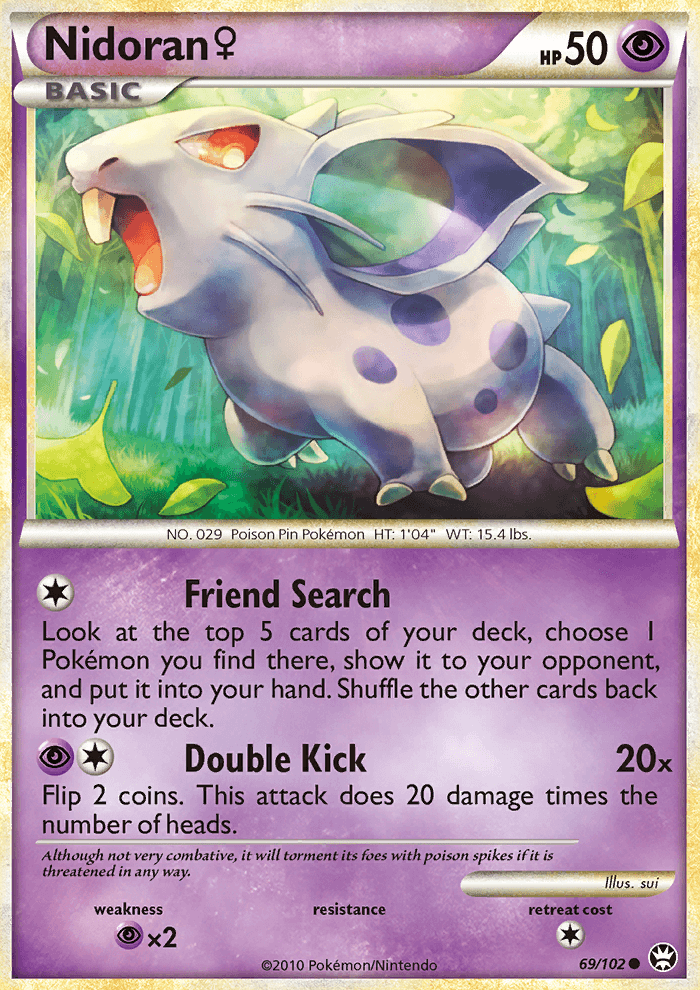
Image courtesy of TCGdex.net
Tracing the Dawn of Deck-Building: How Nidoran♀ Helped Shape Early Pokémon TCG Design
In the grand tapestry of the Pokémon Trading Card Game, certain cards feel like turning points—moments when design language shifted from quaint novelty to a playable, strategic experience. Nidoran♀, a small but significant presence in the Triumphant expansion (HGSS4), sits squarely in that conversation. This basic Psychic Pokémon, with its modest 50 HP and two-button arsenal, embodies the early design philosophy: simplicity of purpose, clarity of function, and a slowly unfolding toolkit that rewarded smart opening plays and careful deck construction. ⚡
Triumphant, released as part of the HeartGold & SoulSilver era, carried a refined aesthetic under the watchful eye of illustrator sui. The card’s layout—a clean portrait framed by bold typography, a single-line description of its abilities, and a compact set of numbers—speaks to a transitional moment in the game’s visual and mechanical language. The first attack, Friend Search, is a quiet revolution: look at the top five cards of your deck, pick one Pokémon, and add it to your hand. It’s early-stage consistency with a strategic tilt toward initiating your plan on turn one or two. In an era when Trainers were increasingly integral to tempo, a Pokémon that can help you curate your own toolkit without drawing an additional Supporter card felt both practical and empowering. The second attack, Double Kick, introduces an early flavor of risk vs. reward—pay Psychic and a Colorless for a damage mechanic that depends on coin flips (20 damage per heads). The coin-flip mechanic, while simple, seeded a probabilistic style that would echo through later sets in more complex forms.
From a gameplay standpoint, Nidoran♀ is emblematic of a design language built to reward planning and early pressure, rather than brute-force raw power. Its Psychic typing, while visually striking in the purple-and-lilac palette of the era, comes with a straightforward risk matrix: a single retreat cost of 1, a Psychic weakness at ×2, and no special effects beyond the two attacks. This combination fosters early-game decisions—should you search for a critical Basic that can set up a stronger board state, or push for damage while hoping for favorable coin outcomes? The card’s economy is deliberately approachable, yet its settings invite players to think ahead and optimize their opening turns. The constraints—HP 50, basic stage, and a modest attack suite—are a reminder of an era when players built around consistency and tempo rather than the power spikes seen in later years. 🔎
Artistically, Nidoran♀ benefits from the era’s emphasis on clear, legible art that communicates mood at a glance. sui’s rendition captures the Pokémon’s iconic spikes in a posture that feels both alert and a touch combative, which aligns with the card’s role as a thinker’s Pokémon rather than a bruiser. The Triumphant set’s design language—balanced borders, crisp text boxes, and a strong emphasis on the Pokémon’s silhouette—helps new players grasp the basics quickly while giving collectors a stable, repeatable aesthetic across a broad roster. This balance between artful presentation and practical readability helped set a design standard that newer sets would expand upon, without sacrificing the clarity that made early TCG learning approachable. 🎨
As the game evolved, so did its design constraints and opportunities. The shift from simple HP ceilings and bite-sized attacks toward more elaborate text boxes, varied energy costs, and intricate timing windows was driven by a desire to create deeper strategic space without alienating newcomers. Nidoran♀ sits at a crossroads: it shows how a card can be functionally robust (deck-search utility) while still keeping simplicity at the fore—an anchor point for designers layering in more complex mechanics later. The card’s retreat cost and its psychic weakness remind us that even in early iterations, moves and typings were chosen with a broader board strategy in mind, foreshadowing the later emphasis on synergy between types, energies, and trainer tools. 💎
For collectors and historians, the Common rarity of Nidoran♀ in Triumphant is a meaningful marker. Common cards often form the backbone of a collectible pathway—accessible to new players, frequently reprinted, and central to the nostalgia of early game sessions. The set’s statistics—102 official cards (with 103 total in the full print run)—highlight how expansive the early modern printlines could be and how every slot in a common card carried notable design intent. The evolution from this era toward higher HP ceilings, broader ability taxonomies, and more nuanced weaknesses and resistances mirrors the broader journey of the TCG from a straightforward skirmish game to a deeply strategic hobby. This is not just a relic of the past; it’s a blueprint for how card design can steadily increase depth while preserving the core play experience that made the franchise beloved in the first place. 🔥
Looking forward, the lesson of Nidoran♀ remains clear: thoughtful card design is less about cramming every mechanic into a single card and more about giving players meaningful, repeatable tools that can be woven into a coherent game plan. The simple yet effective Friend Search ability foreshadows present-day search and tutor effects, while Double Kick embodies the early flirtation with probabilistic outcomes that modern sets have refined into more predictable, outcome-driven dynamics. The evolution of the Pokémon TCG’s design language—balancing accessibility with strategic depth—continues to honor the spirit of cards like Nidoran♀, ensuring that nostalgia and innovation walk hand in hand. ⚡🎴
Key takeaways
- Nidoran♀ demonstrates how early design leveraged basic HP, simple costs, and targeted effects to teach core mechanics.
- The Friend Search attack introduces a proto-deck-thinning concept that enriches opening-game decision-making.
- Artwork by sui and the Triumphant set’s clean layout helped establish a lasting aesthetic standard for readability and collectibility.
- Rarity and set size illustrate how common cards can still carry historical significance and influence future design choices.
Image courtesy of TCGdex.net
More from our network
- https://crypto-acolytes.xyz/blog/post/inside-unreal-engine-5-the-future-of-hyper-realistic-graphics/
- https://crypto-acolytes.xyz/blog/post/debros-561-debros-nft-stats/
- https://articles.zero-static.xyz/blog/post/sonic-adventure-2-multiplayer-strategies-for-victory/
- https://transparent-paper.shop/blog/post/stable-diffusion-xl-prompt-surrealism-noir-metallic-texture-glow-encryption-motif-cinematic-lighting/
- https://crypto-acolytes.xyz/blog/post/lnl-1550-long-neck-legends-nft-stats/
Nidoran♀
Set: Triumphant | Card ID: hgss4-69
Card Overview
- Category: Pokemon
- HP: 50
- Type: Psychic
- Stage: Basic
- Dex ID: 29
- Rarity: Common
- Regulation Mark: —
- Retreat Cost: 1
- Legal (Standard): No
- Legal (Expanded): No
Description
Although not very combative, it will torment its foes with poison spikes if it is threatened in any way.
Attacks
| Name | Cost | Damage |
|---|---|---|
| Friend Search | Colorless | |
| Double Kick | Psychic, Colorless | 20x |
Support Our Decentralized Network
Donate 💠More from our network
- https://crypto-acolytes.xyz/blog/post/inside-unreal-engine-5-the-future-of-hyper-realistic-graphics/
- https://crypto-acolytes.xyz/blog/post/debros-561-debros-nft-stats/
- https://articles.zero-static.xyz/blog/post/sonic-adventure-2-multiplayer-strategies-for-victory/
- https://transparent-paper.shop/blog/post/stable-diffusion-xl-prompt-surrealism-noir-metallic-texture-glow-encryption-motif-cinematic-lighting/
- https://crypto-acolytes.xyz/blog/post/lnl-1550-long-neck-legends-nft-stats/