
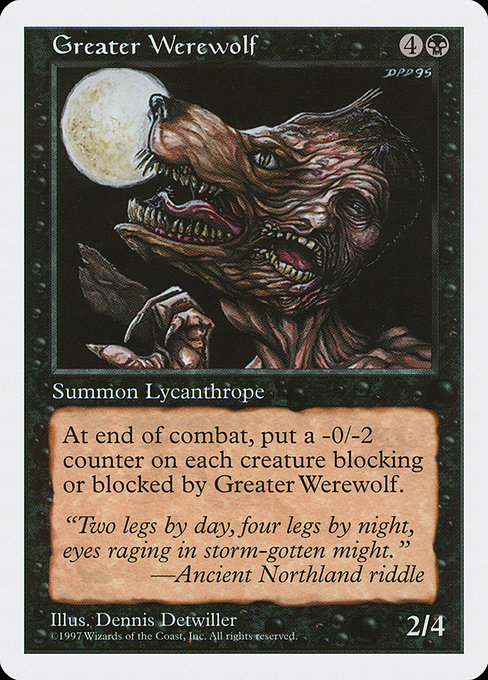
Image courtesy of Scryfall.com
Templating, Clarity, and a Classic Werewolf
Magic: The Gathering has always thrived at the intersection of flavor and function, but the way a card is worded (its templating) can dramatically shape how players understand and interact with it. Greater Werewolf, a core-set staple from Fifth Edition, is a perfect case study in how historical templating affects timing, blocks, and combat decisions. 🧙♂️🔥 This unassuming creature—black mana, a 2/4 body for four mana—carries a deceptively simple line of text that becomes a mental model for players when they parse combat during a match. ⚔️
Card at a glance
- Name: Greater Werewolf
- Mana Cost: {4}{B}
- Type: Creature — Werewolf
- Rarity: Uncommon
- Set: Fifth Edition (core set, 1997)
- Power/Toughness: 2/4
- Oracle Text: At end of combat, put a -0/-2 counter on each creature blocking or blocked by this creature.
- Flavor text: "Two legs by day, four legs by night, eyes raging in storm-gotten might." — Ancient Northland riddle
The beauty of templating here is how a single sentence anchors timing and consequence. The phrase “At end of combat” makes the event strictly tied to the end of combat steps, not the damage step. The clause “on each creature blocking or blocked by this creature” places the onus squarely on the interaction between Greater Werewolf and its neighbors, not just on the Werewolf itself. In modern templating, you’ll often see slightly more explicit timing or rewordings, but this older phrasing still communicates clearly what happens and when. 💎
Why templating matters for understanding
Template choices guide what players expect when a block is declared or when an attack goes unblocked. In this case, you don’t draw a card; you don’t deal extra damage; you don’t generate mana. Instead, you add a -0/-2 counter to creatures that touched Greater Werewolf in combat. The effect is subtle on turn two, but it compounds with every subsequent combat, creating a persistent nagging pressure on the battlefield. The layout emphasizes cause (this creature) and effect (the counters) in a way that translates to mental models: “If I block, I risk reduced stats later,” or “If I’m swinging, I should watch who is left after the end step.” It’s a reminder that a card’s actual power comes from how its text interacts with the rest of the board, not just its raw stats. ⚔️
From a design perspective, templating like this helps players infer timing without needing a rules guide open in the middle of a game. But it can also sow confusion for newer players who aren’t yet fluent in combat math. Would the counters be placed if Greater Werewolf becomes blocked after a combat damage exchange? The answer lies in the precise wording and the step-by-step flow of the combat phase. The more explicit a card becomes (e.g., “At the end of combat, put a -0/-2 counter on each creature that blocked or was blocked by Greater Werewolf”), the more accessible it is to newcomers. Yet the classic phrasing remains a touchstone for veteran players who’ve internalized the old-school cadence of MTG’s templating. 🧙♂️
Strategies and playstyle implications
Greater Werewolf sits at an interesting crossroads of aggression and tempo. Its mana cost of {4}{B} and its 2/4 body give it staying power in the midgame, while its end-of-combat drawback punishes wide boards—think of it as a soft counter to massed blockers. In a black-centered deck, you can leverage removal and discard to protect the Werewolf while using the end-of-combat trigger to chip away at the opponent’s board presence. The flavor text hints at a timeless hunter—bloodlines, night, and a riddle that echoes through Northland lore. It’s not just flavor; it’s a reminder that in many shadowy corners of MTG, control and attrition win the day. 🔥🎲
In casual or cube environments, Greater Werewolf can function as a “fuse” card—a midgame threat that scales with the density of the battlefield. If your deck is built to maximize combat trades or to leverage -0/-2 counters through other synergies (think proliferate or creatures that trigger on counters), you’ll find that templating subtly nudges decisions in a direction that favors control and attrition rather than pure beatdown. And because this card is from a classic era, it also serves as a tactile bridge to fans who remember the days when core sets looked a little different, the borders were white, and every corner of the battlefield felt a touch more mythic. 🎨
Flavor, art, and collector angle
Dennis Detwiller’s illustration captures a stark, primal energy that pairs well with the Fifth Edition era—where players learned to read a card’s silhouette alongside its rules text. The flavor line about ancient Northland riddles adds a storytelling layer that makes templating feel like a living part of the world rather than a dry set of instructions. For collectors, the card’s status as a reprint in a core set and its status as an uncommon provide a nice niche—accessible to newer players, but with enough historic flavor to delight long-time fans. 💎
Whether you’re chasing nostalgic vibes or trying to teach a newer player how to read combat timing, Greater Werewolf remains a handy anchor card. It demonstrates how a few words, arranged thoughtfully, can shape hours of gameplay and countless decisions at the table. And if you ever need a practical demonstration of templating in action, you don’t have to look far from this classic werewolf. 🎲
Custom Mouse Pad 9.3 x 7.8 Non-Slip Desk MatMore from our network
Greater Werewolf
At end of combat, put a -0/-2 counter on each creature blocking or blocked by this creature.
ID: 34b77373-6066-436b-aa60-4cb0f8077599
Oracle ID: 02847b0d-03a1-4e30-902e-60bdf6952c58
Multiverse IDs: 3849
TCGPlayer ID: 2186
Cardmarket ID: 9399
Colors: B
Color Identity: B
Keywords:
Rarity: Uncommon
Released: 1997-03-24
Artist: Dennis Detwiller
Frame: 1997
Border: white
EDHRec Rank: 28875
Set: Fifth Edition (5ed)
Collector #: 166
Legalities
- Standard — not_legal
- Future — not_legal
- Historic — not_legal
- Timeless — not_legal
- Gladiator — not_legal
- Pioneer — not_legal
- Modern — not_legal
- Legacy — legal
- Pauper — legal
- Vintage — legal
- Penny — not_legal
- Commander — legal
- Oathbreaker — legal
- Standardbrawl — not_legal
- Brawl — not_legal
- Alchemy — not_legal
- Paupercommander — legal
- Duel — legal
- Oldschool — not_legal
- Premodern — legal
- Predh — legal
Prices
- USD: 0.48
- EUR: 0.23
More from our network
- https://wiki.digital-vault.xyz/wiki/post/pokemon-tcg-stats-pachirisu-card-id-dp4-5/
- https://articles.zero-static.xyz/blog/post/unwritten-rules-of-the-chrono-trigger-community/
- https://crypto-acolytes.xyz/blog/post/nft-stats-angel-2971-from-angels-collection/
- https://crypto-acolytes.xyz/blog/post/nft-stats-pedale-ale-1879-from-beer2-collection/
- https://wiki.digital-vault.xyz/wiki/post/pokemon-tcg-stats-alolan-exeggutor-gx-card-id-sm4-118/