
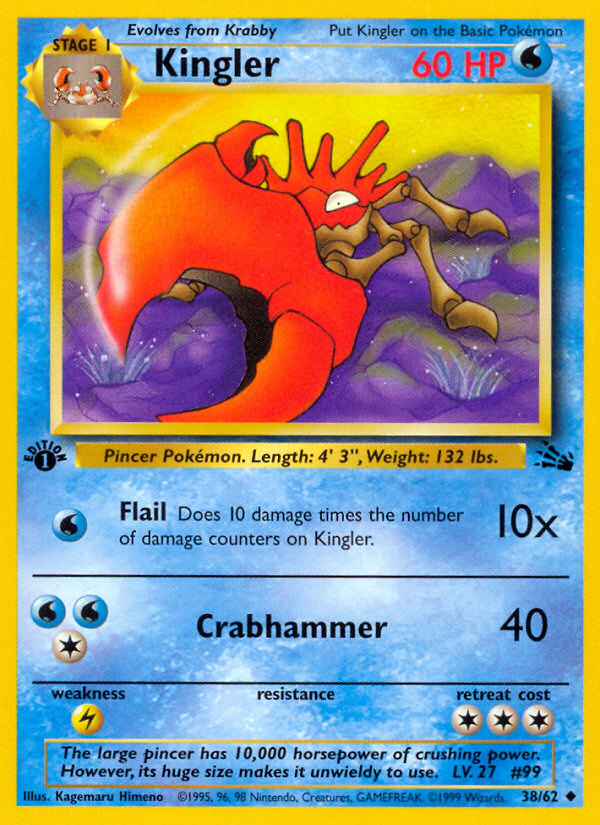
Image courtesy of TCGdex.net
How Kingler's damage stacking shapes the tide of battle
From the misty shores of the Fossil era comes a humble Water-type that teaches us a playful but powerful lesson in how to read the board: Kingler. This Stage 1 evolution from Krabby is a compact package with two distinct attacks that interact with the battlefield in surprisingly dynamic ways. While it doesn’t boast flashy “abilities” in the modern sense, its signature trick—Flail—revolves around a very old-school mechanic: damage counters on the Kingler itself can amplify the damage it deals. In a game where risk and timing determine the winner, understanding how this stacking works is essential for both collectors and players ⚡🔥.
Kingler at a glance: data that matters
- Card name: Kingler
- Set: Fossil (Base 3)
- Rarity: Uncommon
- Stage: Stage 1 (evolves from Krabby)
- HP: 60
- Type: Water
- Attacks:
- Flail — Cost: Water. Damage: 10x the number of damage counters on Kingler.
- Crabhammer — Cost: Water, Water, Colorless. Damage: 40
- Weakness: Lightning ×2
- Illustrator: Kagemaru Himeno
- Card art note: Classic Fossil-era illustration with a bold, slightly stylized line that captures Kingler’s compact power. The artistry by Himeno remains a fond touchstone for many collectors who love this era’s design language 🎨.
The two attacks illuminate a core distinction between raw damage and scalable effect. Crabhammer is straightforward: a flat 40 damage, reliable for finishing targets when the coast is clear. Flail, by contrast, is a scaling tool that rewards you for building up Kingler’s own resilience on the battlefield. The more damage counters you’ve placed on Kingler, the higher the multiplier for Flail’s damage. It’s a classic example of “risk and reward” in the early TCG era: you must weather hits to unleash a bigger payoff on your next turn 🚀.
How stacking works in practice on this card
Damage counters are a global concept in the Pokémon TCG that track how much punishment a Pokémon has absorbed. On Kingler, those counters directly modify the potency of Flail. Here’s how it translates in real terms:
- 0 counters → Flail does 0 damage. No payoff for the risk yet.
- 1 counter → Flail does 10 damage.
- 2 counters → Flail does 20 damage.
- 3 counters → Flail does 30 damage.
- And so on—each additional counter adds 10 more damage to Flail's total.
These numbers matter because they create a simple but powerful strategic arc: you may deliberately keep Kingler under light hits to stay ready for a brutal, high-damage Flail when the right moment arrives. The natural counterplay emerges too—opponents will try to KO Kingler quickly or exploit its 60 HP to prevent the stacking from growing too large. The double weakness to Lightning amplifies the tension: a rapid Lightning-type assault can push Kingler toward a precarious threshold, inviting a risky but potentially rewarding Flail finisher on the following turn ⚡.
“In Fossil’s era, a well-timed Flail can swing a game, especially when Crabhammer leaves the defender on edge after a grueling chase.”
Of course, Kingler’s own vulnerability is part of the calculus. With a Lightning-type weakness, an aggressive opponent can pressure Kingler into early counters, but the trade-off is clear: if you can land a single successful Flail after a couple of rounds of trading blows, you could wipe out a sizable portion of the opponent’s lineup in one sensational swing. That balance between staying power and burst is the heart of how this card teaches stacking in miniature.
Strategic notes for players and builders
- Timing matters: Use Flail when you’ve stacked enough counters to threaten a knockout, but be wary of overcommitting Kingler to a bad trade. The math rewards patience, but you don’t want to miss the opportunity window.
- Crabhammer as a finisher: When the target is near defeat and you want to preserve Kingler for future turns, Crabhammer offers reliable, steady pressure that doesn’t hinge on the number of damage counters.
- Damage management: Since Counters accumulate from any source, plan your opponent’s potential responses. If you foresee a need to reset or reduce Kingler’s damage counters later, consult the deck’s broader strategy and available reset tools, especially those common to the Fossil era’s play patterns.
- Weakness awareness: While your opponent may lean Lightning-types to knock you out quickly, remember that the same weakness will be exploited by your own mixed-attacker strategies, turning a potential vulnerability into a pivotal moment for a decisive Flail.
Collector insights: value, art, and nostalgia
Kingler’s base Fossil print is a cherished piece for many collectors. Its Uncommon rarity, the first-edition stamp in early prints, and the signature artistry of Kagemaru Himeno make it a desirable fossil-era addition. The imagery conjures a bygone era of the TCG when simple, elegant lines defined the card’s aesthetic, and the idea of stacking damage counters became a memorable gameplay mechanic for new players learning the ropes. The combination of playability and nostalgia fuels these Kinglers in binder sets and casual games alike 💎🎴.
Market snapshot and pricing context
Pricing for this Kingler variant tends to sit in the low-to-mid range for unsupported, open-market copies, with subtle variances based on edition and condition. Community data shows a typical spread around modest prices for unlimited formats, while first-edition prints—if available—carry a premium among vintage collectors. As with many older, uncommon cards, condition and sleeve protection will heavily influence value. For modern players building budget-friendly decks, Kingler’s combination of a scalable attack and a solid second option in Crabhammer remains an attractive pick, especially for those who enjoy the strategic flavor of stacking mechanics in the Fossil era 🔎💬.
In the end, Kingler isn’t about overwhelming power; it’s about reading the tide and timing your attack. The interplay between Flail’s scaling and Crabhammer’s steady pressure invites players to think several turns ahead, weighing risk, reward, and the ever-present possibility of a dramatic swing on the next turn. For fans of the water tribe and the late-90s, early-2000s TCG era, it’s a charming reminder of how a single card can teach the art of stacking in a way that feels both simple and deeply satisfying 🎨🎮.
Want to bring this strategic classic into your collection? Explore more about the product linking to our recommended case, and keep exploring the countryside of strategies with Kingler’s dependable, wave-crashing toolkit.
Beige Circle Dot Abstract Pattern Tough Phone Case by Case-Mate
More from our network
- https://blog.rusty-articles.xyz/blog/post/building-modern-minecraft-homes-with-warped-fence-accents/
- https://blog.crypto-articles.xyz/blog/post/guzzlord-gx-in-top-tournament-decks-win-rate-analysis/
- https://crypto-acolytes.xyz/blog/post/nft-stats-sleaze-369-from-sleaze-collection/
- https://blog.digital-vault.xyz/blog/post/wall-of-blossoms-green-card-draw-archetypes-and-engines/
- https://blog.digital-vault.xyz/blog/post/creative-ways-to-use-wither-rose-in-animal-pen-designs/
Kingler
Set: Fossil | Card ID: base3-38
Card Overview
- Category: Pokemon
- HP: 60
- Type: Water
- Stage: Stage1
- Evolves From: Krabby
- Dex ID: 99
- Rarity: Uncommon
- Regulation Mark: —
- Retreat Cost:
- Legal (Standard): No
- Legal (Expanded): No
Description
Attacks
| Name | Cost | Damage |
|---|---|---|
| Flail | Water | 10x |
| Crabhammer | Water, Water, Colorless | 40 |
Pricing (Cardmarket)
- Average: €0.99
- Low: €0.02
- Trend: €0.98
- 7-Day Avg: €1.33
- 30-Day Avg: €1.07
Support Our Decentralized Network
Donate 💠More from our network
- https://blog.rusty-articles.xyz/blog/post/building-modern-minecraft-homes-with-warped-fence-accents/
- https://blog.crypto-articles.xyz/blog/post/guzzlord-gx-in-top-tournament-decks-win-rate-analysis/
- https://crypto-acolytes.xyz/blog/post/nft-stats-sleaze-369-from-sleaze-collection/
- https://blog.digital-vault.xyz/blog/post/wall-of-blossoms-green-card-draw-archetypes-and-engines/
- https://blog.digital-vault.xyz/blog/post/creative-ways-to-use-wither-rose-in-animal-pen-designs/