
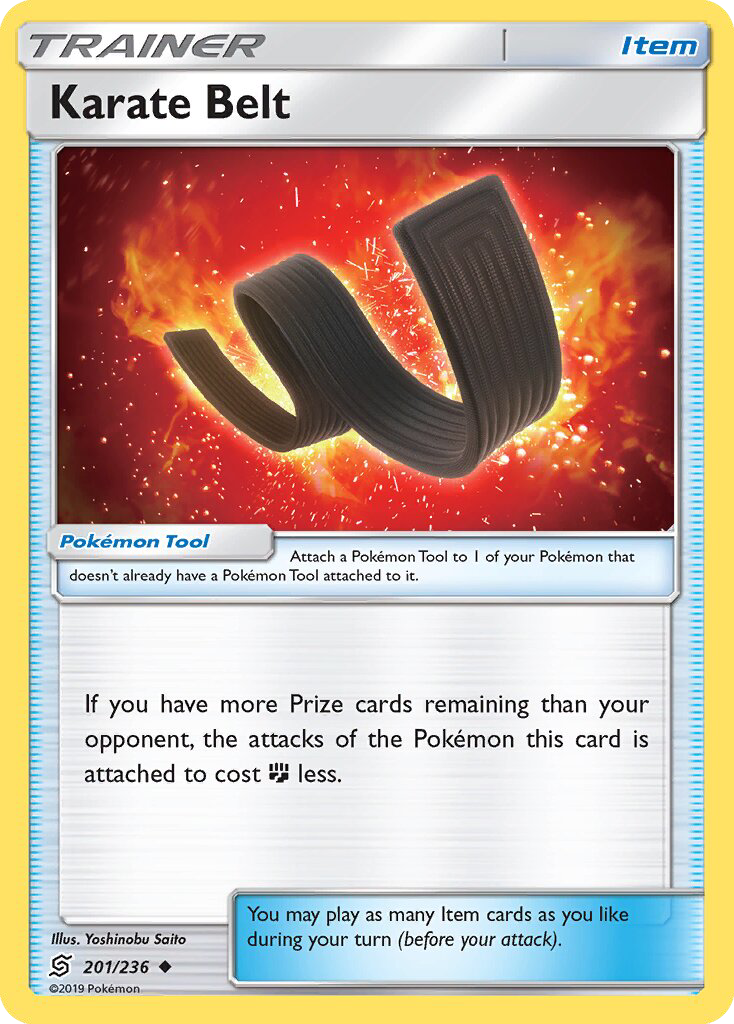
Image courtesy of TCGdex.net
Karate Belt and the Evolution Line: A Strategic Look
In the vast toolbox of the Pokémon TCG, small tools can shift the tempo of a match as decisively as big swings. Karate Belt, a Trainer Tool from the Unified Minds era (SM11), embodies that idea. Illustrated by Yoshinobu Saito, this uncommon card slips into the spotlight not by flashy stats, but by clever timing and evolving-line dynamics. Its presence reminds players that evolution isn’t just about the next stage—it's about when and how efficiently you can deploy attacks to seize the lead.
- Card Type: Trainer — Tool
- Set: Unified Minds (SM11) — 236 official cards (total 258)
- Rarity: Uncommon
- Illustrator: Yoshinobu Saito
- Legal in: Expanded format (not Standard)
- Effect: If you have more Prize cards remaining than your opponent, the attacks of the Pokémon this card is attached to cost Fighting less.
- Variants: Normal, Reverse, and Holos exist; First Edition not indicated for this print
What makes Karate Belt intriguing is not the raw power of the attached Pokémon, but the way its reduced Fighting-energy cost can unlock aggressive evolution lines earlier in the game. The card’s effect requires you to have the prize advantage, which adds a tactical layer: you’re rewarded for pressuring your opponent’s resources while you advance your own board. In practical terms, this means you might attach Karate Belt to a core attacker that belongs to a longer evolution ladder, enabling that ladder to hit harder, sooner—especially when the opponent’s board and prize situation shift in your favor ⚡.
“In a game where tempo wins, every energy saved on a key attacker compounds across turns.”
How this Tool influences your evolution plan
Evolution lines in the Pokémon TCG hinge on the timing of your plays: you want to drop a Stage 1 Pokémon when you’re set up to swing, then push into a Stage 2 while maintaining pressure on your opponent. Karate Belt specifically tackles the energy-cost friction for the attached Pokémon’s attacks. By reducing the Fighting portion of the attack costs by 1 energy (assuming you have more Prize cards than your opponent), a pivotal Pokémon in your line can threaten more powerful moves earlier than it otherwise could. This doesn’t change the rules for when you evolve—those are still governed by your hand and play sequence—but it does tilt the field toward earlier, more aggressive evolutions where the payoff comes in the form of superior attacks sooner in the game. The result is a more dynamic ladder: you can evolve from Basic to Stage 1, and then to Stage 2 with less energy debt to pay on the attack side, provided your Prize lead remains intact.
Consider a typical evolving line in Expanded play where a heavy Fighting-cost move becomes viable one turn earlier thanks to the belt’s discount. Karate Belt doesn’t automatically promote an evolution; it tilts the energy calculus so that an already-imminent evolution can translate into a stronger board state on the very next turn. That distinction—subtle, but meaningful—helps explain why a seemingly modest card can shape a lineup’s tempo across a game arc 🔥🎴.
Practical tips for strategy and collection
- Attach Karate Belt to your primary attacker who is part of an important evolution line. The sooner that attacker can unleash its cost-heavy moves, the more leverage you gain as you press your prize advantage.
- Leverage the prize lead to maximize value. Since the belt’s discount only applies when you have more Prize cards, smart play involves not just building a board, but also protecting your lead and forcing your opponent into tough decisions.
- In Expanded, you’ll find a richer ecosystem of Tools and energy manipulation options. Karate Belt can synergize with other Tools to create a layered approach: reduce costs, accelerate each stage, and threaten opponent’s boards with efficient momentum.
- Collectors value rarity and set context. As an Uncommon card from Unified Minds, Karate Belt sits in a space where players appreciate handy utility that complements evolving strategies, not just raw power. The art by Yoshinobu Saito adds to its appeal for display and collection.
- Pricing is usually accessible for players but varies by condition and holo status. Non-holo copies trend in the few-cent to sub-dollar range in markets like CardMarket and TCGPlayer, while holo versions can carry a modest premium depending on supply and demand.
Art, lore, and the trainer’s toolkit
Yoshinobu Saito’s illustration captures a martial, disciplined vibe that suits the card’s purpose: a subtle, strategic tool that steadies the flow of battles. The karate motif aligns with the TCG’s philosophy of clever resource use as much as raw battlefield power. In Unified Minds, Karate Belt is a quiet but effective member of the Trainer toolbox, and its presence in a deck often signals a plan—not just a plan to attack, but a plan to evolve with intention and timing 💎🎨.
Market snapshot and collector notes
As an Expanded-legal tool, Karate Belt remains a relevant pick for players and collectors building modern-era, non-Standard decks. CardMarket data shows a typical average around €0.15 for non-holo copies, with holo variants trending higher (avg around €0.53). On TCgPlayer, normal (non-holo) copies often sit in the $0.09–$0.25 range, with high-end copies approaching $1.50 in rare cases. These figures vary with condition, print runs, and market demand, but Karate Belt consistently offers a budget-friendly way to experiment with evolving lines in the Expanded format. For collectors, its Uncommon status and the Yoshinobu Saito artwork add appeal beyond straight gameplay value 🔮💡.
Whether you’re chasing a competitive edge or a nostalgia-driven display piece, Karate Belt represents the kind of thoughtful card that makes a deck feel deliberate rather than accidental. Its compact text, clear condition for play, and the strategic depth it unlocks around evolution lines make it a quiet star of the Expanded scene.
To explore more gear for your deck, check out the product linked below and consider pairing Karate Belt with other tools that support your preferred evolution strategy.
Neon Card Holder MagSafe Phone Case for iPhone 13 Galaxy S21 S22 1More from our network
- https://wiki.digital-vault.xyz/wiki/post/pokemon-tcg-stats-super-energy-removal-card-id-base4-108/
- https://crypto-acolytes.xyz/blog/post/webcam-hustlers-5-webcam-hustlers-nft-stats/
- https://blog.digital-vault.xyz/blog/post/clustering-eidolon-of-inspiration-with-mechanically-similar-mtg-cards/
- https://blog.crypto-articles.xyz/blog/post/master-stealth-tactics-in-rollercoaster-tycoon-classic/
- https://blog.crypto-articles.xyz/blog/post/nft-data-bmb-community-season-2-4053-from-bmb-community-airdrop-season-2-collection-on-magiceden/
Karate Belt
Set: Unified Minds | Card ID: sm11-201
Card Overview
- Category: Trainer
- HP:
- Type:
- Stage:
- Dex ID:
- Rarity: Uncommon
- Regulation Mark: —
- Retreat Cost:
- Legal (Standard): No
- Legal (Expanded): Yes
Description
Pricing (Cardmarket)
- Average: €0.15
- Low: €0.02
- Trend: €0.14
- 7-Day Avg: €0.17
- 30-Day Avg: €0.16
Support Our Decentralized Network
Donate 💠More from our network
- https://wiki.digital-vault.xyz/wiki/post/pokemon-tcg-stats-super-energy-removal-card-id-base4-108/
- https://crypto-acolytes.xyz/blog/post/webcam-hustlers-5-webcam-hustlers-nft-stats/
- https://blog.digital-vault.xyz/blog/post/clustering-eidolon-of-inspiration-with-mechanically-similar-mtg-cards/
- https://blog.crypto-articles.xyz/blog/post/master-stealth-tactics-in-rollercoaster-tycoon-classic/
- https://blog.crypto-articles.xyz/blog/post/nft-data-bmb-community-season-2-4053-from-bmb-community-airdrop-season-2-collection-on-magiceden/