
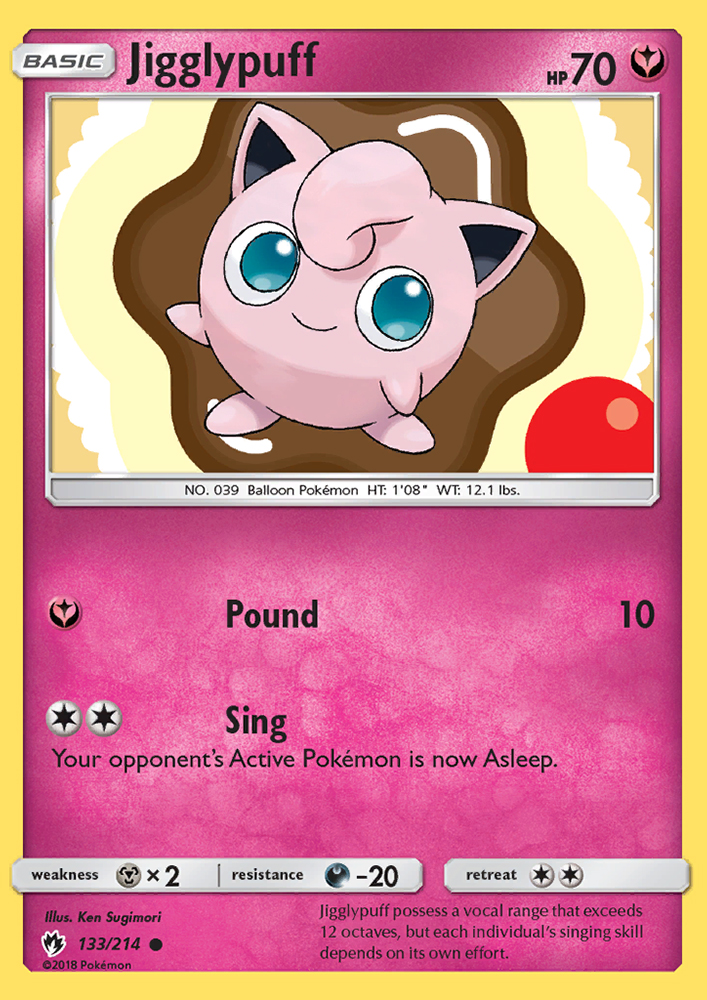
Image courtesy of TCGdex.net
Jigglypuff's role in prize-card trade strategies
In prize-driven decks, every card choice can tilt the balance between taking a crucial two-prize knockout and losing pace as your opponent accelerates toward their own goals. Jigglypuff from Lost Thunder, a humble Basic Fairy with 70 HP, offers a compact toolkit for prize-oriented play. Its ability to disrupt the opponent’s timing with Sing, combined with a low-cost, consistent attack in Pound, makes it a versatile piece for players building niche prize-trade engines. The card’s status as a Common print, illustrated by Ken Sugimori, also makes it a friendly entry point for budget-conscious traders looking to experiment with prize-focused concepts. The Lost Thunder set brings a gentle retro vibe to the prize strategy conversation. Jigglypuff’s Fairy typing aligns with a broader Fairy-era flavor of resilience and disruption, while its weaknesses and resistances prompt thoughtful matchups. The Metal weakness ×2 is a practical nudge to diversify your lineup—plan guard rails around metal-heavy matchups, and you’ll reduce the risk of losing tempo when your Sleep-lock plan needs to land. With Sing’s effect replacing the need for a direct damage rush, you’re incentivized to think in terms of “delayed prize loss” rather than "hard hitting every turn." That delicate tempo is exactly what prize-trade strategies crave: forcing your opponent to confront a clock while you assemble your longer-term plan. Card snapshots like Jigglypuff’s help players conceptualize the trade-off between immediate momentum and future prize gains. The Basic stage keeps setup simple, while its two attacks offer two levers to pull. Pound’s 10 damage on a Fairy-energy cost gives you a reliable early option if you need to threaten a prize while you prepare the battlefield. Sing’s Sleep effect—your opponent’s Active Pokémon is now Asleep—provides a fill-in disruption that can buy you precious turns to evolve a stronger attacker or to attach crucial Energy, setting up a late-game swing when the prize count becomes decisive. Strategically, Jigglypuff shines as a “pressure-relief” tool rather than a powerhouse finisher. In a prize-centric plan, you often want to minimize the risk of giving up multiple prizes in a single misstep. Jigglypuff’s low HP means it’s usually not your main engine to mow through defenses, but as a keyboard-click disruptor it shines. Sleep effects can stall a key opponent attacker long enough for you to pivot to a more favorable prize chase, or to protect a developing bench of bigger threats. The combination of a cheap, dependable attack and a powerful disruption option makes Jigglypuff a prudent inclusion in a deck built around prize floor protection and late-game advantage. From a collecting and market perspective, the card’s Common rarity makes it an accessible centerpiece for prize-trade portfolios. CardMarket data shows a holo variant sitting around €0.45 on average, with non-holo slightly lower—illustrating the typical premium you see on holo foils, even for common cards. In the U.S. market, TCGPlayer reports a normal print range with an average around $0.31 and a broad spread that can spike toward $1.99 for example listings. For prize-trade practice, that affordability is a boon: you can assemble several copies to flex your lineup without breaking the bank, while still offering real disruption value in matches. And as a card illustrated by Ken Sugimori, it carries the classic Lost Thunder aesthetic that resonates with collectors who value iconic art and a nod to the franchise’s history. Incorporating Jigglypuff into a prize-centric build also invites a few practical considerations. Because Sing is a status-based effect, your odds of landing the sleep condition and turning the tide depend on the luck of the match-up and how your opponent structures their bench setup. Pair the Jigglypuff with other disruption-focused Pokémon or support cards that encourage bench management and prize denial, and you create a chain of pressure that isn’t solely reliant on raw damage output. You’ll find that Sleep-lock windows can be sweet spots for evolving a more threatening core—perhaps a bigger Fairy-type or a robust single-prize attacker—while your opponent contends with delayed aggression. For players who love the narrative of the game, Jigglypuff also resonates on a lore level. The character’s pop-star charm and renditions of Sing have long been a fan favorite, making the card a comforting reminder of simpler times in the TCG’s history. This mix of nostalgia and practical utility is exactly what makes a prize-strategy card compelling: it’s approachable for newer players while still offering tactical depth for veterans who enjoy planning multiple turns ahead. Key strategy takeaways: - Use Sing to buy time, especially when you’re setting up your longer-term plan. Sleep can grant you moments to attach energy, evolve, or move key threats to the bench with less risk. - Treat Pound as a secondary option when you need a quick prize threat without committing your higher-HP attackers too early. - Shield Jigglypuff from confrontation with metal-weak meta lines by curating your bench and energy distribution to protect your setup pieces. - Leverage its Common status to test prize trade ideas without over-investing in foil-heavy cards, then decide if you want to upgrade to holo variants for value in trades. Product spotlight and practical pricing note: the bottom-line reality is that Jigglypuff’s charm and utility pair nicely with a prize-trade ethos. If you’re building a budget-conscious prize deck, this card can be a strong foundational disruptor that scales into a broader plan. The Lost Thunder print, illustrated by Ken Sugimori, remains a favorite for players who value both aesthetics and function—especially in formats where prize-trade dynamics are central to your strategy. CTA Neon Gaming Mouse Pad 9x7 Neoprene Stitched EdgesMore from our network
- https://blog.zero-static.xyz/blog/post/chaos-dragon-community-contests-themed-decks-and-strategies/
- https://crypto-acolytes.xyz/blog/post/nft-stats-nft-855-from-solana-terminals-collection/
- https://crypto-acolytes.xyz/blog/post/nft-stats-nft-364-from-solana-terminals-collection/
- https://transparent-paper.shop/blog/post/stable-diffusion-xl-prompt-gothic-horror-liquid-chrome-dragon-scale-texture-neon-glow-surreal-desert-dark-fantasy/
- https://crypto-acolytes.xyz/blog/post/nft-stats-nuddies-580-from-nuddies-collection/
Jigglypuff
Set: Lost Thunder | Card ID: sm8-133
Card Overview
- Category: Pokemon
- HP: 70
- Type: Fairy
- Stage: Basic
- Dex ID: 39
- Rarity: Common
- Regulation Mark: —
- Retreat Cost: 2
- Legal (Standard): No
- Legal (Expanded): Yes
Description
Attacks
| Name | Cost | Damage |
|---|---|---|
| Pound | Fairy | 10 |
| Sing | Colorless, Colorless |
Pricing (Cardmarket)
- Average: €0.17
- Low: €0.02
- Trend: €0.18
- 7-Day Avg: €0.19
- 30-Day Avg: €0.17
Support Our Decentralized Network
Donate 💠More from our network
- https://blog.zero-static.xyz/blog/post/chaos-dragon-community-contests-themed-decks-and-strategies/
- https://crypto-acolytes.xyz/blog/post/nft-stats-nft-855-from-solana-terminals-collection/
- https://crypto-acolytes.xyz/blog/post/nft-stats-nft-364-from-solana-terminals-collection/
- https://transparent-paper.shop/blog/post/stable-diffusion-xl-prompt-gothic-horror-liquid-chrome-dragon-scale-texture-neon-glow-surreal-desert-dark-fantasy/
- https://crypto-acolytes.xyz/blog/post/nft-stats-nuddies-580-from-nuddies-collection/