
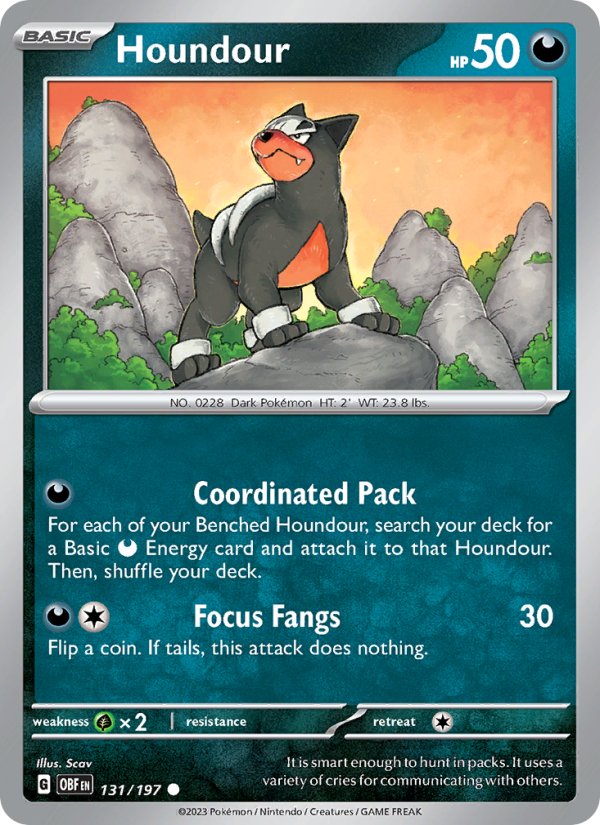
Image courtesy of TCGdex.net
Houndour in the Spotlight: How Influencers Review a Budget-Darkness Gem
In the fast-paced world of Pokémon TCG, influencers often turn to small, scrappy cards that punch above their weight in specific niches. The Houndour from the Obsidian Flames set—SV03-131—has sparked a lively conversation among content creators who love aggressive energy acceleration and budget-friendly picks. This Common basic Darkness Pokémon, illustrated by Scav, may seem modest at first glance with its 50 HP and a pair of straightforward attacks. Yet the way influencers frame its potential reveals a layered approach to building streaming-friendly, bench-rich strategies that often fly under the radar of bigger-set staples ⚡🔥.
What makes Coordinated Pack stand out in reviews
Among the two attacks on Houndour, Coordinated Pack is the star of the show in influencer circles. For each of your Benched Houndour, you search your deck for a Basic Darkness Energy and attach it to that Houndour, then shuffle. On paper, that sounds simple, but the real-world implications are compelling for budget decks and new players alike. Content creators love when a card enables a dynamic early-game engine without requiring multiple booster-pack pulls or rare staples. This is exactly the kind of mechanic that makes a streamer say, “That’s a clean way to ramp energy without overcommitting resources.” The attack acts like a compact, modular energy accelerator that scales with how many Houndour you can safely place on the bench in the first turns of the match. The mechanic also pairs neatly with other Darkness-type cards in Obsidian Flames, inviting viewers to imagine a compact, energy-dense strategy that stays accessible to players building around a budget-friendly core. 🎴
- The approach rewards bench management. Influencers highlight that careful placement of multiple Houndour can maximize energy attachment while keeping a single attacker ready for a robust late-game push.
- The tool aligns with “build a ladder of pressure” playstyles—you flood the board with Houndour, energize several of them, and threaten a rapid, energy-rich assault as you rotate attackers.
- Because Houndour is a Basic Pokémon, it slots into early-game boards without requiring evolving stages, making it a friend to newcomers who want visible action on camera from turn one.
Balancing risk with Focus Fangs
Every influencer who digs into Focus Fangs notes the coin flip mechanic that accompanies the second attack: Darkness and Colorless for 30 damage, with a coin flip deciding whether the attack lands. If tails, the attack does nothing. The verdict from creators: this is a classic “risk-reward” move that adds tension to gameplay streams and gives players a teachable moment about probability, resource budgeting, and risk tolerance. In practice, Focus Fangs works best in decks that can protect Houndour long enough to land a second or third aura of damage, or when combined with other Darkness‑themed tools that create additional value even if the coin flip misfires. The low damage output—30 for two energies—means influencers emphasize embedding Houndour within a broader plan rather than driving a standalone, one-card offense. Still, in a budget-friendly Obsidian Flames kirin, the attack is far from filler; it’s a live, risk-managed option that keeps the stake high on camera. 🔥
Why this card appeals to collectors and budget players
From a collector’s perspective, Houndour SV03-131 sits in a fascinating niche. It’s a common rarity in a set that boasts a sizable card count (officially 197, with total set cards at 230). Its non-holo variant is readily accessible, and it fits neatly into standard and expanded formats, as indicated by its Regulation Mark G. For collectors tracking price dynamics, CardMarket’s latest data paints a clear picture: an average around 0.04 EUR for non-holo, with lows near 0.02 EUR and a gentle upward drift summarized by a trend of about 0.03 EUR. For holo collectors, a significantly higher average sits around 0.24 EUR, but that’s the realm of rare and holo reprints, not the common SV03-131 in its base form. These numbers explain why influencers often highlight Houndour as a “get-it-now” budget pick that can scale into mid-game value when folded into a broader deck plan. The combination of rarity, accessibility, and synergy with a dark-energy engine makes it a frequent topic for budget build showcases on social feeds and blogs alike. 💎
Artwork, lore, and the Scav touch
Artwork and flavor are never far behind in influencer discourse, and Scav’s illustration for Houndour adds a moody, razor-sharp aesthetic that fans recognize across the Obsidian Flames subset. The dark, ember-lit vibe suits the Darkness-type identity—an evocative piece that resonates with collectors and casual players years after the first printing of Houndour. While the card’s mechanics drive the gameplay conversation, the art contributes to the card’s collectability and shelf appeal, a factor many influencers mention when they review a card’s “feel” on camera and in thumbnails. 🎨
Practical deck-building ideas inspired by influencer chatter
Putting ideas into practice, several creators suggest a lean, bench-heavy approach to maximize Coordinated Pack. A typical strategy centers on jamming multiple Houndour on the bench early, then using Coordinated Pack to attach Basic Darkness Energy to each of them. This approach primes your bench for a coordinated, rapid switch to heavier attackers without spending excessive resources on specialized energies or rare trainers. In parallel, Focus Fangs provides a controllable risk element—you can press your advantage when the coin flip smiles on you, but you’re prepared to lean on other Darkness tools if it doesn’t. The low HP of 50 means you’ll want to pair Houndour with faster comeback lines—think a couple of low-cost attackers or support cards that can buy time while you set up the energy engine. In short: play smart, keep your bench balanced, and let Coordinated Pack carry the tempo. For collectors who want to echo influencer deck-building in real play, consider using Obsidian Flames’ broader Darkness toolkit to extend Houndour’s reach without inflating cost. The set’s energy acceleration themes pair naturally with Houndour’s ability, making it a versatile launchpad for both streaming-friendly games and off-camera practice nights. ⚡🎮
Bottom line for influencers and players alike
Houndour exemplifies how a Common card can drive creative, budget-conscious strategies when framed by insightful influencer commentary. It offers a clear, repeatable mechanic for energy acceleration that scales with the board state, balanced by a risk-laden second attack. The card’s art, its place in Obsidian Flames, and its price profile create a compelling narrative for new players looking to break into competitive play without breaking the bank. When you see Houndour on a table in a streaming match, you’re not just watching a small, dark canine—you're witnessing a primer in deck-building economy, probability, and the joy of discovering a hidden potential in a familiar silhouette. 🔥💎
Slim Lexan Phone Case Glossy Ultra-thin for iPhone 16More from our network
- https://blog.digital-vault.xyz/blog/post/budget-sigiled-paladin-decks-white-aggro-strategies/
- https://crypto-acolytes.xyz/blog/post/red-color-confounds-distance-for-a-hot-star-in-ophiuchus/
- https://articles.zero-static.xyz/blog/post/why-new-players-should-try-pubg-battlegrounds-today/
- https://crypto-acolytes.xyz/blog/post/demonfella-ii-50-demonfella-ii-nft-stats/
- https://wiki.digital-vault.xyz/wiki/post/pokemon-tcg-stats-heracross-card-id-sv01-002/
Houndour
Set: Obsidian Flames | Card ID: sv03-131
Card Overview
- Category: Pokemon
- HP: 50
- Type: Darkness
- Stage: Basic
- Dex ID: 228
- Rarity: Common
- Regulation Mark: G
- Retreat Cost: 1
- Legal (Standard): Yes
- Legal (Expanded): Yes
Description
Attacks
| Name | Cost | Damage |
|---|---|---|
| Coordinated Pack | Darkness | |
| Focus Fangs | Darkness, Colorless | 30 |
Pricing (Cardmarket)
- Average: €0.04
- Low: €0.02
- Trend: €0.03
- 7-Day Avg: €0.03
- 30-Day Avg: €0.04
Support Our Decentralized Network
Donate 💠More from our network
- https://blog.digital-vault.xyz/blog/post/budget-sigiled-paladin-decks-white-aggro-strategies/
- https://crypto-acolytes.xyz/blog/post/red-color-confounds-distance-for-a-hot-star-in-ophiuchus/
- https://articles.zero-static.xyz/blog/post/why-new-players-should-try-pubg-battlegrounds-today/
- https://crypto-acolytes.xyz/blog/post/demonfella-ii-50-demonfella-ii-nft-stats/
- https://wiki.digital-vault.xyz/wiki/post/pokemon-tcg-stats-heracross-card-id-sv01-002/