
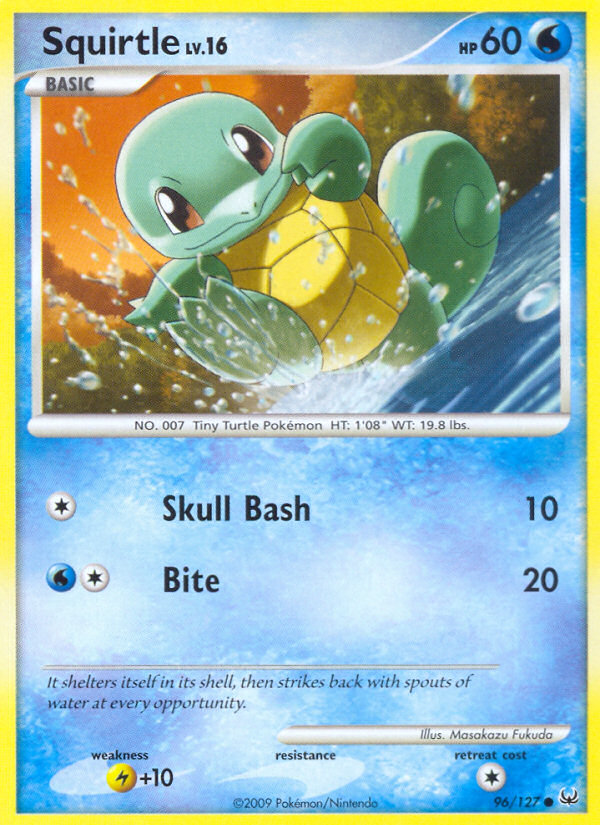
Image courtesy of TCGdex.net
Grading and Value: How Certification Shapes a Platinum Squirtle
For Pokémon TCG fans, grading isn’t just about a shiny label on a slab—it's a trusted signal that a card’s condition, centering, surface, and edge wear have been verified by a professional grader. When we look at Squirtle from the Platinum set (PL1), a common, basic Water-type with unassuming stats, grading takes on a nuanced role. The card’s enduring charm comes from its art by Masakazu Fukuda, its place in a beloved early-2000s era, and the way condition can influence how collectors perceive it. Since this particular Squirtle is non-holo and not first edition, the financial uplift from grading will be more measured, but it remains a meaningful factor for the right buyer at the right time. ⚡🔥
Why this Squirtle stands out in the grading conversation
- Rarity and role in gameplay: Common, Basic, HP 60, with Skull Bash for 10 damage and Bite for 20. Its simplicity makes it less flashy than holo or reverse-holo peers, but it remains a nostalgic gateway card for many players and collectors.
- Illustration and era: Masakazu Fukuda’s art is a touchstone of the Platinum line, evoking the era’s clean, approachable style. The art quality contributes to the desirability of a high-graded copy even among non-holos.
- Print variants: Normal and Reverse-Holo exist; while the non-holo version is common, the reverse-holo variant often carries more visual appeal and can fetch a higher premium when graded. This dynamic shapes how graders and buyers value a specific copy.
- Set context: Platinum’s PL1 catalog shows a wide card pool (official 127, total 133), which means supply of clean copies is robust. In grading markets, higher supply can temper prices, making condition a more crucial differentiator for buyers.
Current market context: what raw Squirtle teaches us about grading uplift
Looking at price snapshots helps ground expectations. In ungraded form, a normal Squirtle from this era sits near modest baseline values: TCGPlayer reports a market price around $2.42 for the normal (non-holo) copy, with a low of about $1.04 and a high around $9.09 depending on condition and listing. CardMarket data for similar commons highlights a different currency perspective with a €0.66 average for this class of card, illustrating how location and market platform affect perceived value. In short, the raw copy sits in the single- to low double-digit dollars in the most favorable conditions, but the exact figure sways widely with demand and visibility. The question graders ask is: does certification meaningfully lift that figure, and by how much? 🔎
Grading can confer a measurable premium, but the uplift for a common, non-holo card is typically moderate. Here’s what to expect in practical terms:
The raw Squirtle often hovers in the $1–3 range for most clean copies; the market price around $2.42 reflects this broad baseline. A high-grade copy—from PSA or CGC—can push the value into a higher neighborhood, but the ceiling is tempered by rarity. A PSA 9 or CGC 9 might land in the $4–6 bracket, while a rare PSA 10 could push toward the upper single digits or, in especially motivated markets, near ten dollars. The exact number depends on the grade’s appeal to buyers, centering, and the presence of any surface flaws that graders would duck for in a lower grade. The reverse-holo version tends to command a larger premium when graded, because its optical appeal is higher and collectors seek the combination of rarity and condition. A non-holo (normal) copy’s graded premium is steadier and often smaller. Grading costs—shipping, grading fees, and turnaround—can eat into small premiums. For a card in the $2–3 raw range, the economics favor grading only if you expect to achieve a clearly higher grade and a buyer pool that actively seeks graded hollow or reverse-holo aesthetics. If you expect to flip quickly, the math may not pencil out. 💡
Strategy: when to grade and when to hold steady
For a Squirtle in Platinum’s PL1, the decision to grade hinges on a few practical checks. First, assess centering and common surface concerns—many copies of these older, non-holo cards exhibit minor whitening along the edges or faint printing flaws. If your copy exhibits exceptional centering and minimal wear, a grade 9 is a safer target; a pristine example with rare mint-like attributes might even push toward a 9.5 on some grading scales, though 10s remain rarer for non-holo commons. The reverse-holo variant, if available, is a stronger candidate for grading due to natural visual appeal and demand. Second, evaluate your long-term collecting goals. If you’re building a broader Platinum-era collection, grading can anchor your display and sale notes; if you’re flipping for quick profit, you’ll want to compare grading costs against the expected uplift and the luck of the grade with ASA (autographed selling psychology) in mind. 🎴
From a gameplay and nostalgia viewpoint, Squirtle’s straightforward toolkit—two modest attacks and a low HP—works as a gentle reminder of the franchise’s early design philosophy. The card’s value in the market is not only about raw power on the arena table but about the shared memory of playing during those formative days. Masakazu Fukuda’s art makes the card visually engaging, and grading helps preserve that charm in pristine condition for collectors who appreciate a well-kept piece of the Platinum era. For many fans, this is less a sprint for price and more a stroll down memory lane with a collectible that’s easy to showcase in a well-curated binder or display. 💎
Bottom line for collectors and traders
Grading is a powerful tool, but its impact is card- and context-dependent. For a common, basic Squirtle from Platinum PL1, expect a moderate uplift when moving from raw to graded, with the strongest returns tied to the reverse-holo variant and to copies that pass strict centering and surface checks. The card’s price reality—around a couple of dollars in many markets—means the decision to grade should be weighed against grading costs and the probability of achieving a top-tier grade. In the end, grading for this Squirtle is less about dominating the market and more about preserving a beloved piece of the TCG puzzle—an affordable beacon to remind us of where the journey began. ⚡🎨
Neon Gaming Mouse Pad Rectangular 1/16in Thick Non-SlipMore from our network
- https://blog.crypto-articles.xyz/blog/post/nft-data-no-function-token-564-from-no-function-token-collection-on-magiceden/
- https://wiki.digital-vault.xyz/wiki/post/pokemon-tcg-stats-aggron-card-id-sm4-67/
- https://articles.zero-static.xyz/blog/post/prismarine-bricks-lighting-techniques-for-120-builds/
- https://crypto-acolytes.xyz/blog/post/blue-white-giant-reveals-thick-disk-clues-in-the-milky-way/
- https://wiki.digital-vault.xyz/wiki/post/pokemon-tcg-stats-vespiquen-card-id-dp7-31/
Squirtle
Set: Platinum | Card ID: pl1-96
Card Overview
- Category: Pokemon
- HP: 60
- Type: Water
- Stage: Basic
- Dex ID: 7
- Rarity: Common
- Regulation Mark: —
- Retreat Cost: 1
- Legal (Standard): No
- Legal (Expanded): No
Description
Attacks
| Name | Cost | Damage |
|---|---|---|
| Skull Bash | Colorless | 10 |
| Bite | Water, Colorless | 20 |
Pricing (Cardmarket)
- Average: €0.66
- Low: €0.02
- Trend: €0.78
- 7-Day Avg: €0.68
- 30-Day Avg: €0.64
Support Our Decentralized Network
Donate 💠More from our network
- https://blog.crypto-articles.xyz/blog/post/nft-data-no-function-token-564-from-no-function-token-collection-on-magiceden/
- https://wiki.digital-vault.xyz/wiki/post/pokemon-tcg-stats-aggron-card-id-sm4-67/
- https://articles.zero-static.xyz/blog/post/prismarine-bricks-lighting-techniques-for-120-builds/
- https://crypto-acolytes.xyz/blog/post/blue-white-giant-reveals-thick-disk-clues-in-the-milky-way/
- https://wiki.digital-vault.xyz/wiki/post/pokemon-tcg-stats-vespiquen-card-id-dp7-31/