
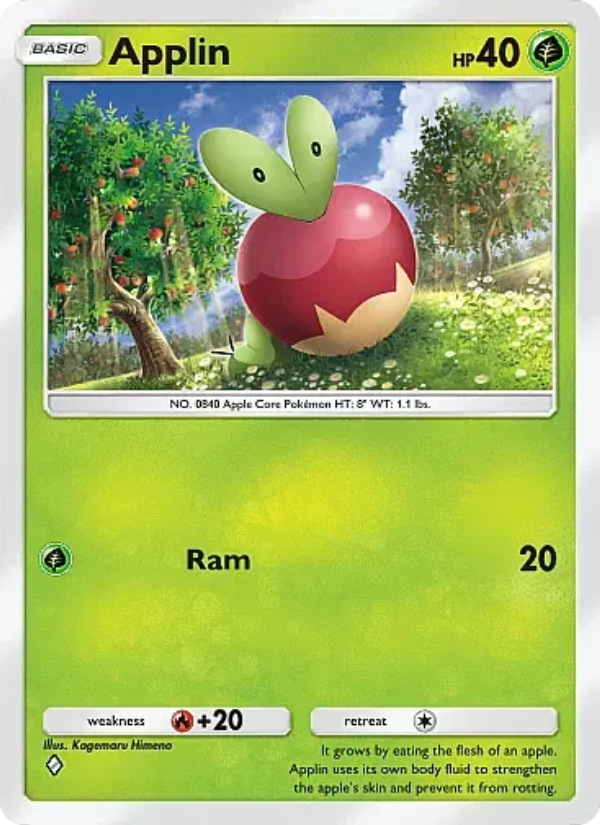
Image courtesy of TCGdex.net
How Grading Impacts Applin’s Card Value in the TCG Market
For Pokémon TCG enthusiasts, the value of a card isn’t just about how powerful it is in a game. It’s also about the story a card tells when it sits in a binder or in a protective slab. Grading is a powerful storytelling tool: it communicates condition, rarity, and desirability to the market. For a charming little Grass-type like Applin from the Eevee Grove subset, grading can be the difference between a neat collectible and a prized centerpiece in a showcase. ⚡🔥
Meet the card: Applin from Eevee Grove
Applin (A3b-006) is a Basic Grass Pokémon card featuring 40 HP and a single, straightforward attack: Ram for 20 damage. Its flavor text evokes a whimsical, almost mythic tale—“It grows by eating the flesh of an apple. Applin uses its own body fluid to strengthen the apple’s skin and prevent it from rotting.” This blend of cute design and a touch of lore is part of why collectors chase holo prints from the Eevee Grove set. Kagemaru Himeno provides the artwork for the holo variant, and the card’s rarity is labeled as One Diamond, a designation that has become a talking point among players and collectors alike. The card exists in multiple variants within the Eevee Grove line: normal, reverse, and holo, all standard-sized for modern boosters, with the holo version being the most coveted by graders and display enthusiasts. The set itself, identified as A3b, contains a total of 107 cards, with 69 cards officially cataloged in the official count, a balance that makes holo Applin a standout in a relatively tight market.
From a gameplay standpoint, Applin’s stats are modest: 40 HP, a single Grass-type attack for 20 damage, a Fire weakness (+20), and a retreat cost of 1. That modest profile doesn’t scream “meta staple,” but it does scream “display-worthy” for fans who collect the Eevee Grove line or who adore the art by Himeno. In grading discussions, the visual presentation—foil sheen, surface texture, and foil pattern consistency—becomes almost as important as the card’s mechanical value in the game. 💎
What grading adds to value for this card
- Holo premium: The holo variant from Eevee Grove typically commands a higher premium than its normal or reverse-print counterparts, due to the dynamic foil pattern and the desire to collect complete holo runs of popular sets. For Applin, this holo presentation helps it stand out on a graded page, especially when the surface shows a crisp holo finish without waviness.
- Centering, edges, corners, and surface: Grading services scrutinize every factor. A perfectly centered card with sharp corners, clean edges, and a smooth surface will earn a higher grade. Since Applin’s artwork includes a nuanced foil surface, surface quality—such as faint scratches or fingerprint-induced gloss loss—can heavily influence the final grade.
- Print quality and misprints: While not specific to all sets, Applin’s Eevee Grove print run can carry subtle print-label quirks. A high-grade card that is free of misprints and with faithful color saturation will be valued more by collectors who want a pristine example of this rarity.
- Rarity and edition status: The “One Diamond” label, combined with holo status and the Eevee Grove branding, adds to the desirability of a high-grade copy. Collectors often reward limited- or special-print variants with a premium when they are in gem condition.
- Population awareness: Graded population data—how many copies achieve near-perfect grades—drives demand. For a card with holo appeal and a well-regarded illustrator like Himeno, a PSA 9–10 or CGC 9.5–10 can move significantly in price for the right buyer.
Beyond raw numbers, grading transforms Applin from a pleasant booster pull into a tangible asset. It’s a story in plastic: a holo print, touched by a renowned artist’s hand, slabbed and verified for condition, ready to be displayed or traded with confidence. And for fans who love the Eevee Grove era, the combination of card art, rarity, and the gentle green hue of the Grass type can feel almost nostalgic—like a page from a beloved guidebook on pocket-monster lore. 🎨🎴
Market dynamics: how condition shifts perceived value
In the Pokémon TCG market, grading tends to disproportionately reward visually striking cards. Applin’s holo print from Eevee Grove sits in a tier where condition dictates the premium. A high-grade holo can surpass non-holo copies in price, while a mid-grade copy may align closely with non-holo or even bulk-equivalent values, depending on the seller and market window. Since this card features a modest HP, it isn’t typically favored for top-tier play in modern formats, which nudges a lot of its value toward collectors. When you couple that with a beloved artist’s depiction and the Eevee Grove theme, grading becomes a reliable signal of care and pedigree. ⚡
Practical tips for grading Applin
- Protect early: Place the holo Applin in a soft sleeve, then a top loader, and finally a rigid case when not in use. Avoid direct sunlight and humidity to minimize surface changes over time. 🔒
- Choose the right service level: If you’re aiming for PSA 9/10 or CGC 9.5/10, factor in turn-around time and the service’s population history for Eevee Grove holo cards. Higher grades typically require meticulous handling and resend considerations. 🕒
- Documentation: Keep purchase receipts and any relevant provenance, especially if you’re building a graded set or aiming to prove the card’s condition through its lifecycle. 📜
- Presentation: A clean, well-lit display slab not only preserves value but also helps you showcase the card’s artistry when you photograph your collection for sale or trade. 📷
Collectors should also keep an eye on broader market trends. Online marketplaces, auction results, and grader population reports can shift quickly, especially for holo prints of popular sets. The Eevee Grove subset continues to attract attention for its charming artwork and cohesive theme, making Applin a card that benefits from both nostalgia and careful handling. 🎮💎
Putting it all together: a buying, grading, and display mindset
When you’re weighing whether to grade Applin, consider not just the potential financial upside but also your objectives as a collector. If you’re building a complete Eevee Grove holo set, a high-grade Applin becomes a keystone piece. If you’re a player-first collector, you might prioritize condition within your budget but still value the holo presentation as a display piece. The intersection of art, rarity, and gameplay history makes Applin a delightful case study in how grading can elevate a card’s worth in the modern market. 💡
To explore this blend of strategy and collecting further, check out the product that inspired this discussion and consider pairing it with protected display options as you curate your own Eevee Grove collection.
MagSafe Card Holder – Polycarbonate Phone Case (Glossy or Matte)More from our network
- https://wiki.digital-vault.xyz/wiki/post/pokemon-tcg-stats-sylveon-card-id-sv065-022/
- https://crypto-acolytes.xyz/blog/post/skeleton-363-skeletons-nft-stats/
- https://articles.digital-vault.xyz/blog/post/incisor-steed-case-study-predictive-analytics-in-set-design/
- https://blog.crypto-articles.xyz/blog/post/efficiently-mining-polished-diorite-slab-in-java-edition/
- https://crypto-acolytes.xyz/blog/post/nft-stats-pix-apes-nft-collection-4657-from-pixel-ape-of-the-hill-collection/
Applin
Set: Eevee Grove | Card ID: A3b-006
Card Overview
- Category: Pokemon
- HP: 40
- Type: Grass
- Stage: Basic
- Dex ID:
- Rarity: One Diamond
- Regulation Mark: —
- Retreat Cost: 1
- Legal (Standard): No
- Legal (Expanded): No
Description
It grows by eating the flesh of an apple. Applin uses its own body fluid to strengthen the apple's skin and prevent it from rotting.
Attacks
| Name | Cost | Damage |
|---|---|---|
| Ram | Grass | 20 |
Support Our Decentralized Network
Donate 💠More from our network
- https://wiki.digital-vault.xyz/wiki/post/pokemon-tcg-stats-sylveon-card-id-sv065-022/
- https://crypto-acolytes.xyz/blog/post/skeleton-363-skeletons-nft-stats/
- https://articles.digital-vault.xyz/blog/post/incisor-steed-case-study-predictive-analytics-in-set-design/
- https://blog.crypto-articles.xyz/blog/post/efficiently-mining-polished-diorite-slab-in-java-edition/
- https://crypto-acolytes.xyz/blog/post/nft-stats-pix-apes-nft-collection-4657-from-pixel-ape-of-the-hill-collection/