
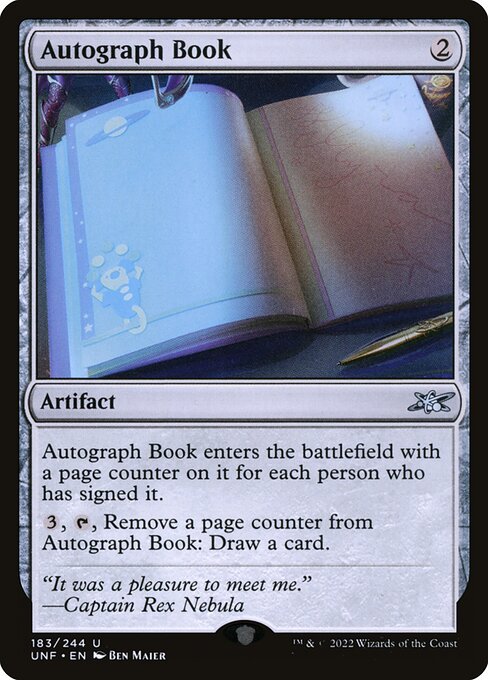
Image courtesy of Scryfall.com
The role of grading companies in card valuation
In the Magic: The Gathering community, few topics spark as much debate as grading. Fans love the idea that a pristine slab could capture a card’s journey from mint-condition reality to enduring legend. Yet grading isn’t just about shine and centering; it’s a conversation between physical condition, rarity, and the story a card carries. Case in point: Autograph Book, an artifact from Unfinity, a set celebrated for its goofy charm and quirky design. This two-mana artifact doesn’t just sit on a shelf; it tells a dynamic story about signatures, page counters, and the way we value memorabilia in a world where mystery and nostalgia matter as much as mana curves. 🧙♂️🔥💎
Autograph Book is an artifact with a very specific mechanic: it enters the battlefield with a page counter on it for each person who has signed it. The card’s text—“{3}, {T}, Remove a page counter from this artifact: Draw a card.”—turns a social artifact into a subtle engine. The more signatures, the more pages exist to be drawn through, yet you always have to pay the cost of three mana and a tap to turn a page into a draw. The collectible value here isn’t just about the card’s utility in a game; it’s about provenance, the social moment, and the art of autographs intersecting with gameplay. And that intersection matters to graders too. 🧩
“It was a pleasure to meet me.” —Captain Rex Nebula
When grading firms look at a card like Autograph Book, they’re not just evaluating edges and centering. They’re also considering the autograph narrative—whether the signer’s identity is verified, whether the signature adds character or risks altering surface integrity, and how the inscription contributes to a card’s overall history. Autograph Book’s Unfinity printing is uncommon and features a playful flavor text and Ben Maier’s distinctive illustration style that appeals to collectors who chase both humor and rarity. The grading decision’s nuance grows here: a pristine Autograph Book in near-mint condition with unsigned counters looks different from a version that bears authenticated signatures or signs of use, even if both play as artifacts on the table. ⚡
Grading firms typically separate the physical condition from the card’s content. For a card like Autograph Book, condition factors—corners, surface sheen, potential scratches on the holo or art area, and any wear around the page counters—play a major role in the numerical grade. If a card is foil or has a special print variant, those factors can also swing the price. But the “page counters” mechanic invites a conceptual twist: if a card has seen actual play or has autograph signatures, graders may weigh the story behind each mark differently. In short, a well-preserved artifact with a clean surface and a well-documented provenance could fetch a premium, even if its numerical grade isn’t at the top of the range. 🧙♂️🎨
From a market perspective, grading brings liquidity. Collectors who want a reliable, verified slab often prefer graded Autograph Book copies because they want assurance that what they bought is real and unaltered. The presence—or absence—of authentic autographs can swing a card’s perceived value, even though the base mechanics of the card remain the same. If you’re chasing value, it’s worth noting that Unfinity cards, including Autograph Book, sit in a playful niche: not standard-legal, sometimes non-foil, and frequently printed as part of a set that’s about whimsy as much as power. Yet in the grading market, whimsy can translate into premium when a card exemplifies condition, rarity, and a clear story. 🔎💎
Consider the broader ecosystem of card valuation. Grading is a language that communicates “this card has been preserved and authenticated.” The Autograph Book, with its page-counter mechanic, communicates community—people signed it, and those signatures become a kind of social currency. For graders, authenticity checks might involve validating signatures if a card is signed in a way that would be catalogued by the grader’s authentication network. Attaining a high grade on a signed or storied piece often requires meticulous documentation, careful storage, and sometimes even independent authentication from the autograph community. All of this folds into the final valuation, which blends science with storytelling—exactly the blend that MTG fans crave. ⚔️🧙♂️
As collectors, we know a card’s value is rarely linear. A well-loved Autograph Book might tell a more meaningful tale to a player who remembers drafting with friends or trading at a convention than a pristine, unlived copy sitting in a glass cabinet. Grading firms recognize that dual identity, and the market often reflects this balance: a card with a history—signatures, sleeves, usage—can carry a premium when authenticated, while a pristine, untouched example can fetch its own quiet, steady admiration. The key is transparency: certify what you can, store properly, and understand that the value resides not just in the grade number, but in the story it carries across sleeves and slabs. 🧲
For those exploring the cross-section between art, humor, and gameplay, Autograph Book is a case study in how grading informs price, collector appetite, and community memory. The Unfinity set’s playful design invites a broader conversation: how do we balance the whimsy of a card with the seriousness of a market that seeks stability? The grading process doesn’t erase the card’s personality; it tends to codify it, giving collectors a shared language to discuss condition, provenance, and potential upside. When you pair that with the social texture of autographs and page counters, the valuation conversation becomes not just about a number, but about a memory you can hold in a plastic case. 🧙♂️🎲
Product spotlight
While you’re exploring grading and provenance, you might also enjoy upgrading how you display and protect your collection. Consider upgrading your carry and display with a neon card holder that pairs nicely with the playful energy of Unfinity. It’s a practical companion for casual play or a dedicated display—a small, vibrant upgrade that keeps your prized pieces accessible and safe, while still echoing that sense of wonder every time you draw a card. 🔥
Neon Card Holder Phone Case MagSafe CompatibleMore from our network
- https://blog.crypto-articles.xyz/blog/post/nft-data-angel-1784-from-angels-collection-on-magiceden/
- https://crypto-acolytes.xyz/blog/post/nft-stats-topu-inc-3849-from-topu-inc-collection/
- https://articles.zero-static.xyz/blog/post/red-dead-redemption-2-complete-review-of-story-and-world/
- https://wiki.digital-vault.xyz/wiki/post/pokemon-tcg-stats-arbok-card-id-tk-xy-n-3/
- https://blog.zero-static.xyz/blog/post/bramblewood-paragon-valuation-through-grading-firms-in-mtg/
Autograph Book
This artifact enters with a page counter on it for each person who has signed it.
{3}, {T}, Remove a page counter from this artifact: Draw a card.
ID: b3e53c1d-56cf-4d3f-8150-df307c5a3ae4
Oracle ID: b99af29a-2b1c-4682-bbbd-4fd7452b8f82
Multiverse IDs: 580817
TCGPlayer ID: 287945
Cardmarket ID: 677309
Colors:
Color Identity:
Keywords:
Rarity: Uncommon
Released: 2022-10-07
Artist: Ben Maier
Frame: 2015
Border: black
EDHRec Rank: 29523
Set: Unfinity (unf)
Collector #: 183
Legalities
- Standard — not_legal
- Future — not_legal
- Historic — not_legal
- Timeless — not_legal
- Gladiator — not_legal
- Pioneer — not_legal
- Modern — not_legal
- Legacy — not_legal
- Pauper — not_legal
- Vintage — not_legal
- Penny — not_legal
- Commander — not_legal
- Oathbreaker — not_legal
- Standardbrawl — not_legal
- Brawl — not_legal
- Alchemy — not_legal
- Paupercommander — not_legal
- Duel — not_legal
- Oldschool — not_legal
- Premodern — not_legal
- Predh — not_legal
Prices
- USD: 0.12
- USD_FOIL: 0.11
- EUR: 0.16
- EUR_FOIL: 0.22
More from our network
- https://crypto-acolytes.xyz/blog/post/nft-stats-planet-kaiju-3905-from-planet-kaiju-collection/
- https://wiki.digital-vault.xyz/wiki/post/pokemon-tcg-stats-poliwrath-card-id-xy12-25/
- https://blog.zero-static.xyz/blog/post/how-scaretillers-design-inspires-creative-mtg-cosplay/
- https://blog.crypto-articles.xyz/blog/post/nft-data-vibe-26-from-just-vibe-collection-on-magiceden/
- https://blog.rusty-articles.xyz/blog/post/remnant-ii-symbolism-explored-for-meaning-and-mythos/