
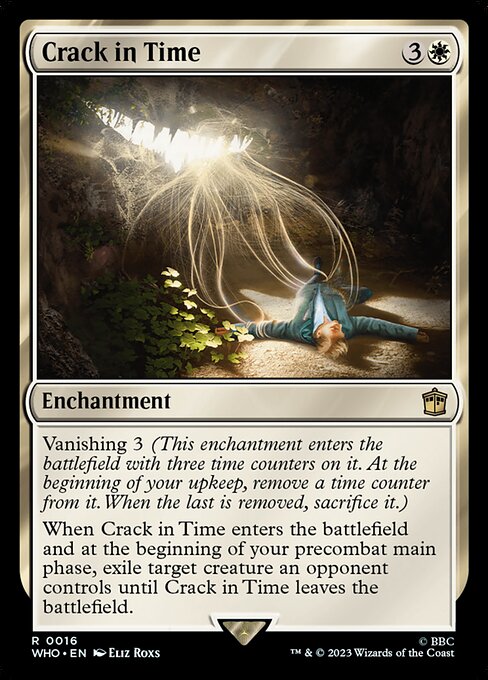
Image courtesy of Scryfall.com
The Quiet Power of Grading in MTG Card Valuation
For many players, grading is a behind-the-scenes drama—glossy slabs, subgrades, and the occasional online debate about what really constitutes a “mint” condition. But in the modern MTG market, grading companies quietly steer a lot of the value narrative. They don’t alter the rules of the game, but they change the math behind what a card is worth to collectors and investors 🧙♂️🔥. Take a closer look at a standout from a crossover set, Crack in Time, a white enchantment from the Doctor Who Commander line, and you’ll see how grading can tilt perception as much as it tilts a board state ⚔️💎.
Crack in Time at a glance
This card is a rare enchantment from the Who set, with a cost of {3}{W} and the classic Vanishing mechanic. It enters the battlefield with three time counters, and at the beginning of your upkeep you remove one. When the last counter leaves, you sacrifice it. On entry—and again at your first main phase—the card exiles a target creature an opponent controls until Crack in Time leaves the battlefield. It’s a neat tempo tool in a white-heavy strategy, offering removal tempo while advancing a time-themed narrative that riffs on the Doctor Who mythos 🕰️🎨.
Judged purely as a card, its power lies in the symmetry of tempo disruption and reusability. For Commander players, the exile-on-entry can disrupt opposing lines long enough to set up a favorable swing, while the Vanishing counters create a soft “time lock” on threats. The artistry, too, is part of the package: Eliz Roxs’ illustration and the set’s Doctor Who branding give it a memorable, story-rich aura. That blend of gameplay and lore is precisely what graders look for when they consider the collectibility and preservation worth of a single print ✨.
Why grading shifts the value narrative
Grading companies evaluate every facet of a card: centering, edges, corners, surface, and even the presence of any print flaws that might be invisible to the naked eye. A higher grade means a “safer” asset in a slab, which appeals to collectors who want a stable, authenticated piece of their hobby. For modern, non-foil to foil variants like Crack in Time, the grade can create a liquidity premium: a perfectly preserved copy commands a premium over its near-mint peers because the grade is a third-party stamp of confidence. And yes, the slab itself has become a status symbol in the MTG community, just as a perfectly blue-tinted display case is for a rare silver coin 🧭💎.
“Grading isn’t magic—it's a verification layer. It tells you that what you’re buying is exactly what you think you’re getting, and it quantifies risk for collectors who want to store memories, not just cards.”
From a market perspective, the current card prices for Crack in Time reflect its Doctor Who novelty and its rarity in print. Scryfall notes a USD price of about 0.10 for non-foil copies and 0.25 for foil bets, with euro equivalents just above those figures. Those numbers aren’t the stuff of multimillion-dollar speculation, but they create a natural baseline. A high-grade PSA or CGC copy can still fetch a meaningful premium if it hits a top tier—particularly if it’s a foil and in pristine condition—but the ceiling isn’t as dramatic as you’d see for ultra-popular mythics or heavily stocked chase rares. Grading can therefore tilt a card’s appeal toward a more discerning subset of collectors who value long-term stability and showcaseability as much as raw play power 🧙♂️⚖️.
Putting Crack in Time in a deck and on a shelf
In gameplay, Crack in Time gives you a control angle—exiling an opposing creature early can buy you precious time to establish your board state. In the collector’s world, the card earns attention because of its unique Doctor Who linkage and its place in a modern Commander landscape. Grading affects not just who buys but how they store: a slabbed version becomes a display piece as much as a playable asset. The combination of white’s efficiency and the enchantment’s time-bending flavor makes it a compelling artifact in the eyes of fans who measure value in both utility and story—the kind of card that benefits from a careful, graded lens to preserve its beauty for years to come 🕰️🧩.
Market reality and the collector mindset
Grading can unlock a premium, but the margin depends on a card’s popularity, print runs, and the strength of its narrative pull. Crack in Time sits at an approachable price point today, making it a prime candidate for new collectors who want a graded piece without breaking the bank. The value proposition isn’t just about rarity; it’s about comfort—knowing you possess a card whose condition is certified and verifiable by a trusted third party. For modern sets with strong lore connections, this can translate into steady demand and a more durable market than purely played copies 🚀.
And if you’re juggling MTG collecting with real-world gear love, you might enjoy blending your hobby with tech-friendly gear. For instance, you can protect your everyday devices with a clear, durable phone case that echoes the precision and clarity graders seek in cards. Speaking of which, consider a sleek accessory like the Clear Silicone Phone Case Slim Durable Open Port Design from the shop, a practical companion for the journey between local game nights and online auctions. It’s a small detail that completes the collector lifestyle, just like a properly graded slab completes a collection 🧳📦.
Clear Silicone Phone Case Slim Durable Open Port DesignMore from our network
- https://wiki.digital-vault.xyz/wiki/post/pokemon-tcg-stats-dedenne-card-id-swsh9-tg07/
- https://blog.crypto-articles.xyz/blog/post/nft-data-opioid-698-from-opioids-collection-on-magiceden/
- https://wiki.digital-vault.xyz/wiki/post/pokemon-tcg-stats-regidrago-vstar-card-id-swsh12-136/
- https://blog.zero-static.xyz/blog/post/metroid-dread-world-building-analysis-of-lore-and-atmosphere/
- https://crypto-acolytes.xyz/blog/post/nft-stats-faerin-plumadorada-shattered-342-from-risen-collection/
Crack in Time
Vanishing 3 (This enchantment enters with three time counters on it. At the beginning of your upkeep, remove a time counter from it. When the last is removed, sacrifice it.)
When this enchantment enters and at the beginning of your first main phase, exile target creature an opponent controls until this enchantment leaves the battlefield.
ID: 559e77be-42a2-47cf-a2cf-057b37384cb4
Oracle ID: a3099143-0146-435f-8d29-cd364aefbc2b
Multiverse IDs: 634711
TCGPlayer ID: 519260
Cardmarket ID: 738500
Colors: W
Color Identity: W
Keywords: Vanishing
Rarity: Rare
Released: 2023-10-13
Artist: Eliz Roxs
Frame: 2015
Border: black
EDHRec Rank: 12001
Set: Doctor Who (who)
Collector #: 16
Legalities
- Standard — not_legal
- Future — not_legal
- Historic — not_legal
- Timeless — not_legal
- Gladiator — not_legal
- Pioneer — not_legal
- Modern — not_legal
- Legacy — legal
- Pauper — not_legal
- Vintage — legal
- Penny — not_legal
- Commander — legal
- Oathbreaker — legal
- Standardbrawl — not_legal
- Brawl — not_legal
- Alchemy — not_legal
- Paupercommander — not_legal
- Duel — legal
- Oldschool — not_legal
- Premodern — not_legal
- Predh — not_legal
Prices
- USD: 0.10
- USD_FOIL: 0.25
- EUR: 0.27
- EUR_FOIL: 0.32
More from our network
- https://blog.crypto-articles.xyz/blog/post/nft-data-poketardio-1263-from-poketardio-collection-on-magiceden/
- https://articles.zero-static.xyz/blog/post/guild-wars-2-100-hour-review-explores-endgame-and-lore/
- https://crypto-acolytes.xyz/blog/post/crowdfunded-horror-titles-indie-creators-redefining-fear/
- https://crypto-acolytes.xyz/blog/post/nft-stats-doodle-bonk-3-from-doodle-bonk-collection/
- https://blog.crypto-articles.xyz/blog/post/nft-data-astromilio-1830-from-astromilio-cosmic-cousins-collection-on-magiceden/