
Image courtesy of TCGdex.net
How Grading Affects Weedle's TCG Value and Market Worth
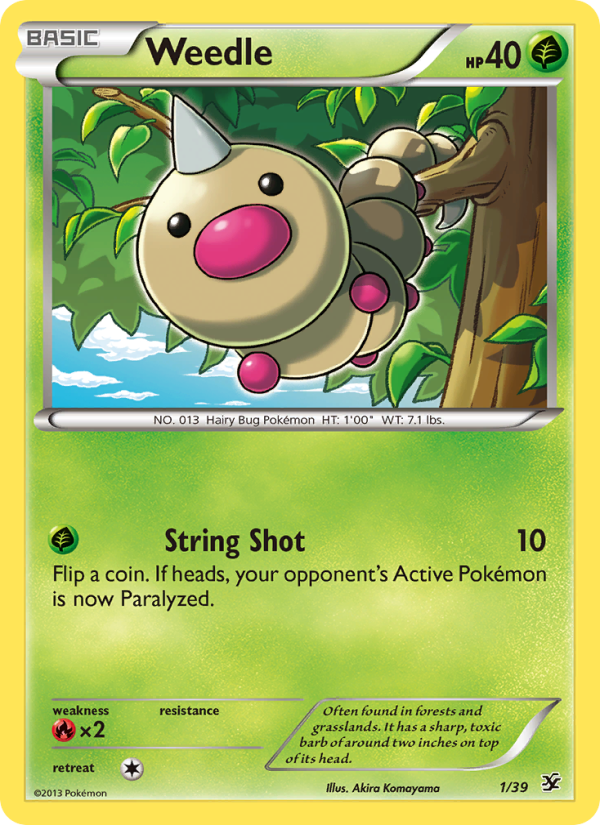
Grading Pokémon TCG cards is a conversation about preservation, scarcity, and the patience of collectors. For a humble Basic Weedle from the Kalos Starter Set (XY0-1), the question isn’t just “how good is the card on the table?” but “how good can it be perceived in a graded slab years from now?” The Weedle in this set is a Grass-type, with a modest 40 HP and a single attack—String Shot—that flips a coin to potentially paralyze the opponent’s Active Pokémon. It’s a charming little figure in a hobby that often prizes showy holographics and dramatic chase cards, yet grading can still meaningfully shift its value, especially for a holo variant and dedicated Kalos-era collectors.
First, a quick refresher on the card’s essentials. Weedle XY0-1 is a basic stage Grass-type Pokémon, illustrated by Akira Komayama. It appears in multiple variants within the Kalos Starter Set: normal, reverse, and holo foils, with the holo version generally casting the brightest light on a small creature that embodies nostalgia for early XY-era design. Its rarity is listed as None in this data snapshot, which hints at its role as a common, introductory piece in the set. In practice, this matters for grading because common cards tend to sell at modest prices unless there’s a compelling feature—such as a pristine holo surface, a perfectly centered print, or a rare misprint that becomes a coveted error card.
Pricing data from major markets provides a clear snapshot of how this Weedle is valued in the wild, short of a formal grade. CardMarket shows an average price around €0.49 with a low of €0.05 and a recent uptrend (trend around 0.74). Holo variants show a similar but slightly different dynamic, with a low holo price around €0.40 and a gentler holo trend (~0.3). On TCGPlayer, the non-holo Weedle sits in a low-to-mid pricing band (low about $0.48, mid around $0.70, high up to $2.41, market price near $1.36). In other words, even without a grade, this Weedle sits in the accessible range for casual collectors and new players alike, a sweet spot where grading can amplify some copies but won’t typically inflate the entire card line into a blockbuster spectacle. The data signals that a graded copy could be worth more, but the uplift is proportionate to the card’s baseline popularity and condition."
So, what does grading actually do for a Weedle? The answer sits at the intersection of condition, presentation, and market sentiment. Grading services such as PSA or BGS examine centering, corners, edges, and surface. For a holo Weedle, the surface—specifically the holo foil—becomes a critical factor. Any micro-scratches, indentation, or foil misalignment can shave value, even if the card looks flawless in the sleeve. Conversely, a holo Weedle with near-perfect centering, razor-sharp corners, clean edges, and a gleaming foil surface can command a premium—especially if the grade is high. For non-holo versions, the premium is often smaller, since the visual impact and scarcity are inherently lower. This is the heart of grading’s impact: it creates a standardized, verifiable claim on a card’s physical quality, which in turn reduces uncertainty for buyers and sellers alike.
What graders look for in this Weedle
- Centering on both the front and back. A Weedle with near-perfect centering is more likely to achieve a higher grade, which translates to greater desirability in the marketplace.
- Surface integrity for holo copies, including any scratches, scuffing, or foil blemishes. The holo surface is particularly unforgiving of flaws that aren’t immediately visible at first glance.
- Edges and corners—nicks, whitening, and edge wear can significantly impact the final grade, even on a card that otherwise looks minty fresh.
- Print quality and alignment within the Kalos Starter Set print run. Some copies display minor misprints, but those are a mixed bag—some collectors prize them as misprint charms, while others drop grades for standard perfection.
Why a graded copy can still pay off—and when it might not
For a card like Weedle XY0-1, the uplift from grading is often twofold: you gain confidence in authenticity, and you open the door to a broader pool of buyers (many collectors specifically seek graded completes or specific holo conditions). A PSA 9 or 10 holo copy can attract attention from players looking for pristine display pieces or from collectors aiming to complete a Kalos-era holo set. Yet the premium isn’t boundless. Because the baseline price for this Weedle already sits in a relatively modest range, the return on investment for high-grade slabs can be tempered by the cost of grading itself, plus shipping and authentication. In practical terms, a graded example might fetch a noticeable premium, but it’s unlikely to mirror the sky-high multiples seen on rare chase cards from later sets.
“Grading adds a layer of trust," notes a veteran TCG collector. "For entry-level cards, the value lift comes from a reliable, verified condition, not from hype alone. It’s about preserving a moment in the hobby’s history.”
Tips for buyers and sellers
: holo copies tend to hold slightly firmer value, particularly when graded, but non-holo copies aren’t immune to a quality-grade premium if they’re exceptionally clean. : given the modest current market for Weedle, waiting for a graded price spike might not pay off if the grading costs are high. Quick acquisitions of raw copies can be smart, followed by selective grading for the strongest candidates. : Weedle XY0-1 is marked as Expanded-legal but not Standard-legal in its data snapshot. This shapes where and how collectors trade it, often driving a more niche but dedicated audience in the expanded format market. : a clean sleeve, a solid support for display, and clear photos help significantly when selling a graded copy. Clarity matters as much as grade because buyers rely on those service reports to assess condition remotely.
For fans of the Kalos era and for those who love the quiet charm of early XY artwork, Weedle’s journey from a simple skeleton of grass and a single attack to a graded, admired piece is a reminder of how far the hobby has evolved—and how every card can tell a story through condition, provenance, and presentation. The artist Akira Komayama’s work on this Weedle, paired with the set’s nostalgic design language, makes it a collectible that resonates beyond its numeric grade. ⚡
Bottom line for grading Weedle XY0-1
If you own a holo Weedle XY0-1 in pristine shape, especially with solid centering and a clean holo surface, grading can unlock a respectable premium within the expanded-legal landscape. For non-holo copies, expect a more modest uplift, but don’t discount the value that a crisp, well-centered card can command in a dedicated Kalos collection. As with many TCG classics, the true worth lies in the story the card tells, the memories it evokes, and the joy it brings to the table—whether you’re battling across a kitchen table or curating a glass-fronted display shelf. 🎨🎴
Product spotlight: If you’re looking to level up your gaming setup while you chase condition-conscious collections, consider the Non-Slip Gaming Mouse Pad—smooth polyester front with a rubber back to keep your play area steady during long sessions. It’s a small luxury for nights spent polishing your collection and strategizing future trades.
Non-Slip Gaming Mouse PadMore from our network
- https://blog.zero-static.xyz/blog/post/shellos-price-trends-and-collector-value-in-pokemon-tcg/
- https://blog.crypto-articles.xyz/blog/post/nft-data-himalaya-644-from-himalaya-collection-on-magiceden/
- https://wiki.digital-vault.xyz/wiki/post/pokemon-tcg-stats-dracozolt-v-card-id-swsh7-178/
- https://blog.rusty-articles.xyz/blog/post/potted-cornflower-in-pvp-arenas-creative-tactics-and-decor/
- https://articles.zero-static.xyz/blog/post/low-cost-synergies-to-power-up-surtr-fiery-jotun/
Weedle
Set: Kalos Starter Set | Card ID: xy0-1
Card Overview
- Category: Pokemon
- HP: 40
- Type: Grass
- Stage: Basic
- Dex ID: 13
- Rarity: None
- Regulation Mark: —
- Retreat Cost: 1
- Legal (Standard): No
- Legal (Expanded): Yes
Description
Attacks
| Name | Cost | Damage |
|---|---|---|
| String Shot | Grass | 10 |
Pricing (Cardmarket)
- Average: €0.49
- Low: €0.05
- Trend: €0.74
- 7-Day Avg: €0.43
- 30-Day Avg: €0.69
Support Our Decentralized Network
Donate 💠More from our network
- https://blog.zero-static.xyz/blog/post/shellos-price-trends-and-collector-value-in-pokemon-tcg/
- https://blog.crypto-articles.xyz/blog/post/nft-data-himalaya-644-from-himalaya-collection-on-magiceden/
- https://wiki.digital-vault.xyz/wiki/post/pokemon-tcg-stats-dracozolt-v-card-id-swsh7-178/
- https://blog.rusty-articles.xyz/blog/post/potted-cornflower-in-pvp-arenas-creative-tactics-and-decor/
- https://articles.zero-static.xyz/blog/post/low-cost-synergies-to-power-up-surtr-fiery-jotun/