
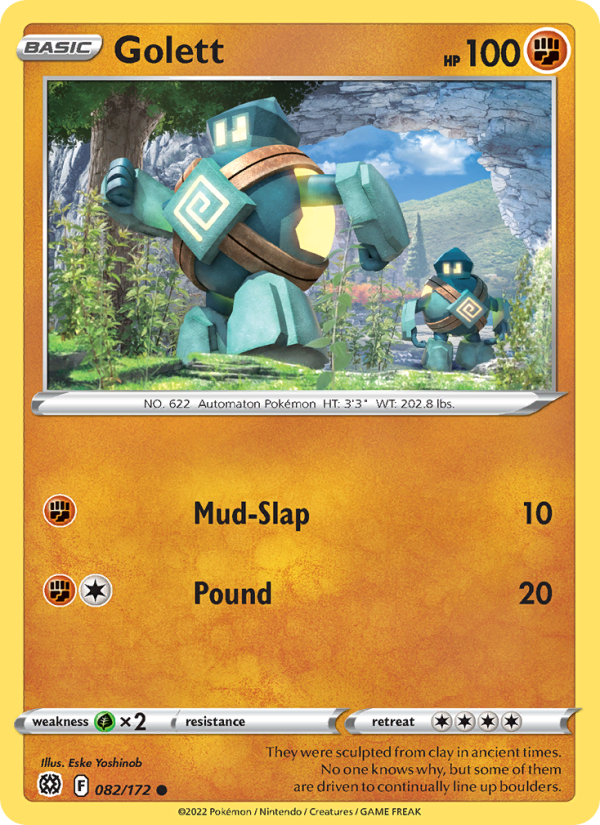
Image courtesy of TCGdex.net
Golett and the Reality of Ability Stacking in the Pokémon TCG
Pokémon TCG players love to chase the shimmer of a powerful combo, but sometimes the most instructive lessons come from the cards that keep things simple. Golett (Brilliant Stars, swsh9-082) is a perfect example: a basic Fighting-type Pokémon with 100 HP and two straightforward attacks, Mud-Slap and Pound. With rarity listed as Common, this little creature reminds us that stacking abilities isn’t just about flashy text on a single card — it’s about understanding how multiple sources of influence interact on the battlefield. For many players, Golett serves as a blank canvas for exploring how effects stack (or don’t) when you combine different Pokémon, Trainer cards, and Stadiums in your deck.
In the Pokémon TCG, the term “Ability” usually refers to special, ongoing effects that persist while the card is in play. Golett’s card text doesn’t feature an intrinsic Ability; its power comes from the two attacks it can unleash: Mud-Slap, a Fighting-type attack for 10 damage, and Pound, a Fighting/Colorless attack for 20 damage. Because there’s no built-in ability on this card, any stacking you achieve in a game will come from other cards you’ve chosen to accompany Golett — a crucial distinction that shapes how you deploy it in the early stages of a match. This makes Golett an excellent case study for when stacking matters most: not within a single card’s text, but in the multi-card ecosystem you assemble around it.
What “ability stacking” means in this context
- Multiple sources, multiple modifiers: In practice, ability stacking occurs when more than one card applies a modifier to the same parameter — such as damage, energy costs, or status conditions. If you have two effects that increase the damage of an attack, those modifiers can combine, typically in additive fashion, unless a card specifies that the effects override one another or that only the strongest effect applies.
- Order of operations matters: The Pokémon TCG uses a defined sequence for applying effects. Damage calculations begin with base damage, then apply damage modifiers from effects like Weakness/Resistance, then any additional effects from Trainer cards, Stadiums, or tools. With Golett as a raw base, you’ll be watching how each outside effect interacts as you build a strategy around it.
- Abilities vs. attack text: An intrinsic Ability on a Golett card would complicate stacking, because each Ability’s wording determines whether its effect stacks with others. Since this Golett print doesn’t list an Ability, the card itself doesn’t contribute a stacking engine — it relies on your broader deck composition to create any layered effects.
- Consistency and predictability: The beauty of a card without Abilities is predictability. You know Mud-Slap does 10 damage and Pound does 20, with no hidden modifiers baked into the card itself. When you add external modifiers, you can reason about stacking with greater confidence, which is especially valuable for players who value toolkit-style decks that rely on Trainers andstadiums.
For collectors and players, that predictability has strategic resonance. Golett’s Basic status means you can field it early, lay a groundwork on the bench, and then pivot to Golurk (its evolution) when you draw the right cards. The evolution line is a reminder that stacking potential can evolve over a match as you upgrade your board state. If Golurk brings its own Abilities or different attacks later in a build, you can begin to appreciate how one card’s text interacts with another’s across stages. Meanwhile, Golett’s simple toolkit keeps the door open for timing your damage output just right, which is the essence of efficient combat in the TCG.
Practical build thoughts: turning stacking into a game plan
Because Golett itself doesn’t supply an Ability, your stacking play comes from synergy with other components. Consider these conceptual avenues, always confirming with your current card pool and the allowed formats:
- Name the synergy: Pair Golett with Trainer cards that say “your Fighting Pokémon get +X damage,” or with Stadiums that boost Fighting-type attacks. If two sources both say “increase damage,” you’ll often see the effects stack toward bigger numbers on Mud-Slap and Pound. The key is to track how many external modifiers are applying and ensure there are no conflicting instructions from other sources on the field.
- Bench pressure and tempo: On turn one, you might start with Mud-Slap for 10 damage, while preparing your bench to evolve Golett into Golurk for increased threat. If Golurk brings a different suite of Abilities or attacks, you’ll have a new stacking dynamic to manage — a classic example of how a simple card evolves into a more complex strategic thread.
- Damage management: Stacking modifiers can tip the scales when finishing off an opponent’s Active Pokémon or when applying multi-turn pressure. With Golett’s modest base damage, careful use of supporting effects can turn a 10-20 damage spread into meaningful churn on the opponent’s HP pool — a useful reminder that sometimes stacking is about sustaining pressure rather than delivering one oversized hit.
From a collector’s perspective, the Golett card’s Common rarity in Brilliant Stars makes it a practical staple in many decks and a target for binder-friendly trades. Its 100 HP is respectable for a Basic Fighting-type in this set, and the card’s strict two-attack profile invites players to test how far a clean baseline can carry them, especially when you’re drafting a deck centered on speed and tempo rather than raw power. The card’s market presence — reflected in low typical price points for non-holo copies (often a few cents to a couple of dollars depending on condition and market) — makes it an accessible piece for players who want to experiment with stacking concepts without a steep investment. The economics of a Common card like Golett reinforce the idea that understanding how to optimize your deck’s interactions is often more valuable than chasing a rare foil.
As you plan your next Brilliant Stars tournament or casual Friday night, keep this in mind: if you want Golett to shine, you’ll want to surround it with support that can ethically and predictably amplify its damage profile. Its straightforward text acts as a canvas, letting you test how multiple, separate sources of effect interact across a match. The result isn’t just higher numbers; it’s a deeper understanding of game tempo, resource management, and the joy of seeing a well-timed combination emerge from the synergy of your entire deck. ⚡🔥💎
Eco Vegan PU Leather Mouse Mat with Non-Slip BackingMore from our network
- https://transparent-paper.shop/blog/post/stable-diffusion-xl-prompt-bauhaus-bio-digital-geometric-abstraction-terracotta-emerald-palette-granite-texture-high-contrast/
- https://defistatic.zero-static.xyz/78facd21.html
- https://crypto-acolytes.xyz/blog/post/when-negative-parallax-meets-a-distant-hot-giant/
- https://blog.crypto-articles.xyz/blog/post/nft-data-cnp-red-kakera-01051-from-cnp-red-kakera-collection-on-magiceden/
- https://blog.digital-vault.xyz/blog/post/how-voracious-wurm-art-elevates-gameplay-flavor/
Golett
Set: Brilliant Stars | Card ID: swsh9-082
Card Overview
- Category: Pokemon
- HP: 100
- Type: Fighting
- Stage: Basic
- Dex ID: 622
- Rarity: Common
- Regulation Mark: F
- Retreat Cost: 4
- Legal (Standard): No
- Legal (Expanded): Yes
Description
Attacks
| Name | Cost | Damage |
|---|---|---|
| Mud-Slap | Fighting | 10 |
| Pound | Fighting, Colorless | 20 |
Pricing (Cardmarket)
- Average: €0.02
- Low: €0.02
- Trend: €0.02
- 7-Day Avg: €0.02
- 30-Day Avg: €0.02
Support Our Decentralized Network
Donate 💠More from our network
- https://transparent-paper.shop/blog/post/stable-diffusion-xl-prompt-bauhaus-bio-digital-geometric-abstraction-terracotta-emerald-palette-granite-texture-high-contrast/
- https://defistatic.zero-static.xyz/78facd21.html
- https://crypto-acolytes.xyz/blog/post/when-negative-parallax-meets-a-distant-hot-giant/
- https://blog.crypto-articles.xyz/blog/post/nft-data-cnp-red-kakera-01051-from-cnp-red-kakera-collection-on-magiceden/
- https://blog.digital-vault.xyz/blog/post/how-voracious-wurm-art-elevates-gameplay-flavor/