
Image courtesy of TCGdex.net
Balancing the Basics: The Cost of an Early Bite
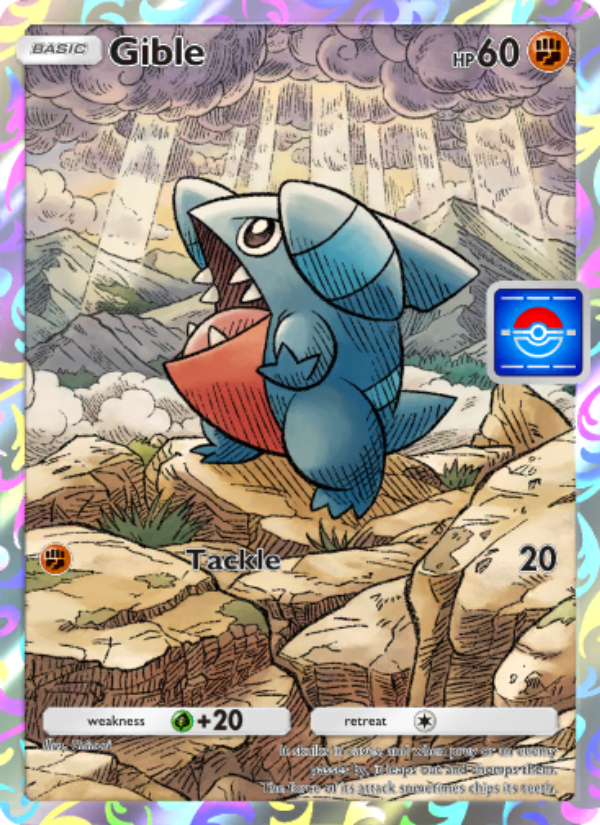
In the Pokémon TCG’s grand chessboard, even the smallest decision can ripple outward. Gible’s attack cost—one Fighting energy for Tackle, which deals 20 damage—speaks volumes about how balance is stitched into every card. With 60 HP, this basic Pokémon isn’t meant to run the table on its own; it’s a tempo piece that fits into a broader strategy, inviting players to weigh speed against staying power. The card’s Grass weakness (+20) acts as a gut check: an opponent who aligns their deck toward Grass types can punish Gible if you overextend, while smart energy placement and timely evolutions keep it relevant. The dynamic becomes a teaching moment about balance: a fast, low-HP attacker can be powerful in the right hands, but it won’t eclipse heavier hitters or more complex evolutions. ⚡🔥
Gible at a glance
- Name: Gible
- Set: Promos-A (P-A)
- Rarity: None
- Stage: Basic
- HP: 60
- Type: Fighting
- Attack: Tackle — Cost: 1 Fighting energy; Damage: 20
- Weakness: Grass (x2)
- Retreat Cost: 1
- Illustrator: Uninori
- Flavor Text: "It skulks in caves, and when prey or an enemy passes by, it leaps out and chomps them. The force of its attack sometimes chips its teeth."
The Promos-A line, with Vol. 5 boosters noted in its booster history, frames Gible as a collectible experience that’s as much about nostalgia as it is about play. The tiny dragon’s design—bold enough to bite, subtle enough to fit into early-game lines—reflects a thoughtful balance philosophy: give players a chance to press for tempo without letting one card dictate the entire game. The visual by Uninori complements the gameplay with a cave-dwelling vibe that hints at Gible’s mischievous nature and the environment in which it shines. 🎨
Attack cost as a balance signal
Why does a single energy matter so much? Because energy costs act as the primordial gatekeepers of tempo. A one-energy attack on a Basic with 60 HP is a powerful opening press, but it isn’t an unassailable edge. It invites the opposing player to respond with counterplay—accelerating energy on their side, using Trainer cards to stall or switch to a more favorable matchup, or preparing for a quick evolution into a stronger partner Pokémon. In Gible’s case, the lack of a second attack or higher HP means it’s not a stand-alone power spike. Instead, its value lies in tempo and synergy: the card can pressure early, set up future plays, and force opponents to respect the threat without overwhelming them in a single turn. This is a core balance principle across the TCG: a card’s energy cost should harmonize with its raw stats to create meaningful, interactive choices for both players. 🔎
From a design perspective, the fight-type identity adds thematic flavor: your early-game aggression is tempered by the potential for Grass-type responses that can swing momentum. The 1 retreat cost keeps Gible mobile on the bench, enabling flexible repositioning or retreat when needed, while the 60 HP anchors it in the realm of fragile early-game momentum—delicate enough to be punished by well-timed removal but sturdy enough to survive a couple of exchanges with the right strategy. This balancing act—speed, vulnerability, and deck-building depth—gives Gible a distinctive niche within the Promos-A lineup. ⚡🎴
Play patterns and player psychology
For players exploring Gible’s role, the path is about leveraging its speed without overexposure. A strong opener might involve using Tackle to threaten early board presence, then hedging for a clean evolve into Gible’s more powerful stage moments if and when the deck can support it. The key is to pair Gible with supportive Trainers and energy acceleration that can tilt the board in your favor while keeping Gible protected from neutralizing effects. The flavor text reads like a card diary from the cave: a bite that’s memorable, yet not determinative—an emblem of early-game decision-making rather than a guaranteed win button. This is precisely the lesson modern sets aim to teach: balance is a living thing, shaped by how players interact with mechanics over time. 💥
Collector insights: rarity, art, and value
As a non-raree card with holo and non-holo variants in the Promos-A family, Gible offers a collectible lure for fans who want a tangible reminder of the series’ early-energy design ethos. The holo treatment adds visual impact on binder displays, while the straightforward stats keep it accessible to newer players who want a tangible sense of how energy costs translate into battlefield outcomes. Uninori’s illustration style brings character to the cave-dweller—an aesthetic that’s as much about storytelling as it is about market value. Collectors often weigh these artistic components alongside practical considerations, such as print runs, promotion windows, and the card’s role in legacy decks. Gible embodies a balance between nostalgia and playability that resonates with both sides of the hobby. 💎🎮
Related readings and context
- Boost retention with smart remarketing campaigns
- NFT stats: Gorbage Chest 586
- NFT data: Planet Kaiju on Magiceden
- Pokemon TCG stats: Pikachu card XY6-20
- Pokemon TCG stats: Electabuzz EX15-29
These reads illustrate how enthusiasts think about data, rarity, and the broader Pokémon TCG ecosystem. They remind us that every card is part of a bigger story—how a single energy cost can ripple into deck-building choices, tournament strategy, and memory across generations of players. The journey from a humble Tackle to a full deck is a microcosm of Pokémon TCG’s enduring magic—a mix of strategy, nostalgia, and community. 🎮🎴
More from our network
- https://transparent-paper.shop/blog/post/boost-retention-with-smart-remarketing-campaigns/
- https://crypto-acolytes.xyz/blog/post/nft-stats-gorbage-chest-586-from-gorbage-chest-collection/
- https://blog.crypto-articles.xyz/blog/post/nft-data-planet-kaiju-824-from-planet-kaiju-collection-on-magiceden/
- https://wiki.digital-vault.xyz/wiki/post/pokemon-tcg-stats-pikachu-card-id-xy6-20/
- https://wiki.digital-vault.xyz/wiki/post/pokemon-tcg-stats-electabuzz-card-id-ex15-29/
Gible
Set: Promos-A | Card ID: P-A-046
Card Overview
- Category: Pokemon
- HP: 60
- Type: Fighting
- Stage: Basic
- Dex ID:
- Rarity: None
- Regulation Mark: —
- Retreat Cost: 1
- Legal (Standard): No
- Legal (Expanded): No
Description
It skulks in caves, and when prey or an enemy passes by, it leaps out and chomps them. The force of its attack sometimes chips its teeth.
Attacks
| Name | Cost | Damage |
|---|---|---|
| Tackle | Fighting | 20 |
Support Our Decentralized Network
Donate 💠More from our network
- https://transparent-paper.shop/blog/post/boost-retention-with-smart-remarketing-campaigns/
- https://crypto-acolytes.xyz/blog/post/nft-stats-gorbage-chest-586-from-gorbage-chest-collection/
- https://blog.crypto-articles.xyz/blog/post/nft-data-planet-kaiju-824-from-planet-kaiju-collection-on-magiceden/
- https://wiki.digital-vault.xyz/wiki/post/pokemon-tcg-stats-pikachu-card-id-xy6-20/
- https://wiki.digital-vault.xyz/wiki/post/pokemon-tcg-stats-electabuzz-card-id-ex15-29/