
Image courtesy of TCGdex.net
Comparing Forretress Across Generations: A Vintage Perspective on a Grass-type Defense
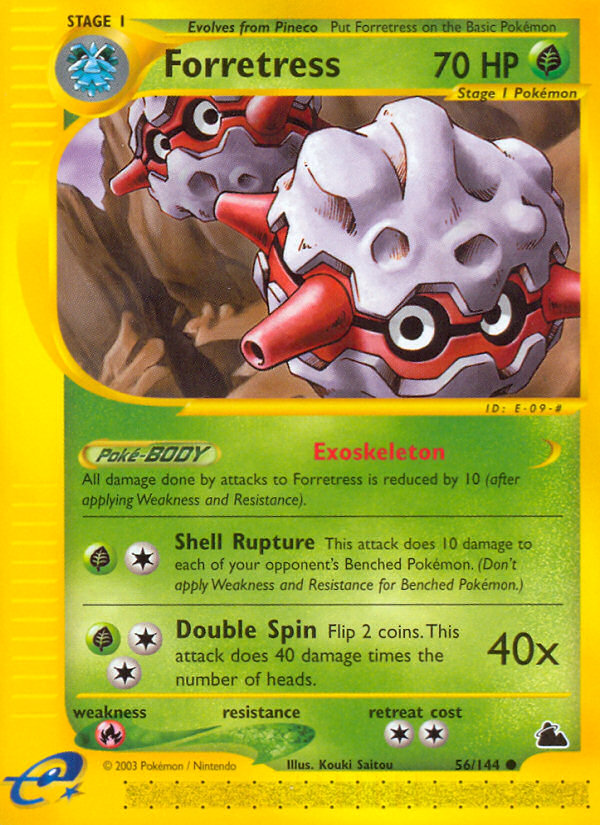
Forretress has long served as a curious bridge between defense and offense in the Pokémon TCG. The Skyridge print we’re examining today—an early-2000s showcase illustrated by Kouki Saitou—presents a distinct take on the creature’s role, moving away from brute aggression toward a more calculated, stall-friendly approach. This particular card sits in the Stage 1 slot, evolving from Pineco, and it’s notable for its Grass typing and a Poke-BODY that changes how damage lands on it, not just how it hits back. For fans and collectors, it’s a reminder that the era’s design language favored layered strategies over one-off power spikes ⚡.
From a gameplay standpoint, this Forretress is representative of the Skyridge era’s willingness to blend solid HP with tricky resistances and reliable—but coin-dependent—offense. With 70 HP, it isn’t a brick wall, but its staying power is reinforced by Exoskeleton, a Poke-BODY that reduces all damage done to it by 10 after applying Weakness and Resistance. That subtle 10-point buffer can be the difference between a knock-out on the following turn and a necessary retreat to reorganize your energy economy. It’s these little bonuses that explain why many players remember the feel of Skyridge cards fondly—the puzzle-like balance between defense and aggression remains a core theme of the era 🔥.
What this Forretress brings to the table
- Stage and Evolution: Evolving from Pineco, allowing an early-game transition into a sturdier midgame anchor. This pedigree echoes the era’s emphasis on evolving lines that shape the midgame tempo.
- HP and Typing: 70 HP for a Grass-type Defense-leaning pivot; this is not a powerhouse, but it’s well-suited for drawn-out battles where attrition and bench pressure decide the outcome.
- Attacks:
- Shell Rupture — Grass + Colorless: Deals 10 damage to every one of your opponent’s Benched Pokémon. It’s the classic “spread to punish a heavy bench” move that incentivizes lines and bench management.
- Double Spin — Grass + Colorless + Colorless: 40 damage times the number of heads on two coins. This is a familiar risk-reward mechanic—potentially strong, but coin-flip variability keeps it honest and tense.
- Weakness: Fire ×2, a vulnerability that makes it a natural target in a field full of heat-backed strategies. You’ll need to temper your play with proper positioning and energy accounting to mitigate the risk.
- Defensive Flavor: The Exoskeleton ability is the star here, shaping how you allocate resources and respond to each attack’s bite. It rewards calculated trades rather than pure aggression.
- Illustration & Set Notes: Art by Kouki Saitou, a standout for Skyridge’s distinct visuals. The card belongs to the Skyridge set, which features a total of 182 cards and 144 official prints, making this Forretress a collectible slice of that era’s design philosophy.
For collectors, the Skyridge print’s normal and reverse variants add to its charm. While this card isn’t one you’ll see in modern Standard or Expanded play (the data shows it’s not current in either format), it remains a sought-after artifact for those who relish the era’s mechanical quirks and the artistry of early-2000s Pokemon illustration. The market signals a healthy appreciation for condition and edition. As of late 2025 snapshots, Cardmarket shows an average around €51.17 with wide variance, while TCGPlayer reports modest mid prices for the regular print and more for reverse holos depending on condition. That spread reflects both rarity and nostalgia—two currencies that age like fine card stock in the hands of a patient collector 🎴💎.
“Skyridge’s Forretress trades a straightforward knockout for a thoughtful, board-state-aware approach. The Exoskeleton buff changes how both players see the matchup—your opponent may be less inclined to press the attack, while you time Shell Rupture to spike pressure on the bench.”
In older versions of Forretress—before Exoskeleton and the Skyridge design ethos—players typically faced a different risk-reward calculus. The variety across early prints often leaned toward simpler, more direct damage methods, with fewer built-in defensive synergies. Skyridge’s Forretress stands out for offering a persistent defensive buffer that, when paired with strategic bench management, can slow an opponent’s momentum while your board advances. The card’s dual-attack setup also invites tactical energy planning: you’ll want to allocate Grass energy thoughtfully between Shell Rupture’s spread and Double Spin’s probabilistic payoff, keeping in mind the all-important coin flip results and the ever-present Fire weakness 🔥.
How to think about this card in vintage or casual playgroups
- Deck rhythm: Use Pineco’s evolution to slide into Forretress in the early to mid-game, creating a lasting presence on the bench that can deter quick KO pressure.
- Energy management: The two attacks demand Grass and a couple of Colorless energies. Build around reliable Grass acceleration and energy retrieval to ensure you can deploy Shell Rupture without starving the Double Spin option.
- Bench strategy: Shell Rupture punishes a heavy opponent bench, so you’ll want to stage a controlled pace—one where you force a swap or draw-out moments to pressure your opponent into bench-filling responses.
- Defensive valuation: Exoskeleton’s 10-point reduction after Weakness/Resistance is perfect for weathering a Fire-heavy metagame, especially when your opponent relies on big single-hit or multi-hit attackers to punch through a midline wall.
Collectors who chase a sense of history will appreciate the card’s normal and reverse print options, plus the broader Skyridge narrative—the last of the era’s major-era sets before the next wave of rules and balance changes reshaped formats. Its non-legal status in Standard and Expanded formats today makes it a pure nostalgia piece for many traders and fans, a reminder of how a single ability can tilt the balance of power in a match. The Forretress you hold, with its Pineco pedigree and Saitou’s art, feels like a small piece of a larger puzzle—the evolution of a game that has always rewarded patient, cunning play as much as raw power ⚡🎨.
Market snapshot and collector notes
Because this is a non-current print, condition and version matter more than raw power when assessing value. The card’s rarity is Common, but in a Skyridge lineup the combination of illustration, type, and the Poke-BODY makes it a conversation piece in many vintage collections. For pricing, Cardmarket’s EUR figure around €51.17 on average with volatility in the low to mid-range shows a healthy interest, while TCGPlayer’s data for normal and reverse variants point to a broader spread depending on market demand and card condition. For collectors, that means a Forretress from Skyridge can be a manageable, meaningful addition to a vintage binder—especially for those who prize the Set’s unique flavor and the imaginative art from Kouki Saitou 🎴.
Art, lore, and the face behind the card
Kouki Saitou’s artwork for this Forretress captures a moment of quiet resilience—an armored shell shimmering with a hint of forest-green vitality, befitting the Grass typing and Skyridge’s outdoor, nature-forward aesthetic. The design nods to a creature built for endurance and unexpected offense, a theme that resonates with players who adore the strategic depth of mid-game positioning. As a note for readers who crave context, the Skyridge era is celebrated for its distinctive card borders, bold energy illustrations, and a sense that every card was crafted to encourage more thoughtful, long-form battles than simple, head-to-head power plays. That spirit shines through in Forretress, a card that rewards planning over pace, and patience over punch ⚡🔥.
Phone Grip Click-On Mobile Holder KickstandMore from our network
- https://crypto-acolytes.xyz/blog/post/nft-stats-solzillav2-526-from-solzillav2-collection/
- https://articles.digital-vault.xyz/blog/post/why-silent-hill-2-remake-still-matters-for-horror-gamers/
- https://crypto-acolytes.xyz/blog/post/solidskulls-236-solidskulls-nft-stats/
- https://blog.crypto-articles.xyz/blog/post/nft-data-joker-90-from-jokers-collection-on-magiceden/
- https://donation.digital-vault.xyz/donation/post/donate-to-keep-open-source-code-public-and-accessible/
Forretress
Set: Skyridge | Card ID: ecard3-56
Card Overview
- Category: Pokemon
- HP: 70
- Type: Grass
- Stage: Stage1
- Evolves From: Pineco
- Dex ID: 205
- Rarity: Common
- Regulation Mark: —
- Retreat Cost:
- Legal (Standard): No
- Legal (Expanded): No
Description
Abilities
-
Exoskeleton — Poke-BODY
All damage done by attacks to Forretress is reduced by 10 (after applying Weakness and Resistance).
Attacks
| Name | Cost | Damage |
|---|---|---|
| Shell Rupture | Grass, Colorless | |
| Double Spin | Grass, Colorless, Colorless | 40x |
Pricing (Cardmarket)
- Average: €51.17
- Low: €13
- Trend: €50.21
- 7-Day Avg: €50.67
- 30-Day Avg: €49.21
Support Our Decentralized Network
Donate 💠More from our network
- https://crypto-acolytes.xyz/blog/post/nft-stats-solzillav2-526-from-solzillav2-collection/
- https://articles.digital-vault.xyz/blog/post/why-silent-hill-2-remake-still-matters-for-horror-gamers/
- https://crypto-acolytes.xyz/blog/post/solidskulls-236-solidskulls-nft-stats/
- https://blog.crypto-articles.xyz/blog/post/nft-data-joker-90-from-jokers-collection-on-magiceden/
- https://donation.digital-vault.xyz/donation/post/donate-to-keep-open-source-code-public-and-accessible/