
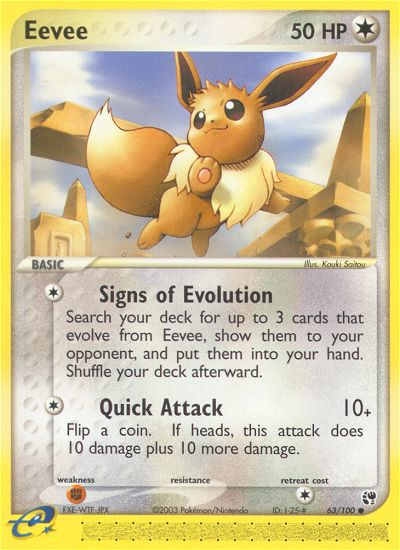
Image courtesy of TCGdex.net
Reprints, Supply, and the Price of Eevee
For Pokémon TCG fans, Eevee isn’t just a cute mascot—it’s a symbol of versatility and potential. The Sandstorm-era Eevee (ex2-63), illustrated by Kouki Saitou, is a perfect case study in how reprints ripple through price and value across the hobby. This basic Colorless Pokémon brings a practical toolkit to decks—its two modest attacks open doors to rapid evolution, while its enduring popularity keeps it relevant long after its first print. As we watch reprint cycles unfold, the question becomes not only “how strong is the card?” but also “how will supply shifts affect its value over time?” ⚡🔥
Snapshot: Eevee ex2-63 from Sandstorm
From the Sandstorm set, Eevee sits as a Basic Colorless type with 50 HP—humble by today’s standards, yet incredibly influential in deck-building theory. Its two attacks demonstrate its evolution-forward philosophy:
- Signs of Evolution (Cost: Colorless): Search your deck for up to 3 cards that evolve from Eevee, show them to your opponent, and put them into your hand. Shuffle your deck afterward.
- Quick Attack (Cost: Colorless): 10 damage, plus 10 more on a heads flip.
These tools highlight a core mechanic of the era: Eevee acts as a springboard, letting you assemble a suite of evolutions quickly. Its Fighting weakness (×2) reminds us of the meta dynamics of that period, where certain types created tempo swings. The card’s illustrator Kouki Saitou contributed artistry that fans still associate with the Sandstorm era, a time when the TCG was cultivating a robust mix of practical play and collectible charm. In terms of rarity, Eevee is listed as Common with two notable variants: a reverse holo variant and a standard print. The Sandstorm card pool spans 100 cards officially, underscoring a balanced but curated snapshot of the era.
Why reprints matter for price
Reprints affect every pulse point of a card’s life: supply, collectability, and deck usability all react when print runs resume or expand. For a card like Eevee ex2-63, a few dynamics stand out:
- Supply expansion via reprints tends to increase available copies across the market. More copies can cool top-end pricing, especially for common cards that see frequent use in budget or evolving decks.
- Variant psychology matters. The reverse holo variant, though derived from the same card pool, often trades at a premium due to presentation and perceived collectability—an effect visible in current pricing data.
- Deck relevance can buffer price dips. Eevee’s ability to tutor evolutions through Signs of Evolution keeps it relevant for players building low-cost lineups around evolving forms, even when supply climbs.
From a market perspective, the data paints an interesting picture. CardMarket shows Eevee at an average around €2.54 with a broad low of €0.03, signaling that common copies remain widely accessible, while price momentum (trend ~1.78) hints at steady, modest appreciation over time. The holo category in CardMarket can climb, with observed averages like €4.56 and a notable uplift in holo-trends (trend-holo ~11.61). On the U.S. front, TCGPlayer’s numbers reveal a wider spectrum: for the standard, non-holo Eevee, low prices sit near $2.50, mid around $4.98, and highs edging toward $17–$18 in exceptional listings. The market price sits around $5.19, demonstrating how a playable, early-stage Pokémon can still command attention even as print runs continue. Conversely, the reverse holo variant commands a much higher premium, with low around $34.50, mid near $46, and peaks approaching $73. This gap underscores why collectors often pursue specific printings and finishes, even when the base card remains affordable for play. 🔎💎
“A reprint is not just a pause in the price—it's a signal that supply is catching up with demand, and the market will rebalance over time.”
So, what does this mean for Eevee in the context of reprints? In practical terms, a new Eevee reprint can dampen the average price of common copies as supply expands. Yet the card’s utility-driven design—the ability to accelerate evolution for a deck—helps maintain a baseline value: the card remains a gateway to a suite of evolutions and a reliable budget option for players building around Eevee’s evolving family. The reverse holo, while rarer, remains a magnet for collectors who prize presentation and rarity. In short, reprints tend to stabilize prices in the long run, but the exact effect depends on variant, finish, and the broader market mood of the day. 🎴🎨
Strategic takeaways for players and collectors
- For players, Eevee’s Signs of Evolution is the hidden engine behind a fast, flexible evolving strategy. In formats where evolutions are central, a reprint increases card availability, making it easier to assemble a full evolution deck without inflating costs.
- Collectors should pay attention to variant markings. The reverse holo copy can present a meaningful premium, even when the standard is widely available, so plan purchases with both gameplay needs and display goals in mind.
- Stay mindful of market updates. CardMarket and TCGPlayer offer complementary signals—watch the holo trends and the general price drift of non-holo copies to time purchases or sells strategically.
- Always consider condition and complete sets. First editions aren’t a factor here (the card isn’t listed as first edition), but near-mint or better copies—especially reverse holos—hold stronger long-term value in a complete Sandstorm collection.
Collector’s notes: art, lore, and lasting appeal
Artist Kouki Saitou’s work on Eevee captures that warm, cuddly character that fans adore, while the Sandstorm era itself evokes a sense of nostalgia for many collectors and players. The card’s basic status, paired with the evolving-evolutions mechanic, makes it a standout piece for those assembling early-generation decks or framing a “classic” collection. The dual appeal—playability for budget decks and desirability for display—helps explain why a reprint cycle can sustain interest across both camps. The Eevee line remains a soft spot in many binders, a reminder that simplicity and strategy can coexist in the Pokémon TCG’s ongoing evolution. ⚡🎮
Product link for collecting or gifting the perfect desk companion: Neon Desk Mouse Pad - Customizable One-Sided Print (0.12in Thick)
Neon Desk Mouse Pad - Customizable One-Sided Print (0.12in Thick)More from our network
- https://articles.digital-vault.xyz/blog/post/unlocking-machamp-ex-deck-diversity-with-data-driven-insights/
- https://defi-donate.zero-static.xyz/bbc632a2.html
- https://wiki.digital-vault.xyz/wiki/post/pokemon-tcg-stats-shiinotic-card-id-sm3-98/
- https://wiki.digital-vault.xyz/wiki/post/pokemon-tcg-stats-durant-ex-card-id-sv08-004/
- https://blog.rusty-articles.xyz/blog/post/xenic-poltergeist-optimal-deck-archetypes-and-synergies-explored/
Eevee
Set: Sandstorm | Card ID: ex2-63
Card Overview
- Category: Pokemon
- HP: 50
- Type: Colorless
- Stage: Basic
- Dex ID: 133
- Rarity: Common
- Regulation Mark: —
- Retreat Cost:
- Legal (Standard): No
- Legal (Expanded): No
Description
Attacks
| Name | Cost | Damage |
|---|---|---|
| Signs of Evolution | Colorless | |
| Quick Attack | Colorless | 10+ |
Pricing (Cardmarket)
- Average: €2.54
- Low: €0.03
- Trend: €1.78
- 7-Day Avg: €3.02
- 30-Day Avg: €3.04
Support Our Decentralized Network
Donate 💠More from our network
- https://articles.digital-vault.xyz/blog/post/unlocking-machamp-ex-deck-diversity-with-data-driven-insights/
- https://defi-donate.zero-static.xyz/bbc632a2.html
- https://wiki.digital-vault.xyz/wiki/post/pokemon-tcg-stats-shiinotic-card-id-sm3-98/
- https://wiki.digital-vault.xyz/wiki/post/pokemon-tcg-stats-durant-ex-card-id-sv08-004/
- https://blog.rusty-articles.xyz/blog/post/xenic-poltergeist-optimal-deck-archetypes-and-synergies-explored/