
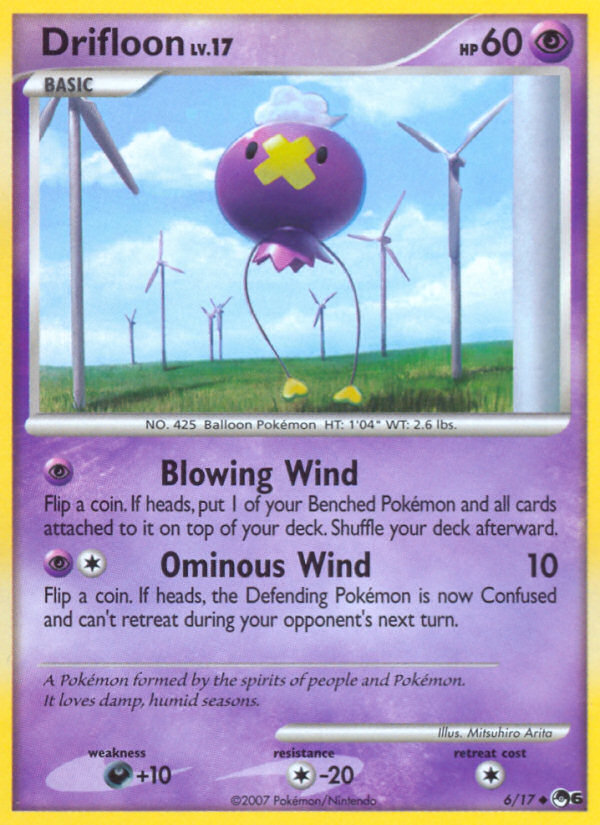
Image courtesy of TCGdex.net
How Drifloon’s Abilities Stack in Pokémon TCG
Drifloon, a shy Basic Psychic Pokémon born from the stories of wandering spirits, has long been a favorite among players who love clever timing and deck manipulation. In its POP Series 6 incarnation, illustrated by the celebrated Mitsuhiro Arita, Drifloon carries a pair of attacks that hinge on coin flips and conditional effects rather than a modern, standalone “Ability” keyword. That distinction matters when we talk about how these effects stack across turns and across a game. In short: there aren’t separate “abilities” on this card to stack in the traditional sense, but the way its two attacks interact, plus how your bench and deck state evolves, creates opportunities for layered strategy that players can exploit to tilt a match in their favor.
First, a quick refresher on the card itself. Drifloon is a Basic Psychic Pokémon with 60 HP, a retreat cost of 1, and weaknesses to Darkness with a +10 multiplier and resistance to Colorless with a -20 modifier. It sits in the nostalgic POP Series 6 set, a non-Modern format era where players often built playful, hole-punishing bench games around a handful of disruptive tricks. Its two attacks are Blowing Wind and Ominous Wind. Blowing Wind has a Psychic attack cost and introduces a coin flip that can rearrange your own bench: if heads, you take one of your Benched Pokémon and all cards attached to it and place that Pokémon on top of your deck, shuffling the remainder. Ominous Wind, costing Psychic and Colorless, deals 10 damage and also has a coin-flip trigger: if heads, the Defending Pokémon becomes Confused and can’t retreat during your opponent’s next turn.
Dissecting the stacking dynamic
- No separate abilities to stack: Drifloon’s two attacks do not grant a continuous, built-in ability you can stack across turns. There is no “Drifloon Ability A” and “Drifloon Ability B” layer that intensifies with multiple Drifloon in play. What you do get is a pair of attack effects that can be triggered multiple times across turns and across games, creating composite pressure when combined with coin-flip outcomes and bench/deck state.
: Each attack’s effectiveness hinges on a coin flip. With Blowing Wind, a successful heads outcome can reposition a key benched Pokémon and its attachments to the top of your deck. When you start repeating these outcomes over several turns, you can “stack” the perceived risk and reward—building draw familiarity and shaping the order in which you encounter crucial Trainer cards, energies, or attackers. In practice, you’re not stacking damage or status effects from Blowing Wind, but you are stacking the strategic leverage of deck manipulation across turns. : The Ominous Wind effect can cause Confusion and restrict retreat for the Defending Pokémon when heads come up. If you flip heads again on a subsequent Ominous Wind, you don’t stack multiple Confusion conditions onto the same Defending Pokémon in the same moment—the game treats Confusion as a single condition that remains until resolved. Same goes for “cannot retreat”; you can’t extend that duration beyond the turn it’s placed unless a card explicitly refreshes the effect. This is one of the hallmarks of stacking logic in the TCG: many effects don’t accumulate linearly; they layer, overlap, or persist, but not in a way that creates an exponential counter within a single attack text. : The most tangible stacking you’ll experience with Drifloon is how you sequence draws and bench management. By using Blowing Wind to pluck a specific benched Pokémon (and its attachments) to the top of your deck, you shape your upcoming draws. If you’ve already secured a critical piece—perhaps a key Trainer or a crucial Energy—you can pull it sooner or delay a problematic topdeck until you’re ready. This is the kind of stacking that relies on memory, probability, and careful counting rather than raw numerical stacking on a single card's text.
Practical gameplay ideas for Drifloon’s two attacks
: Blowing Wind becomes a powerful tempo tool when you know what’s on top or what you want on top in the next couple of draws. If you’re setting up a late-game finisher or aiming to fetch a needed Energy to power Ominous Wind, leverage the heads result to keep your plan on track. Just remember the flip is a coin, so build a route that tolerates even a miss. : Ominous Wind’s 10 damage alongside a potential Confusion can create a psychological edge. If the Defending Pokémon is already under some effect or if you’re pressuring a shaky bench, you can create a tempo swing that compounds with your other plays. The “cannot retreat” bit can be especially nasty against decks that rely on retreat costs for switching lightly—Drifloon helps you trap a problematic backline Pokémon for a turn or two. : With Blowing Wind, you could aim to reposition your own low-HP threats to the top of the deck for quick redraws in a clutch moment—think of it as a way to recycle critical threats or to ensure you see the cards you want when you need them most. This is the kind of tactical play that makes Drifloon feel more like a storytelling puzzle than a raw power card.
Collector insights and flavor
Drifloon’s POP Series 6 rendition carries the charm of Mitsuhiro Arita’s art—the same artist behind countless classic Pokémon cards. Its Uncommon rarity, combined with the nostalgic POP flavor, makes it a compelling target for collectors who chase unique print runs and retro design cues. The card’s lore entry—describing Drifloon as a Pokémon formed by the spirits of people and Pokémon that loves damp, humid seasons—offers a thematic hook for players who love folklore-rich backstories with their gameplay. Collectors often prize variants from POP sets that highlight earlier artwork and frame styles, and Drifloon’s silhouette against a soft, spectral palette is a favorite for display and binder covers alike.
Market pulse: value trends and considerations
Market data for Drifloon (POP Series 6) shows a dynamic though modest price profile typical of uncommon POP-era cards. Cardmarket snapshots place averages around €35 with a low near €28 and a recent upward trend. In the U.S., TCGPlayer reports a normal-price range near $30–$45, with market prices hovering around the mid-$30s to $40s depending on condition and printing specifics. As with all long-tail vintage cards, condition, centering, and surface wear can swing prices dramatically, but the POP6 print’s nostalgic appeal and Mitsuhiro Arita’s hallmark art tend to support steady collector interest. If you’re position-building for a casual deck or a themed binder, Drifloon’s two-attack toolkit remains a clever choice for demonstrating how two simple effects can create layered, strategic play across a game.
Putting it all together
Drifloon may not boast a modern “Ability” in the sense of present-day TCG mechanics, but its dual-attack setup offers a surprisingly rich canvas for strategic play. The interaction between Blowing Wind’s deck manipulation and Ominous Wind’s potential to disrupt a Defending Pokémon’s options creates a microcosm of the tension between luck (coin flips) and planning (deck order and bench composition). For players who enjoy turning a coin flip into real board state advantage, Drifloon is a charming, vintage-flavored case study in how stacking—when defined as layering effects across turns and using bench state to steer draws—works in the Pokémon TCG.
To those building decks or collecting curios from POP Series 6, Drifloon stands as a compact, flavorful relic with practical, if occasionally unpredictable, utility. Its 60 HP, Psychic typing, and a retreat cost of 1 keep it accessible, while the two attacks offer a dynamic approach to tempo and control that resonates with players who adore both nostalgia and tactical depth. And as you shuffle your deck in anticipation of the next draw—perhaps aided by a well-timed Blowing Wind—you’ll feel the heartbeat of a game that, even in a vintage format, rewards patience, calculation, and a little bit of luck ⚡🔥.
Custom Mouse Pad 9-3x7-8 in White Cloth Non-SlipMore from our network
Drifloon
Set: POP Series 6 | Card ID: pop6-6
Card Overview
- Category: Pokemon
- HP: 60
- Type: Psychic
- Stage: Basic
- Dex ID: 425
- Rarity: Uncommon
- Regulation Mark: —
- Retreat Cost: 1
- Legal (Standard): No
- Legal (Expanded): No
Description
A Pokémon formed by the spirits of people and Pokémon. It loves damp, humid seasons.
Attacks
| Name | Cost | Damage |
|---|---|---|
| Blowing Wind | Psychic | |
| Ominous Wind | Psychic, Colorless | 10 |
Pricing (Cardmarket)
- Average: €35
- Low: €28
- Trend: €22.92
- 7-Day Avg: €28.57
- 30-Day Avg: €15.14
Support Our Decentralized Network
Donate 💠More from our network
- https://crypto-acolytes.xyz/blog/post/nft-stats-tcg-542-from-tcg-pack-collection/
- https://blog.zero-static.xyz/blog/post/decoding-thraxodemon-mtg-card-name-semantics/
- https://wiki.digital-vault.xyz/wiki/post/pokemon-tcg-stats-sawk-card-id-sv105w-130/
- https://blog.digital-vault.xyz/blog/post/blue-giant-refines-stellar-evolution-from-2-kpc-away/
- https://wiki.digital-vault.xyz/wiki/post/pokemon-tcg-stats-pokemon-catcher-card-id-bw2-95/