
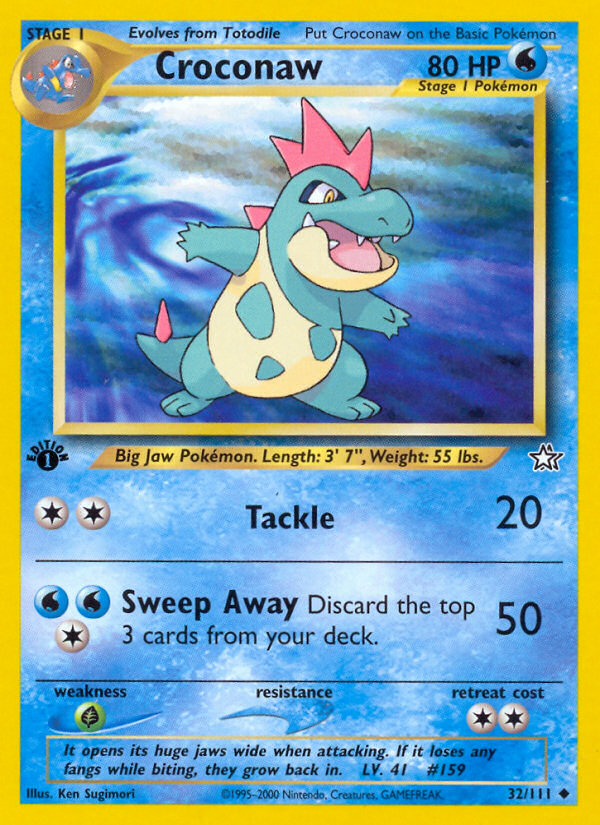
Image courtesy of TCGdex.net
How Croconaw’s Moves Shape Tempo in Early-Gen Pokémon TCG Decks
Tempo is the pulse of every Pokémon TCG match. It’s the rhythm that tells you when to push, when to defend, and how quickly you can tilt the board in your favor. In Neo Genesis, a set famous for its clean lines, bold illustrations, and the dawn of more deliberate deck-building, Croconaw steps onto the stage as a thoughtful tempo engine. Its two attacks don’t shout for attention with flashy gimmicks, but they press your opponent’s tempo in meaningful, game-changing ways. ⚡🔥
Croconaw at a glance
- Name: Croconaw
- Set: Neo Genesis (Neo1)
- Rarity: Uncommon
- Stage: Stage 1 (evolves from Totodile)
- HP: 80
- Type: Water
- Illustrator: Ken Sugimori
- Weakness: Grass ×2
- Attacks: Tackle (Colorless, Colorless) for 20; Sweep Away (Water, Water, Colorless) for 50
- Special note: First Edition variant exists with the familiar stamp—hobbyists love chasing that 1st-edition aura
The card depicts Croconaw in classic Sugimori style—a poised, aquatic predator that hints at the evolution path toward Feraligatr. In gameplay terms, Croconaw’s 80 HP sits squarely in the mid-range of the era’s Stage 1 attackers, giving you a reliable beater that also meaningfully affects how you pace the game. The two-attack suite is where tempo swings begin.
Two moves, two tempo levers
Tackle is a straightforward, reliable opener. It’s a scratch-attack—not flashy, but it buys you immediate field presence and sets up follow-up pressure. In tempo terms, that first hit buys you the space to attach more Water energy, tier your bench, and threaten Croconaw’s stronger asset: the second attack.
Sweep Away is where Croconaw quietly reshapes the pacing of a match. For three energy cards—two Water, one Colorless—you deliver a solid 50 damage, but the real twist is the effect: discard the top three cards from your deck. This is a classic example of a tempo swing because it creates a calculated risk-reward dynamic. If your deck is built with thinning and drawn-to-thin strategies in mind, Sweep Away can accelerate your path to key cards while compressing the game into shorter, more intense exchanges. It asks: can you spare three top-deck cards now to secure a stronger later turn, or will you gamble on what those three cuts reveal on the next draws? 💎🎴
That top-deck disruption also pressures your opponent to adapt. In the era before complex shuffle effects and modern “shuffle-and-search” utility sometimes overshadowed, removing the top cards could remove suboptimal starting lines for your opponent, forcing them to redraw or recalculate their approach. It’s a subtle form of tempo denial: you push you forward, while your opponent recalibrates their setup. The decision tree becomes a ping-pong of pace—one turn you press with Croconaw, the next you anticipate a reset or a counterstrike from a different archetype.
Tempo with risk and reward
Neo Genesis era decks thrived on a balance of consistency and disruption. Croconaw’s two moves embody that ethos. The risk lies in Sweep Away’s self-mill effect: you toss three cards out of your own deck, shrinking your future draws. In a well-tuned tempo deck, you mitigate that risk by pairing Croconaw with draw and search tools that keep your deck cycling toward reliable options—ideally preserving enough gas to sustain acceleration toward a stronger attacker or a decisive knockout.
At the same time, Croconaw’s Water typing, HP, and the Grass-type weakness all color how you deploy it. The Grass ×2 weakness becomes more than a mismatch check—it shapes your match tempo by dictating when you risk a longer direct confrontation on the bench. You’ll want to avoid giving your opponent a clean setup on turns where Croconaw is under pressure, and you’ll favor mid-game exchanges where 50 damage from Sweep Away tilts the balance without overextending your resources.
Deck-building ideas that optimize Croconaw’s tempo swing
- Energy cadence matters: Ensure you have a steady Water-energy supply so you can reliably reach Sweep Away's expensive cost while keeping Tackle as a safety valve.
- Draw and fetch synergy: Include draw-support and search options to replenish your engine after the top-deck thinning. The goal is to keep momentum even as you trim the top of your deck.
- Bench management: Because Croconaw evolves from Totodile, you’ll plan a clean evolution path that doesn’t starve your board. A solid bench gives you a reliable threat-line while you weave through a few turns of tempo play.
- Weakness awareness: With Grass types looming as counter-punches, tempo windows often hinge on avoiding unfavorable matchups. Quick trades and forced damage on your terms help you stay ahead.
- First Edition collectability: If you’re chasing the aesthetic and value of early prints, the 1st Edition Croconaw (stamp) variants offer both nostalgia and potential premium in your collection, alongside the standard Uncommon copy.
From a market perspective, Croconaw sits in an intriguing spot. The Neo Genesis era is beloved, and while this particular Croconaw is Uncommon, the card’s collectible appeal remains strong among players and collectors alike. In pricing snapshots, Cardmarket shows a typical range around a few euros, while TCGPlayer lists a broader spread depending on edition and condition. For first-edition prints, prices trend higher, reflecting nostalgia, scarcity, and the set’s iconic status in the early TCG era. This makes Croconaw a thoughtful addition for players seeking reliable tempo pressure and for collectors chasing the tactile history of the game. 🔥💎
In play, Croconaw’s tempo swings aren’t about one flashy combo; they’re about the subtle art of pacing. The ability to press with a solid 80 HP frame on a Stage 1, backed by two solid attacks, gives you a dependable engine. You’ll feel the tempo shift as you threaten 50 damage with a calculated card-discard mechanism, while your opponent recalibrates to answer the evolving board. It’s a throwback to a purer age of the TCG—where a thoughtfully built tempo engine could tilt a match as decisively as a high-cost, big-power finisher.
Clear Silicone Phone Case: Slim, Flexible with Open PortsMore from our network
- https://rusty-articles.xyz/tmplr0ytd33/f9bbf412.html
- https://blog.rusty-articles.xyz/blog/post/gran-turismo-3-a-spec-hidden-mechanics-explained-for-new-players/
- https://wiki.digital-vault.xyz/wiki/post/pokemon-tcg-stats-carvanha-card-id-pl2-58/
- https://crypto-acolytes.xyz/blog/post/nft-stats-hero-506-from-soul-gate-heroes-collection/
- https://articles.zero-static.xyz/blog/post/verdant-automaton-artist-commentary-and-production-techniques/
Croconaw
Set: Neo Genesis | Card ID: neo1-32
Card Overview
- Category: Pokemon
- HP: 80
- Type: Water
- Stage: Stage1
- Evolves From: Totodile
- Dex ID: 159
- Rarity: Uncommon
- Regulation Mark: —
- Retreat Cost:
- Legal (Standard): No
- Legal (Expanded): No
Description
Attacks
| Name | Cost | Damage |
|---|---|---|
| Tackle | Colorless, Colorless | 20 |
| Sweep Away | Water, Water, Colorless | 50 |
Pricing (Cardmarket)
- Average: €2.54
- Low: €0.05
- Trend: €1.83
- 7-Day Avg: €2.25
- 30-Day Avg: €2.4
Support Our Decentralized Network
Donate 💠More from our network
- https://rusty-articles.xyz/tmplr0ytd33/f9bbf412.html
- https://blog.rusty-articles.xyz/blog/post/gran-turismo-3-a-spec-hidden-mechanics-explained-for-new-players/
- https://wiki.digital-vault.xyz/wiki/post/pokemon-tcg-stats-carvanha-card-id-pl2-58/
- https://crypto-acolytes.xyz/blog/post/nft-stats-hero-506-from-soul-gate-heroes-collection/
- https://articles.zero-static.xyz/blog/post/verdant-automaton-artist-commentary-and-production-techniques/