
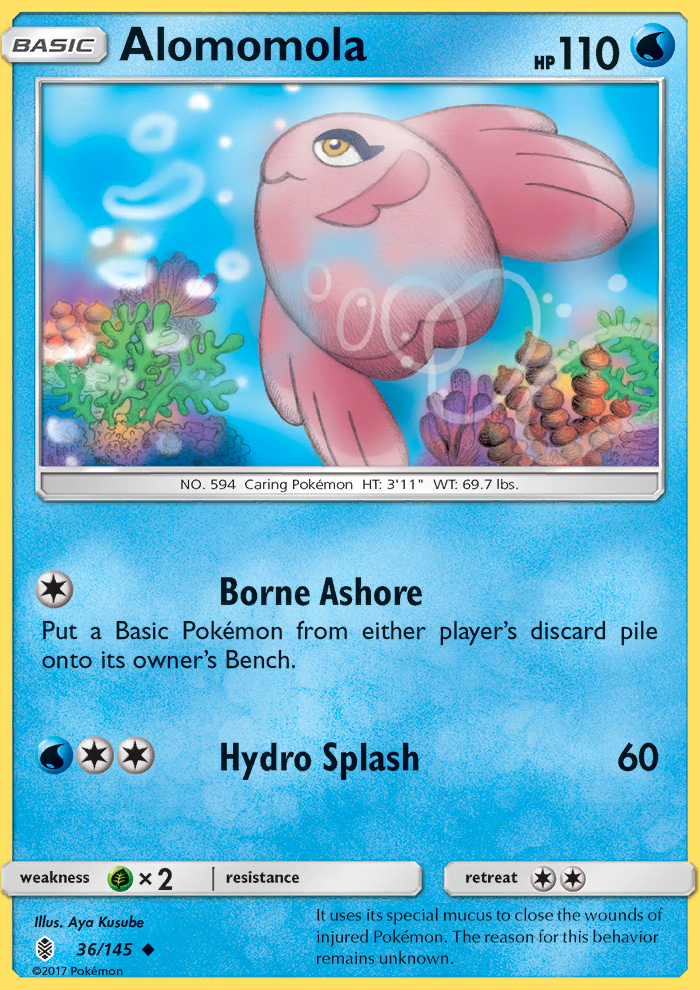
Image courtesy of TCGdex.net
Alomomola and the Evolution of Pokémon Card Design for Support-Focused Keepers
In the long arc of the Pokémon Trading Card Game, certain cards quietly signal a shift in how designers think about resilience, board presence, and “second chances.” Alomomola, a Water-type Basic from the Guardians Rising era (SM2), is a perfect case study in how design evolved to reward defensive play, strategic discard-pile interactions, and thoughtful bench management. Its presence on the battlefield—110 HP, two distinct attacks, and the cheeky bench-recovery mechanic—embodies a shift toward cards that reward tempo and recovery as much as raw damage. ⚡🔥
Laid out on a cool aquatic palette, Alomomola’s illustration by Aya Kusube captures the gentle, buoyant energy of this creature while hinting at the strategic utility hiding beneath its friendly surface. This is not a brute-force attacker; it’s a facilitator for the bigger plan. Its stance, soft lines, and water-inspired motif mirror a broader design philosophy: give players tools that let them pivot after a setback, rather than simply trading blows until the end of the game. The card’s rarity—Uncommon—acknowledges that this is a dependable, niche piece of the puzzle rather than a one-card finisher. Its basic stage confirms a feeling of accessibility: even early in a match, you can start shaping favorable outcomes with careful setup. The concept rings true across generations: cards that reward position, timing, and risk-managed recovery are the backbone of durable deck-building. 🐟💎
Card anatomy that supports the playstyle
- Set and rarity: Guardians Rising (SM2), Uncommon. The set brought a wave of supportive tools and stage-friendly tactics, encouraging players to think beyond pure offense and toward sustainable board development.
- Stage and HP: Basic, 110 HP. A solid baseline that invites early bench-building and keeps Alomomola relevant through mid-game skirmishes.
- Attacks and costs:
- Borne Ashore — Cost: Colorless. Effect: Put a Basic Pokémon from either player’s discard pile onto its owner’s Bench. A true “rescue” utility that reshapes the battlefield’s options mid-game.
- Hydro Splash — Cost: Water, Colorless, Colorless. Damage: 60. A straightforward finisher option that scales with Energy investment.
- Weakness and retreat: Grass weakness ×2; Retreat cost 2. The design nudges players to think about type matchups and resource budgeting (you’ll want to keep an eye on energy in the wake of a bench-recovery swing).
- Illustrator: Aya Kusube, whose art captures the serene yet purposeful aura of Alomomola.
- Variants: holo, normal, reverse holo; the holo treatment adds collectible appeal without obscuring the card’s practical utility for play and deck-building.
How card design evolved to support this kind of Pokémon
Historically, early Pokémon TCG sets favored direct offense and simple, easy-to-understand effects. Over time, designers began weaving in mechanics that emphasize resilience, resource management, and board-state gymnastics. Alomomola epitomizes this evolution in several ways:
- Discard-pile interactions as legitimate tempo tools: Borne Ashore lets you fetch a Basic Pokémon from the discard to the bench. This is a deliberate design choice to reward players who plan their turns around what’s already down or out of the deck. It creates a meaningful decision space: do you pull your own threat back to stabilize, or deny your opponent a potential piece they might rely on?
- Bench-centric resource planning: With the card’s basic stage and a stabilized 110 HP, players can build a resilient bench that persists through trades. Guardians Rising and its contemporaries leaned into this idea, encouraging players to think several turns ahead about what remains in the discard pile and on the bench.
- Balanced attack profiles for strategic depth: Hydro Splash provides a solid 60 damage for a mixed cost, while Borne Ashore disrupts the pure “attack every round” rhythm by offering a rescue option that changes who sits on the bench and how threats are perceived mid-game.
- Economic accessibility and collectibility: The Uncommon rarity paired with holo options makes Alomomola attractive to both players building decks and collectors seeking visually appealing pieces. The card’s pricing landscape—low entry points for non-holo copies and incremental holo premium—reflects a design philosophy that supports long-term engagement rather than one-off power spikes.
Collector’s lens: value, variants, and market pulse
From a collector’s perspective, Alomomola’s mix of utility and artistry makes it a compelling target. In the current market snapshot, non-holo copies sit at modest values (roughly around USD 0.04 to 0.19 for typical condition and market factors), with holo versions tracking higher due to rarity and aesthetic appeal. The market data for related prints shows a spectrum: average prices in the sub-dollar range, occasional spikes around new printings or reissues, and relatively steady demand among players who appreciate a reliable bench-support option in Water-type decks. Those who hunt for a well-balanced card with real play value often find Alomomola a practical purchase that also looks great in a binder or display case. The card’s 110 HP and resilient presence at the uncommon level provide a durable entry point for newer players to explore bench-centric strategies without paying a premium for a chase card. 💎🔥
Art, flavor, and the lore of support
Ayа Kusube’s artwork for Alomomola embraces the calm currents of the Sea of Guardians Rising. The creature’s rounded, friendly silhouette communicates approachability, while the water-themed hues and light reflections illustrate how this Pokémon supports the team—not by sheer aggression, but by ensuring the long game can unfold. The flavor text of the era often highlighted care, protection, and return-to-balance, echoing the card’s mechanics: pull a Basic from the discard, reintroduce it to the board, and press on with a steadier tempo. The art, like the card design, is a reminder that Pokémon battles are as much about patience and positioning as they are about flashy plays. 🎴🎨
Practical play tips for Alomomola in Guardians Rising and beyond
For players who want to weave Alomomola into a broader Water-centric strategy, think of it as a swing vessel: you can recover a fallen Basic Pokémon from either side of the board, re-introducing threats or swapping up your defensive posture. Pair it with bench-enabling teammates and energy acceleration to maximize Hydro Splash’s reach while keeping a safety valve on the board with Borne Ashore. Because the attack costs include Colorless, you can design flexible energy lines that let you respond to both rapid takedowns and slower, grindier games. And in holo form, Alomomola doubles as a beautiful centerpiece for your collection, a reminder of a design era that rewarded tactical thinking as much as raw numbers. ⚡🎮
As the scene evolves, cards like Alomomola help players appreciate the elegance of well-timed recovery. They show that the best victories aren’t always about who lands the biggest hit first; they’re about who can keep threats alive, reposition the bench, and outmaneuver the opponent over the long arc of a match.
Slim Glossy Polycarbonate Phone Case for iPhone 16More from our network
- https://blog.crypto-articles.xyz/blog/post/nft-data-lil-chillers-52-from-lil-chillers-collection-on-magiceden/
- https://donation.digital-vault.xyz/donation/post/sustain-open-collaboration-by-funding-open-source-projects/
- https://blog.digital-vault.xyz/blog/post/cabaretti-initiate-maximizing-multiplayer-commander-value/
- https://blog.crypto-articles.xyz/blog/post/nft-data-klout-genesis-hashtag-1492-from-klout-genesis-hashtags-collection-on-magiceden/
- https://articles.zero-static.xyz/blog/post/using-beacons-for-biome-transformations-in-minecraft/
Alomomola
Set: Guardians Rising | Card ID: sm2-36
Card Overview
- Category: Pokemon
- HP: 110
- Type: Water
- Stage: Basic
- Dex ID: 594
- Rarity: Uncommon
- Regulation Mark: —
- Retreat Cost: 2
- Legal (Standard): No
- Legal (Expanded): Yes
Description
Attacks
| Name | Cost | Damage |
|---|---|---|
| Borne Ashore | Colorless | |
| Hydro Splash | Water, Colorless, Colorless | 60 |
Pricing (Cardmarket)
- Average: €0.07
- Low: €0.02
- Trend: €0.07
- 7-Day Avg: €0.08
- 30-Day Avg: €0.08
Support Our Decentralized Network
Donate 💠More from our network
- https://blog.crypto-articles.xyz/blog/post/nft-data-lil-chillers-52-from-lil-chillers-collection-on-magiceden/
- https://donation.digital-vault.xyz/donation/post/sustain-open-collaboration-by-funding-open-source-projects/
- https://blog.digital-vault.xyz/blog/post/cabaretti-initiate-maximizing-multiplayer-commander-value/
- https://blog.crypto-articles.xyz/blog/post/nft-data-klout-genesis-hashtag-1492-from-klout-genesis-hashtags-collection-on-magiceden/
- https://articles.zero-static.xyz/blog/post/using-beacons-for-biome-transformations-in-minecraft/