
Image courtesy of TCGdex.net
Evolution of Card Design: Cloyster as a Lens on the TCG’s Creative Shifts
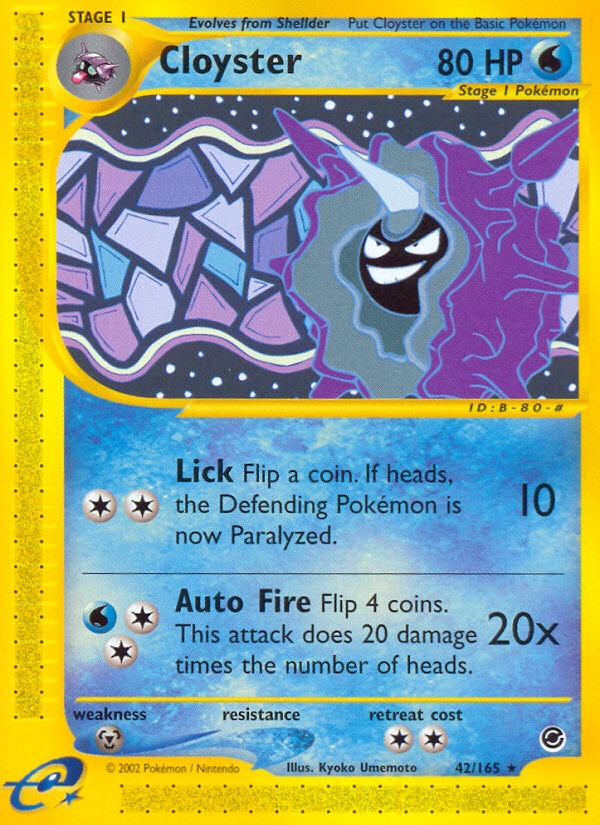
In the early waves of the Pokémon Trading Card Game, designers faced a sweet spot between thematic flavor and approachable gameplay. Cloyster, a Water-type Stage 1 that evolves from Shellder, embodies a turning point in how these decisions shaped strategy, collectability, and the very feel of a new expansion. This Cloyster comes from the Expedition Base Set, a foundational release that helped crystallize how a simple shellfish could become a credible and memorable member of a deck. With 80 HP, a Rare rarity, and a pair of attacks that lean on coin-flip luck, the card captures the era’s tactile balance between risk, reward, and the joy of flipping a necessary heads to turn the tide ⚡🎯.
At first glance, Cloyster’s moves read like a lesson in low-risk mechanics with a high-variance payoff. Its first attack, Lick, costs two Colorless Energy and deals a modest 10 damage, but adds a coin-flip twist: if the coin lands heads, the Defending Pokémon is Paralyzed. This is a classic example of early TCG design where ability effects were as much about setting up a future advantage as about raw damage. The second attack, Auto Fire, requires Water plus two Colorless Energies and delivers a variable payoff: 20 damage times the number of heads across four coin flips. In practice, that means you can skate to victory with a string of favorable flips or stall out on a cold streak. The excitement and tension of coin flips became a strategic feature, not just a gimmick, and Cloyster’s toolkit is a perfect microcosm of that era 🔥🎴.
Beyond the mechanics, Cloyster’s card art—courtesy of Kyoko Umemoto—shows how illustration and surface design worked together to evoke atmosphere. The shell’s spiraling lines, the cool sea tones, and the careful shading all cue a water-dwelling creature that’s both formidable and elegant. Umemoto’s style helped breeders and battlers alike read the card at a glance: a stoic defender with a latent offensive edge. The Expedition Base Set itself, with official card count around 165, carried a consistent visual language that felt cohesive yet distinct from later expansions. This consistency made cross-set drafting less about chasing novelty and more about understanding the subtle language of Energy costs, effects, and weaknesses. In Cloyster’s case, the metal-type weakness ×2 adds a strategic reminder that your opponent’s metallic threats—be they other Water types or evolving steel-themed lines—will pressure Cloyster’s survivability in a meta that wasn’t yet dominated by ultra-brief combos but valued reliability and tempo 👀💧.
From a gameplay-design perspective, Cloyster demonstrates how early cards balanced HP, cost, and effect to create meaningful but approachable decisions. With 80 HP, Cloyster wasn’t a glass cannon or an impenetrable behemoth; it relied on a careful mix of offense and a potential status ailment to edge out opponents. The combination of a coin-based paralysis and a high-variance damage scaler forced players to weigh the probability of successful coin flips against the risk of wasted energy—an early lesson in probability as a strategic tool. As the game evolved, designers gradually shifted toward more deterministic outcomes in many core cards, layering in synergy with Trainers and new mechanics. Cloyster stands as a milestone where the thrill of the coin flip and the tactile joy of evolution intersected with evocative art and collectible appeal ⚡🎨.
Collectors will notice that this Cloyster is classified as Rare and exists in standard (normal) and reverse variants. The allure isn’t just about the stats; it’s about chasing the right print run, the complemented art, and the nostalgia of an era when base-set staples defined many players’ first long-term collections. Market data from CardMarket shows a healthy but measured interest for non-holo copies, with averages hovering in the mid-teens in EUR and lower ranges for the more common entries. The holographic counterparts generally command higher values, reflecting scarcity and condition sensitivity in a market that prizes both playability and display-worthy art. In the U.S. market, the typical non-holo range tends to sit around $6–$11 in recent years, while reverse-holo variants can fetch noticeably more, depending on edition and grade. For a card like Cloyster, those values are a reminder of how a single creature can travel from a simple shell to a cornerstone of sentiment and strategy 💎💬.
Art and lore threads are essential to why this design group endures. Kyoko Umemoto’s Cloyster resonates with players who remember the tactile joy of base-set sleeves, the tactile click of energy attachments, and the suspense of coin flips deciding a match’s fate. The Expedition Base Set’s aesthetic—clear borders, straightforward typography, and a restrained color palette—gave room for the creature’s shell and watery backdrop to tell a story beyond numbers. In the broader arc of card design, Cloyster’s presentation demonstrates how early sets laid a foundation for storytelling through gameplay mechanics, while later sets would expand the palette with trainer-centered strategies and more nuanced creature interactions 🎴🌊.
- HP: 80
- Type: Water
- Stage: Stage 1 (evolves from Shellder)
- Attacks:
- Lick — Colorless, Colorless: 10 damage. Flip a coin. If heads, the Defending Pokémon is Paralyzed.
- Auto Fire — Water, Colorless, Colorless: 20x damage. Flip 4 coins. This attack does 20 damage times the number of heads.
- Weakness: Metal ×2
- Illustrator: Kyoko Umemoto
- Set: Expedition Base Set (ecard1)
- Rarity: Rare
As designers continue to refine the balance between randomness and reliability, Cloyster remains a touchstone for how a single creature’s design can teach broader lessons about deck-building, risk management, and the joy of collecting. The card’s historical footprint—its HP, its two distinct attacks, its evolution line, and its artist’s touch—offers a snapshot of a time when the TCG was expanding rapidly, but still anchored in clear, almost tactile rules. ⚡💬
Interested in seeing more from the network that covers these kinds of shifts in gaming culture and card design? check out related reads and community insights below.
Phone Grip Kickstand Click-On HolderMore from our network
- https://wiki.digital-vault.xyz/wiki/post/pokemon-tcg-stats-shiftry-card-id-xy11-11/
- https://rusty-articles.xyz/tmpwitr0t9x/how-to-practice-mindfulness-every-day-a-simple-step-by-step-guide.html
- https://transparent-paper.shop/blog/post/stable-diffusion-xl-prompt-vaporwave-retro-futurism-mech-rust-texture-sunset-gradient-volcanic-rock/
- https://wiki.digital-vault.xyz/wiki/post/pokemon-tcg-stats-darkrai-card-id-swsh3-105/
- https://blog.crypto-articles.xyz/blog/post/nft-data-clippys-2205-from-clippies-collection-on-magiceden/
Cloyster
Set: Expedition Base Set | Card ID: ecard1-42
Card Overview
- Category: Pokemon
- HP: 80
- Type: Water
- Stage: Stage1
- Evolves From: Shellder
- Dex ID: 91
- Rarity: Rare
- Regulation Mark: —
- Retreat Cost:
- Legal (Standard): No
- Legal (Expanded): No
Description
Attacks
| Name | Cost | Damage |
|---|---|---|
| Lick | Colorless, Colorless | 10 |
| Auto Fire | Water, Colorless, Colorless | 20x |
Pricing (Cardmarket)
- Average: €16.86
- Low: €4.9
- Trend: €14.61
- 7-Day Avg: €12.98
- 30-Day Avg: €20.28
Support Our Decentralized Network
Donate 💠More from our network
- https://wiki.digital-vault.xyz/wiki/post/pokemon-tcg-stats-shiftry-card-id-xy11-11/
- https://rusty-articles.xyz/tmpwitr0t9x/how-to-practice-mindfulness-every-day-a-simple-step-by-step-guide.html
- https://transparent-paper.shop/blog/post/stable-diffusion-xl-prompt-vaporwave-retro-futurism-mech-rust-texture-sunset-gradient-volcanic-rock/
- https://wiki.digital-vault.xyz/wiki/post/pokemon-tcg-stats-darkrai-card-id-swsh3-105/
- https://blog.crypto-articles.xyz/blog/post/nft-data-clippys-2205-from-clippies-collection-on-magiceden/