
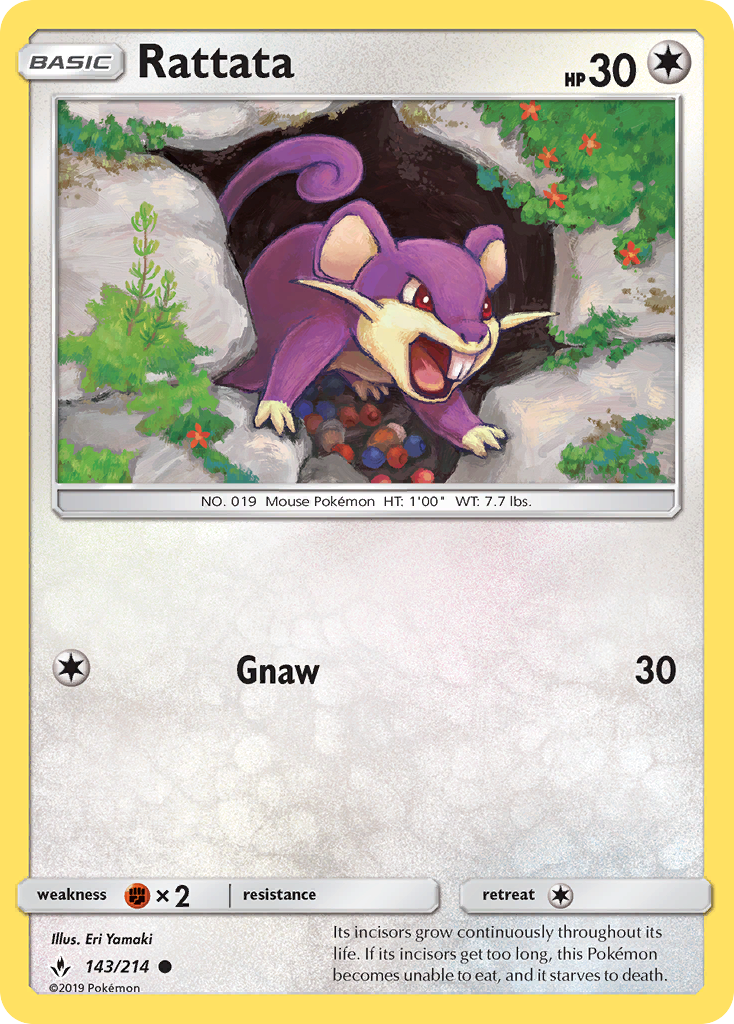
Image courtesy of TCGdex.net
Auction Dynamics and the Curious Case of Rattata from Unbroken Bonds
Pokémon TCG collectors often worry less about the battlefield of the game and more about the auction hall where prices rise and fall with every closing bell. For a humble Common like Rattata (SM10-143) from the Unbroken Bonds set, auction sales can seem almost paradoxical: how does a basic colorless basic creature with 30 HP manage to attract attention in price charts? The answer lies in a convergence of nostalgia, print runs, condition, and the micro-supply-and-demand engine that drives TCG markets online. ⚡ Rattata is a quintessential example of what auction activity reveals about card dynamics. The card’s official details tell a concise story: a basic Colorless-type Pokémon with 30 HP, a single attack—Gnaw—for 30 damage—costing Colorless, and a vulnerability to Fighting with a ×2 multiplier. It retreats for 1 energy, and while it’s not a powerhouse on the table in modern formats, it holds a certain nostalgic weight for long-time collectors who remember sneaking a Rattata into a deck to satisfy early Gym challenges. The Unbroken Bonds printing adds gloss with holo, reverse-holo, and standard variants, all illustrated by Eri Yamaki. Those variants influence auction outcomes far more than raw gameplay power, because condition, rarity type, and collector demand shift the closing prices in meaningful ways. 🎴 A quick snapshot of the card’s data helps set the stage. Rattata appears in SM10: Unbroken Bonds, with the shared dex ID of 19. It’s designated as a Common rarity, and the set total card count sits at 214 official cards out of 234 total in the distribution, reflecting a broad but collectible footprint. The artist behind the art, Eri Yamaki, has a following among fans who appreciate the charm of classic early-rotations, and this aura feeds into auction enthusiasm—especially for holo and reverse-holo copies. The card’s legal usage is Expanded, not Standard, which means it’s more likely to surface in older-format collections that value condition and presentation more than high-velocity meta play. 🔎 What makes auction sales so influential for Rattata’s price? First, the supply thread matters. Even though it’s a Common, the holo and reverse-holo variants create distinct market segments. Holo and reverse-holo copies typically command higher bids and closing prices than the plain non-holo versions, simply because collectors chase the shimmer and nostalgia that those finishes imply. Second, the condition and presentation matter more with “common” cards in auctions than with rare chase cards. A pristine holo copy can fetch a premium, while a worn or heavily played copy remains inexpensive—yet the auction format can still push those submarkets upward when bidders see an opportunity. Finally, external market data feeds influence bidders’ psychology. Across CardMarket and TCGPlayer data snapshots, normal copies of Rattata show low prices in the cent range to a few dimes, while holo variants sit higher, with reverse-holo often occupying a middle tier between normal and holo. These price rails shape auction expectations and often produce short-term spikes when a card is sought for a complete Unbroken Bonds set or a themed collection. 🔥 Price data, while always subject to the flux of auctions, offers a valuable lens. CardMarket records for normal copies of Rattata hover around a few euro cents to a few tenths of a euro on average, with the holo and reverse-holo variants climbing higher depending on the print run and market activity. Specifically, as of late 2025, holo copies show an average around the mid-range of roughly 0.4 EUR in typical market conditions, while reverse-holo averages trend closer to 0.29 EUR. Non-holo normals sit lower, often in the 0.04–0.18 USD spectrum on USD-based listings, with occasional price surges during auction heats or set completions. TCGPlayer mirrors this story in USD: normal copies can sit around a few cents to a couple tenths of a dollar in typical supply, with reverse-holo copies averaging around the high single digits to low tens of cents, and holo forms sometimes cresting into the low dollar range or higher when bidding fervor erupts. While $10 listed as a high point for some listings reflects the volatility of auctions and rare outliers, it underscores how even a common card can experience dramatic price moves when collectors chase a full Unbroken Bonds toolkit or seek a pristine holo for a collection milestone. 📈 For players and collectors, the practical takeaway is clear: auctions elevate price volatility more for holo and reverse-holo variants, and the plain “normal” version remains the most price-stable option in many markets. The sprawl of different printing conditions—firstEdition not applicable here, but holo vs normal vs reverse—means bidders calibrate their bids not just on the card’s power or function in play, but on its potential status as a completed-set trophy, display piece, or sentimental favorite. If you’re considering purchasing or selling, it’s prudent to set thresholds based on the variant. A holo copy may justify a premium, but if you’re chasing a bargain or building a complete collection, the non-holo standard print remains the most affordable entry point, especially in bulk lots. And for those who love the art, the chance to own a holo copy polished by Yamaki’s work can be worth the premium alone, even if the tournament viability of Rattata is limited. 🎨 In practice, timing and condition are your two strongest allies in the auction ecosystem. Watch for end-of-auction countdowns, monitor bid activity on both CardMarket and TCGPlayer, and consider setting automated alerts for price thresholds. For a card like Rattata, the allure of a complete Unbroken Bonds set—plus the aesthetic appeal of holo variants—can amplify competition, nudging prices upward in the closing moments of auctions. Yet patience often pays off: the steady, lower baseline for normal copies tends to stabilize quicker than the high-volatility niches of holo finishes. CTA: if you’re looking to complement your collection with a practical, everyday carry item—while supporting your hobby—consider the Neon Slim Phone Case for iPhone 16 in Glossy Lexan Finish. It’s a stylish companion for any fan’s gear, and you can grab it here: Neon Slim Phone Case for iPhone 16 – Glossy Lexan FinishMore from our network
- https://transparent-paper.shop/blog/post/stable-diffusion-xl-prompt-neo-futurism-mythic-mecha-chrome-realism-lapis-lazuli-palette-terracotta-accents/
- https://crypto-acolytes.xyz/blog/post/nft-stats-bmet-1583-from-baby-met-collection/
- https://wiki.digital-vault.xyz/wiki/post/pokemon-tcg-stats-lucario-card-id-bw4-64/
- https://crypto-acolytes.xyz/blog/post/hot-1214-hot-nft-stats/
- https://crypto-acolytes.xyz/blog/post/188-harlodonsol-nft-stats/
Rattata
Set: Unbroken Bonds | Card ID: sm10-143
Card Overview
- Category: Pokemon
- HP: 30
- Type: Colorless
- Stage: Basic
- Dex ID: 19
- Rarity: Common
- Regulation Mark: —
- Retreat Cost: 1
- Legal (Standard): No
- Legal (Expanded): Yes
Description
Attacks
| Name | Cost | Damage |
|---|---|---|
| Gnaw | Colorless | 30 |
Pricing (Cardmarket)
- Average: €0.1
- Low: €0.02
- Trend: €0.09
- 7-Day Avg: €0.08
- 30-Day Avg: €0.08
Support Our Decentralized Network
Donate 💠More from our network
- https://transparent-paper.shop/blog/post/stable-diffusion-xl-prompt-neo-futurism-mythic-mecha-chrome-realism-lapis-lazuli-palette-terracotta-accents/
- https://crypto-acolytes.xyz/blog/post/nft-stats-bmet-1583-from-baby-met-collection/
- https://wiki.digital-vault.xyz/wiki/post/pokemon-tcg-stats-lucario-card-id-bw4-64/
- https://crypto-acolytes.xyz/blog/post/hot-1214-hot-nft-stats/
- https://crypto-acolytes.xyz/blog/post/188-harlodonsol-nft-stats/