
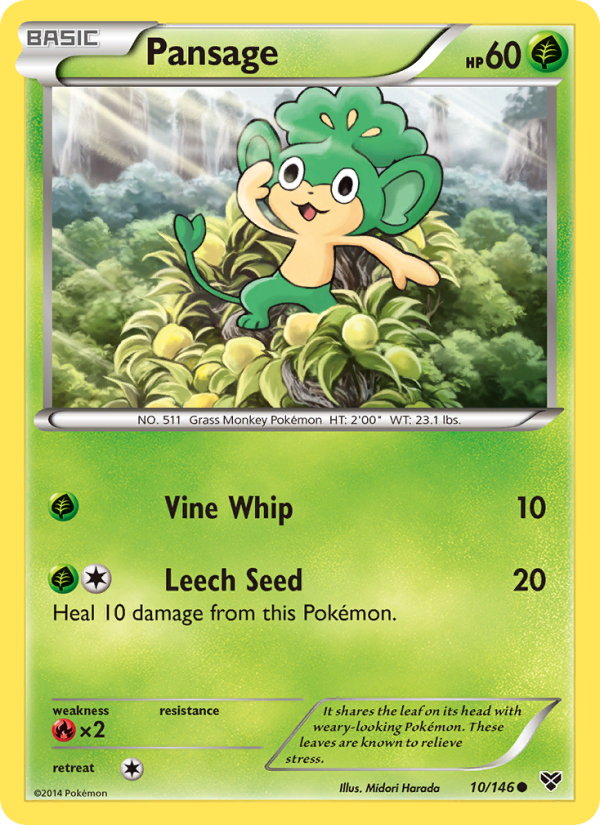
Image courtesy of TCGdex.net
Auction Dynamics in Action: How Pansage’s Price Moves in the Market
For many Pokémon TCG fans, the thrill of auction rooms and online marketplaces isn’t just about snagging a bargain—it’s about reading the pulse of a card’s popularity over time. Pansage, a basic Grass Pokémon from the XY era, sits at a delicate crossroads of accessibility and collectability. With 60 HP, a spry two-attack kit, and a charming, stamp-worthy illustration by Midori Harada, this common card demonstrates how auction activity can shape price narratives even for humble staples in a growing collection. ⚡🔥
Card snapshot
- Name: Pansage
- Set: XY (XY1)
- Card Number: 10
- Rarity: Common
- Stage: Basic
- HP: 60
- Type: Grass
- Attacks: Vine Whip (Grass, 10); Leech Seed (Grass + Colorless, 20) — Heal 10 damage from this Pokémon.
- Weakness: Fire ×2
- Retreat: 1
- Illustrator: Midori Harada
- Legal: Expanded only
- Variants: Normal, Reverse Holo, Holo
Pansage’s humble stats and accessible mana-bar make it a favorite for budget decks and early-game gambits, while its two attacks hint at a steady, attrition-based play pattern. Vine Whip offers a quick pressure option, while Leech Seed conjures a defensive engine: deal a modest 20, then heal 10 on your next turns, nudging your board position toward sustainability. In the age of modern decks, this kind of survivability matters, especially in long tournaments where every hit point counts. The card’s art—lush, leafy greens and a sunny Mt. Moon backdrop—also helps it stand out among more dramatic holo foils, giving players a solid aesthetic reason to appreciatively bid or trade. 🎨
Market snapshot: what the dollars say
Understanding auction-driven price movement means reading multiple marketplaces. For Pansage XY1-10, non-holo, common copies show a modest baseline while holo and reverse-holo variants can fetch noticeably higher prices due to demand and rarity in an era of complete-set collectors.
Average around 0.11 EUR for non-holo, with a low around 0.02 EUR and a subtle upward trend indicated by a 0.1 score in recent data. The holo variants skew higher, with averages closer to 0.61 EUR and a higher trend (0.6). This divergence reflects collector interest in foil finishes that pop on display shelves. For the standard non-holo copy, a low of about 0.05 USD and a mid around 0.24 USD, with occasional highs near 1.49 USD if a bidding crowd clusters. Market price hovers around 0.18 USD, a sweet spot for budget players and casual collectors. Reverse holo copies sit a notch higher, with low around 0.18 USD, mid around 0.40 USD, and highs near 1.53 USD; market price sits near 0.37 USD.
What these figures illustrate is that auction activity can compress or expand the perceived value of Pansage, particularly when the community gravitates toward holo variants. In slang terms among traders, auctions “clear the deck” on inventory and create a visible floor for prices, especially when listings cluster near a popular event—new set announcements, reprint rumors, or a collector’s drive for a complete XY collection. The data also remind us that auctions don’t always move in straight lines; volatility is a natural companion of interest-driven markets, even for a small Grass-type with humble HP. 💎
Why auctions matter for common cards—and for you
Auctions influence pricing in several meaningful ways. First, liquidity: auctions bring buyers and sellers together, lowering the friction to trade. For a card like Pansage, auctions help move non-foil copies from the long-tail of storage into active lists, where curious new players can discover it. Second, variant-driven demand: holo and reverse-holo copies tend to attract premium attention. The XY1-10 holo variant, with a stronger visual appeal and limited print runs compared to its normal counterpart, can pull higher bids and longer auction durations. Third, market psychology: seasoned bidders monitor recent sale histories, and a string of successful auction clears can create a perception of growing rarity—even if print numbers are not dramatically low. In short, auctions can flicker price arrows in both directions, but the longer arc often trends toward gradual appreciation for foil variants and sustained interest for well-illustrated, playable basics like Pansage. ⚡
Tip from the field: watch the listing counts and "sold" history for both non-holo and holo variants. If holo copies consistently sell at higher prices in a given window, that pattern often foreshadows a short- to medium-term price bump as collectors chase a few last pieces for their set.
Gameplay, collection, and market-savvy strategies
For players, Pansage offers a usable Opening-stage tool with Leech Seed’s survive-and-bleed strategy if your deck leans on attrition and board control. In decks where you aim to stall while you power up bulkier attackers, Pansage’s mixed-mode offense can be a reliable hinge. As auctions push prices up for holo versions, players may still rely on regular copies for practice scrimmages or budget tournament builds. The card’s basic status plus its Expanded legality means it remains a flexible option for a variety of play styles, from casual ladder battles to local league nights. 🕹️
Collectors should weigh the appeal of holo vs. non-holo with long-term value in mind. The XY era is known for crisp illustration and enduring nostalgia, and Midori Harada’s artwork gives Pansage a distinctive presence on any binder page. The price gap between non-holo and holo reflects more than mere texture; it mirrors collector sentiment about set completeness and the allure of foil finishes. For those aiming to optimize a collection’s value, earmarking holo copies during favorable auction windows—while keeping non-holo copies as affordable placeholders—can be a balanced approach. 🎴
As always, keep an eye on the broader market indicators: changes in set rotations, shifts in official rules, and the pace at which new players enter the hobby. These factors, interwoven with auction mechanics, shape the daily rhythm of card prices in ways that even a common Pansage card can teach us about value, supply, and community enthusiasm. The XY line remains approachable, from casual trades to online auctions, inviting fans to discover whether a little green monkey can sprint into lasting memory—or simply hold its ground as a dependable staple. 🎮
Phone Case with Card Holder MagSafe Gloss MatteMore from our network
Pansage
Set: XY | Card ID: xy1-10
Card Overview
- Category: Pokemon
- HP: 60
- Type: Grass
- Stage: Basic
- Dex ID: 511
- Rarity: Common
- Regulation Mark: —
- Retreat Cost: 1
- Legal (Standard): No
- Legal (Expanded): Yes
Description
Attacks
| Name | Cost | Damage |
|---|---|---|
| Vine Whip | Grass | 10 |
| Leech Seed | Grass, Colorless | 20 |
Pricing (Cardmarket)
- Average: €0.11
- Low: €0.02
- Trend: €0.1
- 7-Day Avg: €0.1
- 30-Day Avg: €0.12
Support Our Decentralized Network
Donate 💠More from our network
- https://wiki.digital-vault.xyz/wiki/post/pokemon-tcg-stats-heracross-card-id-ecard3-64/
- https://blog.crypto-articles.xyz/blog/post/nft-data-george-plays-clash-royale-802-from-gpcr-nft-collection-collection-on-magiceden/
- https://wiki.digital-vault.xyz/wiki/post/pokemon-tcg-stats-galarian-rapidash-card-id-swsh45-sv048/
- https://transparent-paper.shop/blog/post/stable-diffusion-xl-prompt-acid-neon-obsidian-noir-low-poly-jagged-texture-mixed-media-collage-glitch-aesthetics/
- https://wiki.digital-vault.xyz/wiki/post/pokemon-tcg-stats-alcremie-ex-card-id-sv09-075/