
Image courtesy of TCGdex.net
Analytics and Tropius: Power Creep in the Pokémon TCG
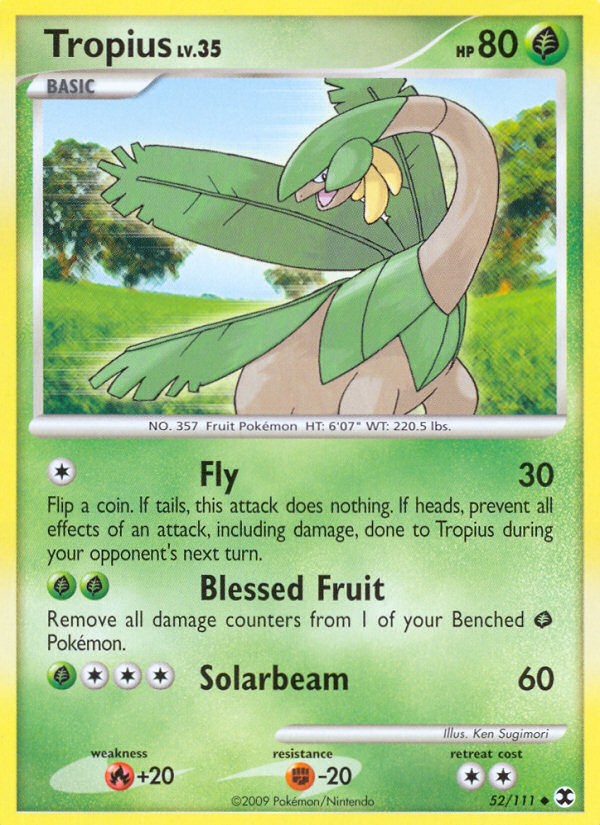
Analysts and players alike love to trace the curves of power as new sets roll out, new mechanics emerge, and the metagame shifts like tides on a sunlit shore. Tropius from Rising Rivals (pl2-52) offers a surprisingly clear snapshot of power creep in action. This Grass-type basic Pokémon, illustrated by Ken Sugimori, sits at 80 HP with a trio of attacks that reveal both the strengths and the clunkiness of its era. Studying Tropius through an analytics lens helps explain why newer Pokémon, abilities, and energy dynamics gradually redefine “viable” on the table—and why collectors still prize a look at these early 2000s design decisions. ⚡🔥💎
HP, energy economics, and the early balance of risk
In a game where the stamina of a card is often measured by its HP versus its energy cost, Tropius’ 80 HP anchors it squarely in the “build-around” category. Compare that to later cycles where cards push into higher HP floors or introduce more efficient energy acceleration. Tropius relies on a mix of two Grass Energy demands and an array of Colorless costs for its most powerful assault, Solarbeam. The math matters: a six-energy, 60-damage attack is not classically oppressive by modern standards, but it’s a heavy investment for a Basic with a moderate HP pool. This is a classic data point in power creep analyses—the cost-to-output ratio can feel steep when newer cards deliver comparable damage with fewer or cheaper resources. Tropius’ presence helps illustrate how early sets balanced raw damage with risk factors like coin flips (Fly) and healing options (Blessed Fruit), creating a tense decision space that forwards the idea of “resource discipline” as a pillar of gameplay.
The interplay of attacks:Fly, Blessed Fruit, and Solarbeam as micro-moments
- Fly (Colorless) — 30 damage with a coin flip: heads prevents all effects of an attack, including damage, to Tropius during the opponent’s next turn. This protection introduces a probabilistic edge—akin to a soft safeguard—that influences opponent line selections and attack timing. Analytics-wise, Fly acts as a risk hedging mechanic: it’s a shield that is powerful in draw-out games but unreliable in a single-turn crush. The randomness adds depth to deck-building, where players weigh protection against consistent pressure.
- Blessed Fruit (Grass, Grass) — Remove all damage counters from 1 Benched Grass Pokémon. This support move encourages bench resilience rather than raw offense, underscoring how early power creep values longevity and setup speed as routes to victory. In aggregate analytics, healing capabilities like Blessed Fruit reduce the volatility of matchups, smoothing outcomes and extending game length in ways modern sets have amplified with more aggressive disruption.
- Solarbeam (Grass, Grass, Colorless, Colorless, Colorless) — 60 damage for a five-energy commitment. The cost-to-damage ratio here highlights a fundamental tension: big payoff comes at the price of resource commitment, which can leave Tropius vulnerable if the board state isn’t stabilized. In long-form analytics, this attack is emblematic of how power creep rewards multi-turn investment—yet it can be outpaced by newer, cheaper, or more flexible options in subsequent sets.
When you map these attacks to win conditions—tradeoffs between damage output, survivability, and healing—the Tropius card paints a microcosm of evolving power. The set’s Rising Rivals identity (Spanish-influenced artwork, pre-release variants, and collectible flavor) sits within a broader arc where HP, energy cost curves, and attack versatility escalate across generations. Tropius’ design emphasizes strategic nuance: sometimes you trade raw DPS for healing and protection, and sometimes you gamble with Fly to stymie an opponent’s offensive tempo. ⚡🎴
Market signals, rarity, and collectible dynamics
From a collector’s standpoint, Tropius pl2-52 is an Uncommon card in a limited pool of Rising Rivals printings. Its Basic stage and 80 HP place it in a class that modern players often relegate to the binder on casual days, yet analytics show that rarity, print run, and condition heavily influence value trajectories across eras. Price data from Cardmarket and TCGPlayer in this card’s window demonstrates how early power curve cards retain niche appeal: modest average prices in the 0.20–0.40 EUR/USD range for non-holo copies, with holo and condition-adjacent variants driving steeper premiums. Such data points help collectors and investors interpret power creep not just as mechanical shifts, but as market dynamics where nostalgia and condition amplify value as decks rotate out of Standard and into broader formats. The card’s deviation from modern power standards—combined with its healing and protection utilities—creates a durable spot in the fan’s memory bank and price sheet.
Strategic implications for players and deck-building analytics
For players exploring older formats or nostalgia-laden builds, Tropius offers a case study in synergy-driven play. Its Solarbeam can be a finisher when a player has established bench pressure and healing support. The Blessed Fruit option rewards patience, encouraging players to protect a key Grass Pokémon on the bench and prevent cascading damage that would otherwise punish a slow start. In terms of power creep analytics, Tropius demonstrates how early designers experimented with “board control via defense” alongside “burst through heavy energy costs.” Later sets would push the envelope by delivering cleaner two- or three-energy machinations, more consistent healing, and fewer dice-roll dependencies. The evolving balance sheet across sets is what keeps the data scientists and tournament organizers busy: HP inflation, energy acceleration, and the tempo of attacks all feed into win rates, deck archetypes, and card valuations. Tropius, with its nature-driven design, remains a gentle reminder that power creep is not just about hitting harder—it’s about designing fights that reward patient planning and robust resource management. 🔥🎨
Nostalgia meets analytics: art, lore, and the human element
Ken Sugimori’s illustration for Tropius anchors the card in a beloved era of Pokémon art, bridging nostalgia with ongoing strategic relevance. The Rising Rivals era captures a transitional moment when players learned to balance raw numbers with board-state discipline. The combination of a protective Fly move, a handy healing option, and a heavy Solarbeam energy cost produced a deck-building puzzle that rewarded foresight and resilience. Even as power creep pushes newer cards toward bigger numbers and more aggressive tempos, Tropius remains a living reference point—an artifact that proves early designers understood the long arc of player experience. The card embodies how analytics can illuminate not only what is powerful in a vacuum, but what sustains a design’s appeal across years of evolving competition. 💎🎮
Non-slip gaming mouse padMore from our network
- https://blog.crypto-articles.xyz/blog/post/nft-data-the-same-old-gag-393-from-the-same-old-gag-collection-on-magiceden/
- https://blog.crypto-articles.xyz/blog/post/nft-data-faerin-plumadorada-shattered-86-from-risen-collection-on-magiceden/
- https://wiki.digital-vault.xyz/wiki/post/pokemon-tcg-stats-drifloon-card-id-b1-107/
- https://blog.crypto-articles.xyz/blog/post/nft-data-gib-1057-from-gib-collection-on-magiceden/
- https://wiki.digital-vault.xyz/wiki/post/pokemon-tcg-stats-aipom-card-id-a2-130/
Tropius
Set: Rising Rivals | Card ID: pl2-52
Card Overview
- Category: Pokemon
- HP: 80
- Type: Grass
- Stage: Basic
- Dex ID: 357
- Rarity: Uncommon
- Regulation Mark: —
- Retreat Cost: 2
- Legal (Standard): No
- Legal (Expanded): No
Description
Attacks
| Name | Cost | Damage |
|---|---|---|
| Fly | Colorless | 30 |
| Blessed Fruit | Grass, Grass | |
| Solarbeam | Grass, Colorless, Colorless, Colorless | 60 |
Pricing (Cardmarket)
- Average: €0.34
- Low: €0.02
- Trend: €0.09
- 7-Day Avg: €0.39
- 30-Day Avg: €0.53
Support Our Decentralized Network
Donate 💠More from our network
- https://blog.crypto-articles.xyz/blog/post/nft-data-the-same-old-gag-393-from-the-same-old-gag-collection-on-magiceden/
- https://blog.crypto-articles.xyz/blog/post/nft-data-faerin-plumadorada-shattered-86-from-risen-collection-on-magiceden/
- https://wiki.digital-vault.xyz/wiki/post/pokemon-tcg-stats-drifloon-card-id-b1-107/
- https://blog.crypto-articles.xyz/blog/post/nft-data-gib-1057-from-gib-collection-on-magiceden/
- https://wiki.digital-vault.xyz/wiki/post/pokemon-tcg-stats-aipom-card-id-a2-130/