
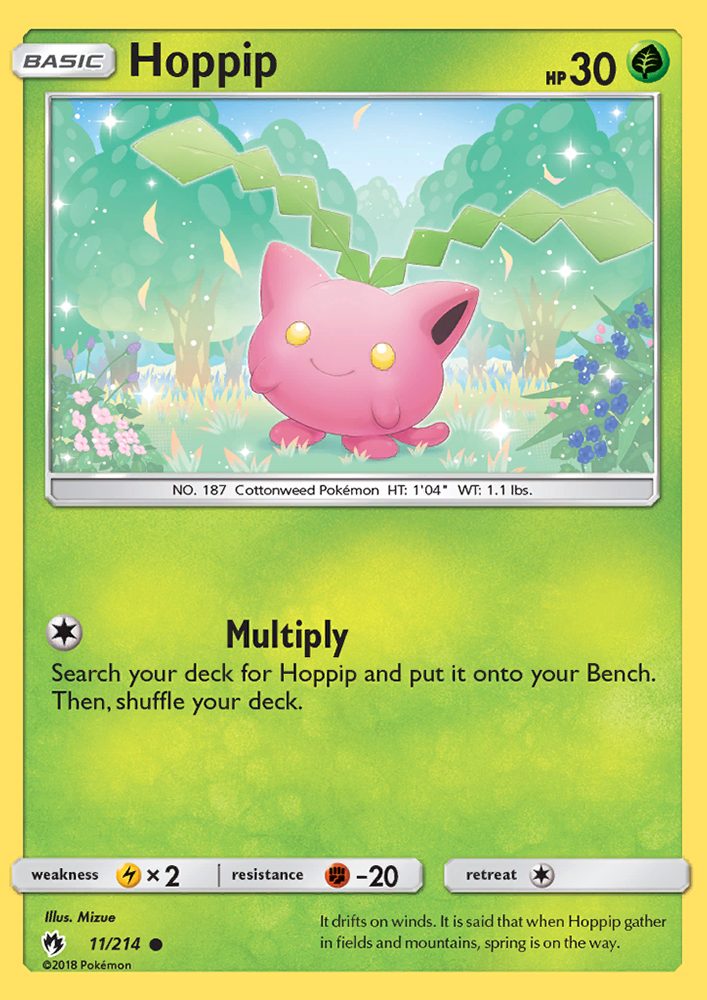
Image courtesy of TCGdex.net
Hoppip's Role in Prize-Trade Strategies in Scarlet & Violet
In the evolving landscape of prize-driven play, players constantly scout for engines that squeeze every last bit of tempo from a turn. When you mix that mindset with the Scarlet & Violet era’s appetite for events, you start looking beyond the latest marquee cards and toward solid, consistent lines that outpace your opponent card-for-card. One such line worth unpacking is Hoppip from Lost Thunder (SM8). Though modest in a vacuum, its role in prize-trade strategies—especially in Expanded formats—is a quiet reminder that the most impactful plays often come from reliable setup and bench control rather than big, flashy knockouts.
Hoppip is a Basic Grass-type with a humble 30 HP and a single, no-frills attack: Multiply. For one Colorless energy, its effect is a simple engine-builder: search your deck for a Hoppip and put it onto your Bench, then shuffle. In practice, this is less about whacking an opponent and more about accelerating your board state. In a prize-heavy game, where every bench space matters and prize advantages swing on the speed at which you assemble a full line of evolutions, that acceleration can be the difference between a stalled game and a clean route to victory.
What the card brings to the table
- Consistency through bench acceleration: The core strength of Multiply is its potential to seed your bench with Hoppip, enabling a quick path toward Skiploom and Jumpluff. If you’re aiming to deploy a Jumpluff-centric engine, Hoppip provides a reliable, low-cost way to stack the bench early, so you can start pressuring your opponent before their own setup lands.
- Low risk and low cost: As a Common card from a past set, Hoppip is inexpensive to collect, easy to reprint into budget builds, and widely available—an attractive trait for prize-trade tactic builders who want a stable backbone without inflating their price tag.
- Format nuance: Expanded viability: The card’s legality sits in Expanded, not Standard, which means its prize-pressing utility shines in formats that allow older engine pieces. In Scarlet & Violet’s broader ecosystem, this invites a strategic bridge: you may rely on legacy bench-accelerators to stabilize your early game while you weather the standard-legal lineup of modern sets.
- Artwork, rarity, and accessibility: Mizue’s art on Lost Thunder brings a familiar, approachable aesthetic to the table, reinforcing the card’s identity as a dependable, “budget-friendly” pick. Its Common rarity further reinforces value-for-effort in a prize-chasing meta, where every card counts toward remaining a step ahead.
Tip: Seed your bench early and keep an eye on your seating capacity. Multiply only works when there’s space to place a new Hoppip on your Bench—overfilling it can blunt the engine you’re trying to build. Plan your turn sequences to avoid bench congestion while you’re racing toward your Jumpluff line.
Beyond the mechanic itself, the card’s weaknesses and resistances shape how you deploy it in prize-driven decks. Hoppip’s Lightning weakness ×2 and Fighting resistance of −20 forces you to consider matchups where energy types are skewed toward quick knockouts or heavy Fighting lines. With a retreat cost of 1, it’s easy to keep your bench healthy for several turns, but you’ll want to pair it with support Pokémon and Trainers that help you protect your engine from disruptive effects and gust-based plays.
In Scarlet & Violet-era prize trades, the dynamic isn’t only about getting to a big showdown; it’s about how you manage your six-prize economy while maintaining tempo. Hoppip’s Multiply attack can be the spark in a broader strategy that uses a few “set-up” turns to establish a multi-card advantage. A typical plan might involve filling the early bench with Hoppip (and later Skiploom) so that Jumpluff can sweep through several prize cards in a controlled sequence once your engine is online. This approach aligns with prize-control principles: you aim to maximize the number of threats you can present from your bench while limiting your opponent’s ability to disrupt your setup with single-prize knockouts on your key pieces.
Drafting a prize-optimized engine
- Bench management: Balance growth with staying within the five-Bench limit. Multiply becomes most valuable when you have breathing room to place new Hoppip on your bench without triggering overfill, which would waste the action.
- Evolution synergy: Build a clear path from Hoppip to Jumpluff (and Skiploom where applicable) to ensure your prize line remains consistent. In practice, you’ll want to pepper in copies of the evolved forms at the right cadence so that late-game pressure comes from a fully realized line rather than a sporadic split of attackers.
- Trash-talk-proof economy: Because Hoppip is common and easy to source, it helps you maintain a stable supply of engine pieces even as prize pressure mounts. It’s the kind of card you can draw into reliably, which matters when you’re trying to stay ahead on prizes in a swingy, wild meta.
- Meta-awareness: If Lightning-heavy decks are circulating in Expanded events, your plan may require extra protection or quick transitions into Jumpluff’s more resilient forms. The card’s weakness is a factor to account for in your matchups and sideboard considerations.
From a market perspective, Hoppip’s price profile reinforces its role as a value pick. Cardmarket data shows average prices hovering around a few euro cents to a couple of euros for holo variants, while TCGPlayer indicates a low baseline for normal copies (low around $0.05, mid around $0.20, and peak around $3 in rare cases). For prize-trade builders who want to keep costs down while maintaining a robust engine, that combination of affordability and reliability is compelling. It’s not about chasing rare pulls; it’s about crafting a resilient, repeatable setup that keeps you in the game as the prize rewards pile up.
Illustration, rarity, and accessibility matter in every tournament kit, and Hoppip delivers on all fronts. The card’s simple text belies the nuance it offers when you weave it into a broader strategy—especially in Expanded environments where you can leverage older engine pieces that Scarlet & Violet players may underutilize. If you’re chasing a prize-leaning, tempo-forward deck that plays long and quiet, Hoppip can be a surprisingly impactful piece in your toolbox.
To explore a practical path and see the engine light up, pair Hoppip with a thoughtful bench strategy and a clear evolution plan. In the prize race, every card you draw—and every bench you fill—holds the potential to tilt the scoreboard in your favor. ⚡🔥💎
Neon Slim Phone Case for iPhone 16 – Glossy LexanMore from our network
- https://wiki.digital-vault.xyz/wiki/post/pokemon-tcg-stats-anorith-card-id-swsh12-095/
- https://articles.zero-static.xyz/blog/post/red-mana-color-palette-and-symbolism-in-ben-ben-akki-hermit/
- https://crypto-acolytes.xyz/blog/post/nft-stats-nft-855-from-unipcs-bots-collection/
- https://donation.digital-vault.xyz/donation/post/support-tech-literacy-for-all-ages-with-your-donation/
- https://crypto-acolytes.xyz/blog/post/ret-land-497-retardio-land-ii-nft-stats/
Hoppip
Set: Lost Thunder | Card ID: sm8-11
Card Overview
- Category: Pokemon
- HP: 30
- Type: Grass
- Stage: Basic
- Dex ID: 187
- Rarity: Common
- Regulation Mark: —
- Retreat Cost: 1
- Legal (Standard): No
- Legal (Expanded): Yes
Description
Attacks
| Name | Cost | Damage |
|---|---|---|
| Multiply | Colorless |
Pricing (Cardmarket)
- Average: €0.09
- Low: €0.02
- Trend: €0.09
- 7-Day Avg: €0.1
- 30-Day Avg: €0.12
Support Our Decentralized Network
Donate 💠More from our network
- https://wiki.digital-vault.xyz/wiki/post/pokemon-tcg-stats-anorith-card-id-swsh12-095/
- https://articles.zero-static.xyz/blog/post/red-mana-color-palette-and-symbolism-in-ben-ben-akki-hermit/
- https://crypto-acolytes.xyz/blog/post/nft-stats-nft-855-from-unipcs-bots-collection/
- https://donation.digital-vault.xyz/donation/post/support-tech-literacy-for-all-ages-with-your-donation/
- https://crypto-acolytes.xyz/blog/post/ret-land-497-retardio-land-ii-nft-stats/