

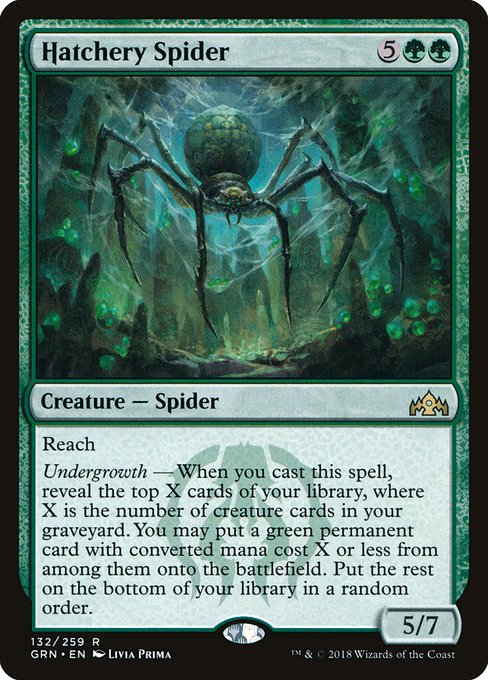
Image courtesy of Scryfall.com
A Green Engine for Card Draw and Board Presence
In Guilds of Ravnica, Hatchery Spider arrives as a Golgari centerpiece—a rare spider that wears Reach and a crimson badge of graveyard ambition. Its creature stat line, a sturdy 5/7 for a hefty seven mana, signals a mid-to-late game thesis: stabilize the board, grow a resilient engine, and grind opponents down with undergrowth advantage. The real spark, though, is its Undergrowth ability: when you cast it, reveal the top X cards of your library, where X is the number of creature cards in your graveyard. You may put a green permanent card with mana value X or less from among them onto the battlefield. The rest head to the bottom in a random order. 🧙♂️🔥💎
That blend of graveyard fueling and immediate board impact is what makes Hatchery Spider a natural catalyst for card-draw engines. You’re not simply drawing cards in the traditional sense; you’re turning your graveyard into a gas tank, then converting the revealed pool into a tangible advantage on the battlefield. It’s the Golgari ethos distilled into a single, elegant clause: grow the graveyard, reveal the fortune, and cash in on the payoff. The art and flavor reinforce the idea of a creeping hive swelling with life, ready to propel you toward victory. ⚔️🎨
How Undergrowth turns draws into a mini-reserve of gas
Undergrowth is a classic MTG dynamic: your graveyard is a resource you can weaponize. When you cast Hatchery Spider, X equals the number of creature cards in your graveyard, so your future draws become a function of how many creatures you’ve already buried. From the revealed top X cards, you may choose a green permanent with mana value X or less and drop it onto the battlefield. The rest of the revealed cards go on the bottom in a random order. This creates a built-in engine: the more creatures you accumulate in the graveyard, the bigger the window to fetch efficient permanents—ranging from low-cost ramp to card-value engines—on each cast. The function is simple, but the pressure it applies on the game state is profound. 🌱🧨
Strategic paths to build a card-draw engine
- Graveyard farming: Fill your graveyard with creature cards quickly using self-mill, token generation, or recursion. Hatchery Spider rewards you for a fuller graveyard by letting you fetch a green permanent that can refill your hand or accelerate your board. It’s about turning a resource you’d normally fear into your next payoff. 🧠
- Accelerants and ramp: The green permanents you fetch can be ramp pieces or value engines that improve your card draw cadence—think permanents that generate extra draws, filter your deck, or simply ramp you into more spells. Even a modest benefit on the battlefield compounds as you sequence more Undergrowth triggers over the course of a game. ⚡
- Late-game inevitability: In longer matchups, Hatchery Spider can convert stacked graveyards into scalable threats, ensuring you have a credible draw-and-play path well into the later turns. The spider’s reach ensures you don’t just stall—you press, with a plan that grows more powerful as the game endures. 🧭
Practical play examples and caveats
Turn planning matters. If you cast Hatchery Spider with X equal to the number of creature cards in your graveyard, you’re betting on the top reveal to yield a green permanent that can swing the game. The simplest targets are cheaper green permanents with ETB effects, ramp pieces, or subtle card-advantage tools that can persist beyond a single turn. Because you’re pulling a permanent from the revealed pool rather than drawing from your hand, you sidestep traditional hand-size friction and push your resources onto the battlefield. This is the heart of Golgari’s value engine: convert graveyard value into tangible pressure. 🧙♂️🎲
That said, there are caveats. If your graveyard isn’t growing fast enough, X stays small and your payoff shrinks. The randomness of what ends up on the bottom can also tilt results away from your desired outcome. But the upside—repeatable, scalable value in the mid to late game—often outweighs the risk, especially in slower metas that prize card quality and attrition over raw speed. The engine rewards patient play and careful sequencing, two hallmarks of truly satisfying MTG strategies. 💎⚔️
“A single, well-timed Undergrowth payoff can outpace two draw spells in a late game.”
A quick deck-theory sketch: building around Hatchery Spider
In a typical Golgari shell, maximize creature-card density in the graveyard and ensure you can reliably cast Hatchery Spider. Consider ways to trigger Undergrowth multiple times across turns, or recast Hatchery Spider without sacrificing your board state. Include a few zero-to-low-cost green permanents that are effective on the battlefield and can yield further advantage once landed. If you’re curious about tech that complements this approach, seek green permanents with on-board effects that enhance card draw or board presence, amplifying the engine’s impact as the game unfolds. 🧭
Ultimately, Hatchery Spider embodies a thoughtful, midrange strategy: you don’t need to flood your hand with spells to win. You stack your graveyard, reveal a cascade of cards, and convert that into a lasting board advantage. The card’s Golgari flavor and willingness to explore the margins between risk and reward make it a favorite for players who savor tempo, value, and the tactile satisfaction of a well-constructed graveyard engine. 🧙♂️🔥🎨
Non-Slip Gaming Mouse Pad with Polyester SurfaceMore from our network
- https://transparent-paper.shop/blog/post/mastering-transparency-in-digital-paper-art/
- https://blog.digital-vault.xyz/blog/post/mtg-dawnhart-disciple-data-driven-mana-efficiency-analysis/
- https://crypto-acolytes.xyz/blog/post/polkadot-vs-harmony-pros-cons-and-outlook/
- https://blog.crypto-articles.xyz/blog/post/fan-spotlight-celebrating-the-fighting-energy-illustrators-style/
- https://wiki.digital-vault.xyz/wiki/post/pokemon-tcg-stats-zinnia-card-id-sm75-70/
Hatchery Spider
Reach
Undergrowth — When you cast this spell, reveal the top X cards of your library, where X is the number of creature cards in your graveyard. You may put a green permanent card with mana value X or less from among them onto the battlefield. Put the rest on the bottom of your library in a random order.
ID: 0b841904-202c-4b42-869a-e345112ab1c8
Oracle ID: d1950094-2cc9-48ce-ae1a-0ae78ba252c1
Multiverse IDs: 452882
TCGPlayer ID: 176778
Cardmarket ID: 364185
Colors: G
Color Identity: G
Keywords: Reach, Undergrowth
Rarity: Rare
Released: 2018-10-05
Artist: Livia Prima
Frame: 2015
Border: black
EDHRec Rank: 10121
Penny Rank: 14728
Set: Guilds of Ravnica (grn)
Collector #: 132
Legalities
- Standard — not_legal
- Future — not_legal
- Historic — legal
- Timeless — legal
- Gladiator — legal
- Pioneer — legal
- Modern — legal
- Legacy — legal
- Pauper — not_legal
- Vintage — legal
- Penny — legal
- Commander — legal
- Oathbreaker — legal
- Standardbrawl — not_legal
- Brawl — legal
- Alchemy — not_legal
- Paupercommander — not_legal
- Duel — legal
- Oldschool — not_legal
- Premodern — not_legal
- Predh — not_legal
Prices
- USD: 0.28
- USD_FOIL: 0.82
- EUR: 0.19
- EUR_FOIL: 0.59
- TIX: 0.02
More from our network
- https://blog.zero-static.xyz/blog/post/how-umbreon-gx-shapes-its-generations-pokemon-tcg-narrative/
- https://blog.crypto-articles.xyz/blog/post/hades-server-performance-and-stability-analyzed-for-pc/
- https://wiki.digital-vault.xyz/wiki/post/pokemon-tcg-stats-ortega-card-id-sv03-219/
- https://rusty-articles.xyz/tmp6nepjutl/15de5a57.html
- https://blog.crypto-articles.xyz/blog/post/nft-data-planet-kaiju-4404-from-planet-kaiju-collection-on-magiceden/