

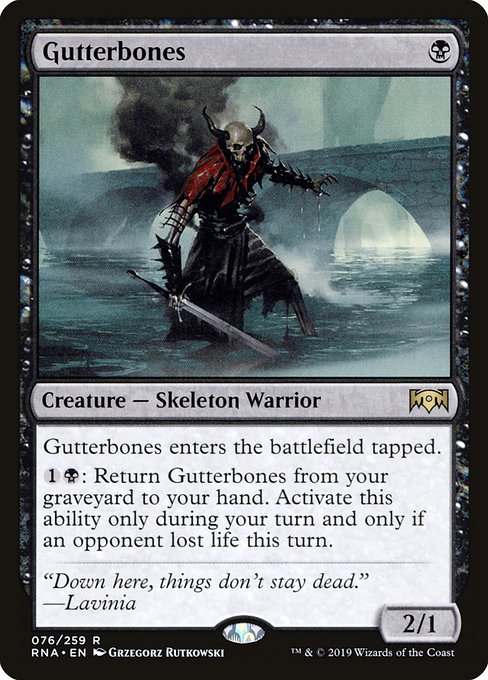
Image courtesy of Scryfall.com
Gutterbones Odds: A Practical Look at Trigger Probabilities in MTG
Probability isn't just a spreadsheet relic; it's the heartbeat behind why certain spells feel clutch and why some creature cards slip into victories by a whisper. When you lean on a card like Gutterbones, a rare skeleton warrior from Ravnica Allegiance, you’re not just playing a one-mana beater—you’re weaving a probabilistic thread through the fabric of the game. This article dives into how to think about the odds of triggering Gutterbones’ signature moment: returning this card from your graveyard to your hand when an opponent has lost life this turn 🧙♂️🔥. We’ll blend theory, deck-building intuition, and a dash of MTG lore to keep your brain as sharp as Lavinia’s blade.
Card Primer: What Gutterbones Does
- Name: Gutterbones
- Mana Cost: {B}
- Type: Creature — Skeleton Warrior
- Power/Toughness: 2 / 1
- Rarity: Rare
- Set: Ravnica Allegiance (RNA)
- Text: This creature enters tapped. {1}{B}: Return this card from your graveyard to your hand. Activate only during your turn and only if an opponent lost life this turn.
- Flavor Text: "Down here, things don't stay dead." —Lavinia
Gutterbones isn’t just a two-power punch; it’s a doorway to a little graveyard recursion, a reminder that in the undercity of Ravnica, life and death dance to the same rhythm.
Because Gutterbones lives in the black color pie, it sits at an intriguing crossroads: it’s a resilient body for one mana, a doorway back from the graveyard, and a conditional engine that demands you respect the turn structure. Its ability to bounce back on your own turn only if an opponent lost life this turn adds a dash of timing precision that can win you late-game feels in the blink of an eye. In formats where life totals matter and mill-and-grind archetypes hover, Gutterbones becomes a compact tactic for sustained pressure and resource denial 🧙♂️🎲.
How the Trigger Works: The Turn Equation
At its core, the trigger is simple: on your turn, if an opponent has lost life during the current turn, you may pay {1}{B} to return Gutterbones from your graveyard to your hand. That phrasing matters. “This turn” can include life lost on your opponent’s prior actions during that same turn, including any combat damage they’ve taken or spells that chipped away their life total. The key is that life loss must have occurred during the current turn when you attempt the ability. If no life was lost yet, the option doesn’t exist—making the timing of your plays brutally relevant 🔎.
In practical terms, building around Gutterbones means embracing decks that can reliably push life loss to your opponent within a single turn window. Do you have a way to deal a little damage now and threaten more later? Are you leveraging discard, drain effects, or targeted removal that also nudges the life total south? All of these factors affect how often you’ll reach that back-from-the-grave moment, and that, in turn, colors your decisions on sequencing and resource management 💡⚔️.
Modeling the Odds: A Practical Framework
Let’s consider a simple, approachable framework to think about the probability that Gutterbones will be able to bounce back on a given turn. We’ll keep things intuitive and avoid over-fitting to a single deck archetype. Imagine your turn has a few potential life-loss events that could affect your opponent:
- Direct damage spells you cast on that turn
- Attacks by your creatures that deal damage to the opponent
- Opponent-damaging permanents you control (for example, other sources that ping or drain)
If you assume these events are independent and each has a probability p_i of causing life loss during the current turn, the probability that at least one life-loss event occurs this turn is 1 minus the probability that none occur:
P(at least one life loss) = 1 - Π_i (1 - p_i)
Let’s illustrate with a few toy scenarios to show how changes in your board state swing the odds, all while keeping Gutterbones’ unique constraint in mind:
- Minimal aggression: two potential life-loss events on your turn, each with a 50% chance (p1 = p2 = 0.5). Then P = 1 - (0.5 × 0.5) = 0.75. There’s a solid three-quarters shot that life loss happens this turn, unlocking the bounce-back option.
- Moderate aggression: three events at 60% each (p1 = p2 = p3 = 0.6). P = 1 - (0.4 × 0.4 × 0.4) ≈ 0.936. A near-certain window opens, letting you reclaim Gutterbones with confidence if you’re on the play or have a spicy combat plan.
- Heavy aggression: four events at 80% each. P = 1 - (0.2^4) ≈ 0.9984. In this space, you’re almost guaranteed to have life-loss this turn, giving frequent access to reusing Gutterbones as a hand-size accelerator from the grave.
Of course, real games aren’t independent Bernoulli trials, and not every life-loss event is equally available on every turn. But this framework helps you calibrate expectations: the more reliable your sources of life loss, and the more ways you have to capitalize on that moment (including other graveyard interactions and draw steps), the higher your practical trigger rate will feel on the battlefield 🧙♂️💎.
Practical Strategies to Tilt the Odds
- Maximize turn-by-turn pressure: include a mix of small creatures and direct-damage spells so that on most turns you’re nudging the opponent’s life total downward by at least a few points. Even a single point of life loss can set up Gutterbones to rebound on your next turn.
- Graveyard synergy: build around recasting Gutterbones from the graveyard and other recursion effects. The more you can ensure a graveyard loop, the more reliably you’ll trigger the bounce-back ability when the turn bleeds life away.
- Timing discipline: remember the activation clause is limited to your turn and only if life was lost that turn. Plan your plays so that you both deal life loss and preserve enough mana to reactivate Gutterbones when the window opens.
- Multiplayer considerations: in a pod, life-total dynamics are more volatile. Shared damage often increases the likelihood that someone loses life in a given turn, broadening the trigger window—though you’ll also need to manage more subtle politics and blockers.
- Aesthetics and flavor: beyond math, the art and lore—“Down here, things don’t stay dead”—remind us that even the smallest skeleton can become a persistent thorn in the side of your rivals 🪦🎨.
As you tune your deck, keep in mind that the true craft lies in balancing risk and reward. Gutterbones rewards patient setup—the kind of patient play that MTG fans savor after years of drafting, dueling, and trading jokes about graveyards and glory. When the odds tilt in your favor, that gleam in the corner of a card’s edge can feel like a spark of fate in a long, winding game 🔥💎.
More from our network
- https://area-53.zero-static.xyz/1a66afe7.html
- https://crypto-acolytes.xyz/blog/post/nft-stats-kode-188-from-kode-collection/
- https://wiki.digital-vault.xyz/wiki/post/pokemon-tcg-stats-cherubi-card-id-bw11-4/
- https://crypto-acolytes.xyz/blog/post/nft-stats-george-plays-clash-royale-1061-from-gpcr-nft-collection-collection/
- https://wiki.digital-vault.xyz/wiki/post/pokemon-tcg-stats-victory-cup-card-id-bwp-bw29/
Want a tidy desk to match your probability nerd energy? Check out this handy accessory for your workstation — a Custom Rectangular Mouse Pad (9.3x7.8 in) that keeps your desk as sharp as your deck-building instincts.
Custom Rectangular Mouse Pad (9.3x7.8 in)
More from our network
- https://area-53.zero-static.xyz/1a66afe7.html
- https://crypto-acolytes.xyz/blog/post/nft-stats-kode-188-from-kode-collection/
- https://wiki.digital-vault.xyz/wiki/post/pokemon-tcg-stats-cherubi-card-id-bw11-4/
- https://crypto-acolytes.xyz/blog/post/nft-stats-george-plays-clash-royale-1061-from-gpcr-nft-collection-collection/
- https://wiki.digital-vault.xyz/wiki/post/pokemon-tcg-stats-victory-cup-card-id-bwp-bw29/
Gutterbones
This creature enters tapped.
{1}{B}: Return this card from your graveyard to your hand. Activate only during your turn and only if an opponent lost life this turn.
ID: 6a1c710b-bd67-4174-ab02-6ae98a7575ac
Oracle ID: 76ae3779-c821-4cd3-8d0f-8c42d1206ce4
Multiverse IDs: 457220
TCGPlayer ID: 183034
Cardmarket ID: 368137
Colors: B
Color Identity: B
Keywords:
Rarity: Rare
Released: 2019-01-25
Artist: Grzegorz Rutkowski
Frame: 2015
Border: black
EDHRec Rank: 9235
Penny Rank: 1829
Set: Ravnica Allegiance (rna)
Collector #: 76
Legalities
- Standard — not_legal
- Future — not_legal
- Historic — legal
- Timeless — legal
- Gladiator — legal
- Pioneer — legal
- Modern — legal
- Legacy — legal
- Pauper — not_legal
- Vintage — legal
- Penny — legal
- Commander — legal
- Oathbreaker — legal
- Standardbrawl — not_legal
- Brawl — legal
- Alchemy — not_legal
- Paupercommander — not_legal
- Duel — legal
- Oldschool — not_legal
- Premodern — not_legal
- Predh — not_legal
Prices
- USD: 0.37
- USD_FOIL: 1.37
- EUR: 0.45
- EUR_FOIL: 1.32
- TIX: 0.02
More from our network
- https://articles.zero-static.xyz/blog/post/what-could-change-after-launch-for-outriders-patch-notes/
- https://crypto-acolytes.xyz/blog/post/nft-stats-nft-116-from-free-sol-collection/
- https://articles.digital-vault.xyz/blog/post/elvish-spirit-guide-green-ramp-that-powers-multicolor-plays/
- https://blog.crypto-articles.xyz/blog/post/nft-data-retardio-271-from-retardio-land-collection-on-magiceden/
- https://articles.digital-vault.xyz/blog/post/satisfactory-pc-setup-optimization-for-peak-fps/