
Image courtesy of Scryfall.com
Goldnight Castigator and the Art of MTG Card Grading: Authenticity, Condition, and Culture
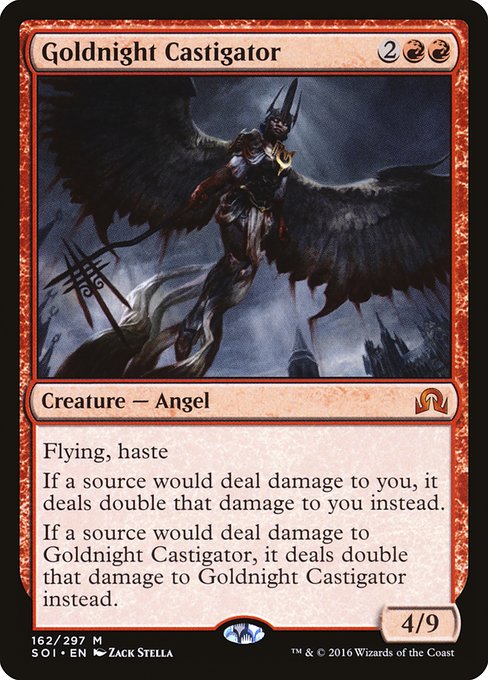
If you’ve ever hunted for a pristine copy of a Shadows over Innistrad mythic, you know the thrill that comes with a rare red dragon—okay, not a dragon, but an imposing, winged sentinel: Goldnight Castigator. This 4/9 Angel of haste with flying is a standout in red-based commander shells and a striking subject in any grading discussion. As a card released in 2016 within the Shadows over Innistrad set, it carries a distinctive print profile: a black border, a 2015 frame, and the oval security stamp that marks a time when Wizards of the Coast was tightening up print integrity. For graders and collectors alike, that combination—color identity, creature type, and print-era hallmarks—creates a rich case study in how authenticity and condition intersect with value 🧙♂️🔥.
The card’s mana cost—{2}{R}{R}—is visually bold, hinting at the fast, aggressive tempo that red wanted to bring to Innistrad’s gothic nightmare. Its creature type, “Angel,” paired with the flying keyword, evokes a rare mix of aerial menace and radiant ferocity. The power/toughness line—4/9—speaks to a battlefield presence that’s sizeable for a red creature, and the haste ability adds a extra layer of tempo that can swing games. In authenticity terms, the physical card’s attributes—centered borders, crisp text, and the signature “mythic” rarity—stand as a baseline for grading, but the real conversation begins with print-era markers and surface integrity. The card exists in both nonfoil and foil finishes, a factor that often doubles as a grading cross-check: foils tend to show more whitening risk on the reverse, while nonfoils might reveal minor edge chips that would otherwise be hidden in a busy battlefield scene ⚔️🎨.
What makes this card a compelling study for grading and authentication
Goldnight Castigator is a perfect example to discuss core grading criteria: centering, edges, corners, and surface. In practice, a collector will scrutinize:
- Centering and alignment: Off-center prints are not unusual in 2015–2016 era sets. A pristine copy shows a balanced border on all sides, but many players accept a touch of misalignment if the surface is clean and the corners are sharp.
- Edge wear and corner rounding: The cast of a foil vs. nonfoil copy diverges here. Foils often show micro-frays or silvering along the edges, while nonfoils tend to exhibit uniform edge whitening if abused in storage. In both cases, strong corners—especially on the “mythic” slope—can push a grade toward near-mint or higher.
- Surface and gloss: For a high-rarity card, surface scratches, scuffing, or gloss issues can be a limiter. The SOI foil line has a distinct gloss profile; nonfoil copies typically show their own surface texture quirks from the printing process.
- Print-era authenticity markers: The oval security stamp, black border, and the 2015 frame style are mint-condition fingerprints of authenticity. This is a big deal if you’re verifying a card sold as “ungraded, mint condition” in a market where counterfeits exist or where reprints blur the line between sets.
- Foil vs. nonfoil value differentiation: The data from Scryfall shows USD values that differ meaningfully between finishes, with foil often commanding a premium. While the listed price flattens in casual conversation, the real market behavior for a high-rarity card like this can reflect scarcity in pristine foil condition more than the nonfoil counterpart.
For graders, the key is to establish a credible baseline: confirm set and collector-number (SOI 162, Shadows over Innistrad), verify the security features (oval stamp), and cross-check with reliable databases like Scryfall and Gatherer. The card’s current market snapshot—roughly a few dollars in nonfoil condition with foil commanding higher—underscores that authenticity and condition carry as much weight as raw math in a lot of modern MTG markets. In short: the art, the frame, and the stamp tell you as much about a card’s story as its battle-readiness on the table 🧙♂️💎.
Authenticity isn't just about proving a card is real—it's about preserving its narrative. A graded Goldnight Castigator isn't merely a number on a slab; it's a preserved moment when red wings folded into Innistrad's flash-lit skies 🧙♂️.
Grading guidance: translating lore and layout into a numeric verdict
When you approach grading a SOI mythic like Goldnight Castigator, here are practical guidelines to translate lore into a fair assessment:
- Match the grade to the card’s finish. A mint nonfoil often sits differently from a near-mint foil, primarily due to surface texture and edge wear patterns. If you’re chasing a specific grade, note the finish upfront.
- Document condition with photos from multiple angles. A small scuff on the border might be the difference between a 9.0 and a 9.5 slab, especially for a high-profile mythic with audience-facing features like holographic light in foil copies.
- Check the security stamp integrity. The oval stamp is a widely recognized authenticity marker; any deviation can flag a reprint or counterfeit risk. If you’re uncertain, consult the official rulings or trusted community validation sources.
- Cross-reference with market data. Even though the card’s intrinsic power is clear, its market resonance is more volatile for this era’s mythics. A well-documented sale history often informs the “true” value in a grade scenario.
From a collecting perspective, Goldnight Castigator is a vivid lens into how art, lore, and playability intersect. The card’s red-on-red design language—fiery frame, gold-accent wings, and the bold mana symbol—speaks to the aesthetic choices Wizards makes to signal power and danger. That aesthetic value, paired with the card’s complexity in gameplay and the signature 2015 frame, elevates its status as a grading conversation piece, not just a play-ready card 🧙♂️🔥.
Gameplay, lore, and the broader collector conversation
Beyond grading, Goldnight Castigator invites reflections on design and flavor. The card’s text—Flying, haste; double-damage consequences for the bearer and for the target—creates narrative tension: the caster fills the skies with speed and savagery, while every encounter becomes a high-stakes exchange. In Commander, it’s a monster that can turn the tide, a legendary stall-breaker, and a reminder that red’s “go fast, break things” philosophy can come with a heavy personal price tag. The lore sense—the Sunlit nights colliding with Innistrad’s moonlit dread—makes this a favorite for players who savor both mechanical heft and storytelling depth 🧙♂️🎲.
For collectors, the card’s mythic rarity signals scarcity in sealed products, especially in pristine foils. Combined with its set’s notorious printing quirks, this piece often appears in discussions about preservation, grading standards, and market volatility. The data points in play here—set, rarity, frame era, and security stamp—become the backbone of credible authentication narratives that help buyers and sellers navigate the modern MTG landscape with confidence 🧭💎.
Meanwhile, the broader MTG ecosystem keeps evolving with new sets, tools, and markets. If you’re curious about how these shifts ripple into card valuation and authenticity practices, there’s a lot to learn from the way communities discuss and verify iconic cards like Goldnight Castigator. And yes, the excitement of chasing that perfect copy—whether in a shiny foil or a quiet nonfoil—remains a shared thrill for the tribe of collectors and players alike 🧩🎨.
Rugged Phone Case - Impact Resistant TPU/PC for iPhone & SamsungMore from our network
- https://wiki.digital-vault.xyz/wiki/post/pokemon-tcg-stats-latias-card-id-ex11-8/
- https://wiki.digital-vault.xyz/wiki/post/pokemon-tcg-stats-dracovish-v-card-id-swsh9-114/
- https://blog.crypto-articles.xyz/blog/post/nft-data-ryujin-3255-from-ryujin-collection-on-magiceden/
- https://blog.digital-vault.xyz/blog/post/designing-standout-digital-resume-templates-with-canva/
- https://crypto-acolytes.xyz/blog/post/unlocking-decentralized-trading-with-polkadot-parachains/
Goldnight Castigator
Flying, haste
If a source would deal damage to you, it deals double that damage to you instead.
If a source would deal damage to this creature, it deals double that damage to this creature instead.
ID: ca3d3c9a-d41b-4743-87a6-68d116460fe2
Oracle ID: d46a6e0b-d39e-42ad-b95f-6902e1b72e62
Multiverse IDs: 409916
TCGPlayer ID: 115985
Cardmarket ID: 289074
Colors: R
Color Identity: R
Keywords: Flying, Haste
Rarity: Mythic
Released: 2016-04-08
Artist: Zack Stella
Frame: 2015
Border: black
EDHRec Rank: 12045
Penny Rank: 10541
Set: Shadows over Innistrad (soi)
Collector #: 162
Legalities
- Standard — not_legal
- Future — not_legal
- Historic — legal
- Timeless — legal
- Gladiator — legal
- Pioneer — legal
- Modern — legal
- Legacy — legal
- Pauper — not_legal
- Vintage — legal
- Penny — legal
- Commander — legal
- Oathbreaker — legal
- Standardbrawl — not_legal
- Brawl — legal
- Alchemy — not_legal
- Paupercommander — not_legal
- Duel — legal
- Oldschool — not_legal
- Premodern — not_legal
- Predh — not_legal
Prices
- USD: 0.50
- USD_FOIL: 1.54
- EUR: 0.59
- EUR_FOIL: 1.36
- TIX: 0.02
More from our network
- https://wiki.digital-vault.xyz/wiki/post/pokemon-tcg-stats-cottonee-card-id-b1-015/
- https://articles.zero-static.xyz/blog/post/rarity-scaling-and-set-balance-teferis-ageless-insight/
- https://crypto-acolytes.xyz/blog/post/nft-stats-nuddies-2072-from-nuddies-collection/
- https://wiki.digital-vault.xyz/wiki/post/pokemon-tcg-stats-ariados-card-id-swsh105-007/
- https://blog.digital-vault.xyz/blog/post/draft-strategy-leveraging-chariot-of-the-sun-in-limited-play/