
Image courtesy of TCGdex.net
Grading Geodude: How Condition Elevates a Common Card
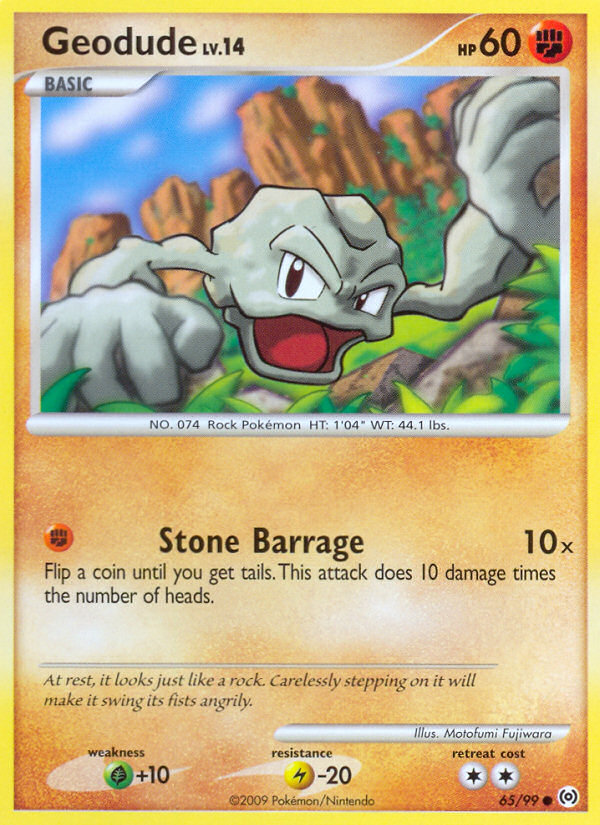
For many players and collectors, Geodude is a familiar, friendly face from the early days of the Pokémon TCG. The card we’re focusing on here—the pl4-65 Geodude, a Basic Fighting-type from the Arceus era—shows that even a Common rarity can become a story worth telling when you consider grading. The notion that “price equals rarity” quickly loosens its grip once you understand the more nuanced world of card condition, grading standards, and market demand. In practice, grading is less about turning a common into a museum acquisition and more about preserving a narrative: how the card traveled from a factory print to a sleeve, to a binder, to a PSA or BGS submission, and finally to your display case or sales listing. ⚡
Geodude’s card data tells a compact, confident tale. It’s a Basic stage Geodude with a straightforward attack—Stone Barrage—costing Fighting and dealing 10 damage per head after a flip sequence. It carries a Grass weakness (+10) and a Lightning resistance (-20), with a retreat cost of 2. The illustrator, Motofumi Fujiwara, contributes a clean, nostalgic look that resonates with 1990s and early-2000s collectors. The set, pl4, is part of the Arceus-line family and includes both normal and reverse-foil variants. That mix matters a lot when you think about grading value, because the foil surface (or its absence) interacts with condition metrics in unique ways. 🎨
When you evaluate grading, you’re assessing four pillars: centering, edges, corners, and surface. For Geodude, centered prints are prized because a card this simple and compact relies on clean borders to pop in a display. Edges need to be crisp, corners sharp, and surface free of scuffs, scratches, and print flaws. Printing variances—such as whitening along edges or light printer lines—are particularly noticeable on a pale, single-color figure like Geodude. A gem in a common card’s armor can be worth a buyback premium, especially if the pop in numerical grades proves scarce for the particular variant you own. 🔎
Understanding the Variant Value: Normal vs. Reverse Foil
The Geodude in this discussion exists in both normal and reverse-foil variants within the same pl4 set. In the market, reverse holofoil versions generally carry higher speculative value than their non-foil counterparts—grading a reverse holo Geodude to a pristine 9 or 10 can yield a more noticeable upside than grading a non-foil Geodude, thanks to strong demand for visually striking cards. Yet, the rarity of the card remains “Common.” That juxtaposition—common rarity paired with a foil accent—drives a quiet but meaningful attention to condition. In 2025 pricing terms, typical non-foil Geodude from this subset can hover around a few cents to under a dollar in many markets, while reverse-foil copies can attract higher baselines in the low-dollar range. The data from Cardmarket and TCGPlayer illustrate this spread: an ungraded or near-mint normal card may average around 0.12 EUR on Cardmarket, with a mid price similar to 0.25 USD on TCGPlayer for the normal variant; reverse-holo values considerably higher, with market prices often topping the 1 USD mark and peaking higher for exceptional copies. These are the kinds of numbers that make grading a deliberate, value-conscious choice for collectors. 💎
Illustrations like Fujiwara’s work on Geodude contribute beyond pure value. A well-preserved card with clean centering and margins allows the art to shine, delivering the “wow” moment when fans flip the card and see a well-graded version of a familiar rock-type Pokémon. The combination of a straightforward move like Stone Barrage and the trainer-friendly practicality of a basic Geodude makes this a great candidate for a modest graded collection that still commands respectful attention. And for those who love the ongoing evolution narrative, Geodude’s ultimate path—Graveler and then Golem—adds a layer of storyline that can be highlighted in binder pages and display cases. 🎴
Market Trends: What Does Grading Do to Value?
Grading isn’t a magic wand; it’s a mechanism that communicates condition with objective confidence. A PSA 10 Geodude (normal or reverse) can attract a premium over a PSA 9, particularly for foil variants where surface gloss and edge integrity are easier to verify under grading scrutiny. While common cards typically carry smaller absolute premiums than their rare or holo counterparts, the reverse-foil Geodude pl4-65 can still reveal meaningful value gains when the surface shines, edges are pristine, and centering is near-perfect. In the current market snapshot you can glean from Cardmarket and TCGPlayer, even modest-grade examples of normal Geodude hold value in the sub-dollar range, while reverse holo cards show a wider spread and stronger growth potential in higher grades. This dynamic is what makes grading a thoughtful choice for collectors who want to balance acquisition costs with potential future resale value. 🔥
Price data isn’t destiny, but it is guidance. For example, Cardmarket shows an average around 0.12 EUR for normal copies with a low of 0.02 and a trend around 0.15. On TCGPlayer, normal copies sit with a low around 0.09 USD, a mid near 0.25, and a high around 2.84 USD for the most sought-after non-foil copies. For reverse holofoil variants, the numbers tilt upward—low around 0.57 USD, mid around 1.05, and a high approaching 4.99 USD or more on the market. This demonstrates that the grading decision, the variant you own, and the card’s surface quality collectively shape the potential upside. 🧭
Practical Tips for Collectors Consider Grading Geodude
- Subtle centering matters most on a small card: a 60/40 to 55/45 centering is usually ideal for a gem-grade 10 in many grading standards. Avoid prints with heavy whitening along the borders.
- Handle with clean hands and proper storage: keep the card sleeve-free from oils, fingerprints, and humidity; use clean top-loaders and rigid cases for submission prep.
- Choose the right grading service: PSA and BGS are popular, with CGC growing in visibility for TCG portfolios. Consider subgrades if you’re aiming for a precise assessment.
- Document variant and card details: clearly indicate normal vs. reverse variant, and capture the Motofumi Fujiwara attribution in your notes—art matters to collectors as much as condition does.
- Be mindful of market timing: graded copies can outpace raw cards in collector markets, but the premium tends to be proportional to the grade and variant demand rather than the rarity alone.
Geodude remains a welcoming entry point for grading exploration: it’s affordable to acquire, pleasant to own, and scientifically collectible in the eyes of modern markets that value both condition and presentation. The basic nature of its attack, the earthy silhouette, and Fujiwara’s artwork converge into a neat package that can be preserved and appreciated for years. If you’re building a small, well-curated collection that includes a few solid graded pieces, Geodude pl4-65—especially the reverse holo—offers a compact, approachable path into the world of higher-grade Pokémon TCG assets. ⚡🎴
Neon Desk Mouse Pad: Customizable One-Sided Print 0.12in ThickMore from our network
- https://blog.rusty-articles.xyz/blog/post/exeggcute-performance-heatmap-by-tournament-region/
- https://transparent-paper.shop/blog/post/stable-diffusion-xl-prompt-celestial-serpent-metallic-palette-space-art-neon-glow-cinematic-lighting-high-detail/
- https://blog.crypto-articles.xyz/blog/post/nft-data-streamflowsolmail-from-solmail-id-collection-on-magiceden/
- https://wiki.digital-vault.xyz/wiki/post/pokemon-tcg-stats-lycanroc-gx-card-id-sma-sv66/
- https://transparent-paper.shop/blog/post/stable-diffusion-xl-prompt-holographic-oni-neon-cyberpunk-japanese-folklore-poster-ready-glowfx/
Geodude
Set: Arceus | Card ID: pl4-65
Card Overview
- Category: Pokemon
- HP:
- Type: Fighting
- Stage: Basic
- Dex ID: 74
- Rarity: Common
- Regulation Mark: —
- Retreat Cost: 2
- Legal (Standard): No
- Legal (Expanded): No
Description
Attacks
| Name | Cost | Damage |
|---|---|---|
| Stone Barrage | Fighting | 10x |
Pricing (Cardmarket)
- Average: €0.12
- Low: €0.02
- Trend: €0.15
- 7-Day Avg: €0.17
- 30-Day Avg: €0.17
Support Our Decentralized Network
Donate 💠More from our network
- https://blog.rusty-articles.xyz/blog/post/exeggcute-performance-heatmap-by-tournament-region/
- https://transparent-paper.shop/blog/post/stable-diffusion-xl-prompt-celestial-serpent-metallic-palette-space-art-neon-glow-cinematic-lighting-high-detail/
- https://blog.crypto-articles.xyz/blog/post/nft-data-streamflowsolmail-from-solmail-id-collection-on-magiceden/
- https://wiki.digital-vault.xyz/wiki/post/pokemon-tcg-stats-lycanroc-gx-card-id-sma-sv66/
- https://transparent-paper.shop/blog/post/stable-diffusion-xl-prompt-holographic-oni-neon-cyberpunk-japanese-folklore-poster-ready-glowfx/