
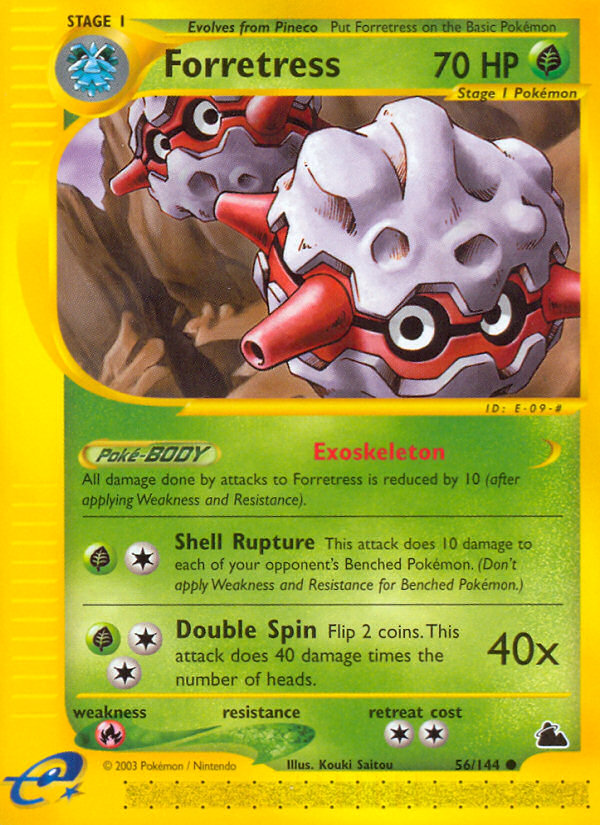
Image courtesy of TCGdex.net
Meta snapshot: Forretress in Winning Decks
In the sprawling tapestry of vintage Pokémon TCG play, some cards earn eternal respect not by raw power, but by clever design and clutch utility. Forretress from the Skyridge era fits that bill beautifully. With a modest 70 HP, a Grass-type frame, and a pair of surprisingly disruptive attacks, this Stage 1 evolves from Pineco and carries a subtle but meaningful toolkit for players who love bench manipulation, defensive resilience, and a touch of RNG drama. Its collectability benefits from its set pedigree—Skyridge is fondly remembered for bold artwork and a distinctive roster—and the card’s practical impact in vintage decks remains a talking point among enthusiasts who still duel for glory with a smile.
Card snapshot
- Name: Forretress
- Set: Skyridge (ecard3)
- Rarity: Common
- Stage: Stage 1 (Evolves from Pineco)
- HP: 70
- Type: Grass
- Ability: Exoskeleton — Poke-BODY: All damage done by attacks to Forretress is reduced by 10 (after applying Weakness and Resistance).
- Attacks:
- Shell Rupture (Grass, Colorless) — This attack does 10 damage to each of your opponent's Benched Pokémon. (Don't apply Weakness and Resistance for Benched Pokémon.)
- Double Spin (Grass, Colorless, Colorless) — Flip 2 coins. This attack does 40 damage times the number of heads.
- Weakness: Fire ×2
- Illustrator: Kouki Saitou
How it plays: strategy and practical use
From a gameplay perspective, Forretress trades raw power for tactical shrewdness. The Exoskeleton ability effectively adds a built-in shield, absorbing a chunk of damage from hostile attacks. In practice, that means you can soak up several midrange hits while setting up your bench-damage plan. The real trick lies in Shell Rupture: hitting every Benched Pokémon with a single attack can force your opponent into awkward bench management, especially in matchups where bench alignment matters—think decks that rely on spreading damage to set up KOs or force opponent errors.
Double Spin is a classic example of vintage volatility. With two coin flips, you can deal 0, 40, or 80 damage (multiplying by the number of heads). That randomness keeps games lively and gives you a narrow window to swing a late-prize KO or to punish a vulnerable back row. It also means Forretress rewards players who read the board: if your opponent has two or more Benched targets, Shell Rupture becomes more attractive, while Double Spin’s potential payoffs increase when timing lines up with a critical turn. The risk, of course, is the low HP—70 isn’t a lot in a modern metagame where one big hit can KO you. This is where Exoskeleton earns its keep, offsetting some of that vulnerability by reducing incoming damage by 10 after weaknesses and resistances are calculated.
In terms of deck architecture, Forretress tends to slot into niche builds that value disruption and defense over brute attack power. It’s a natural fit for vintage Grass-based engines that can sustain a few turns while pressuring the opponent’s bench. Its evolution from Pineco also encourages players to weave a compact early-game line that can stall or outlast less patient strategies. The Grass typing aligns with classic energy acceleration themes seen in older sets, where players balance energy attachment with deliberate tempo, making Shell Rupture a first step toward forcing bench KO sequences or quickly thinning the opponent’s resources through forced bench losses.
Matchups and meta signals
While modern formats largely overlook Skyridge-era staples, studying Forretress provides a window into how players exploited bench-focused tactics. Against Fire-weak attackers, Forretress benefits from the opponent’s choice of aggression. If a deck leans into single-target pressure instead of bench-wide disruption, Forretress’s Exoskeleton can help it survive a couple of rounds, giving you time to set up Double Spin or to apply pressure with Shell Rupture as the bench reshuffles. Conversely, against decks that spam heavy bench damage or rely on spread across multiple benched targets, Shell Rupture becomes more valuable, turning a defensive card into a genuine nuisance for the opponent’s non-active lineup. The cautionary note remains: with a fragile 70 HP, a single powerful KO can swing the game’s balance, making careful timing and positioning essential.
From a market and rarity standpoint, this Forretress isn’t a modern-day staple, but it carries vintage appeal. In card markets, the non-holo version often sits at accessible price points in the sealed era, while reverse-holo variants fetch higher attention among collectors. The card’s longevity is buoyed by its illustrator—Kouki Saitou—whose work on Skyridge is celebrated for its distinctive, crisp linework. For collectors, a well-preserved example of this card can be a satisfying centerpiece for a vintage Grass-type-focused collection, especially for players who enjoy the nostalgia of bench-control games and the quirky charm of early-2000s design.
Market notes and collectibility
Market data paints an interesting picture. CardMarket shows an average value around the mid-€50 range for this card in certain conditions, with a notable spread between low and high prices (roughly €13 to well over €50 depending on condition and variant). On TCGPlayer, the standard (non-holo) version tends to be budget-friendly—low prices hovering around a few dollars with mid-range values a little higher, and reverse-holofoil variants climbing into the mid-to-upper teens. These figures reflect the card’s vintage status, the Skyridge print run, and its dual appeal to both players seeking a quirky competitive edge and collectors chasing a complete Skyridge set experience. Keep in mind that formats for this card are not Standard or Expanded today, so its competitive relevance is anchored in era-appropriate play or in curious, themed decks that celebrate vintage mechanics.
As you weigh this card for your collection or for a playful vintage build, consider not just the numbers but the narrative—the way Forretress embodies a time when players experimented with new ways to interact with the bench and to turn defensive positioning into a strategic advantage. The combination of Exoskeleton and Shell Rupture invites you to think in terms of tempo, pressure, and the ever-present chance of a favorable coin flip turning the tides of a tightly contested match. ⚡
Clear Silicone Phone Case Slim Flexible ProtectionMore from our network
- https://blog.digital-vault.xyz/blog/post/from-idea-to-launch-ai-accelerates-product-development/
- https://crypto-acolytes.xyz/blog/post/nft-stats-singapore-special-warfare-group-swg-from-noyfb-black-ops-badge-collection-collection/
- https://blog.crypto-articles.xyz/blog/post/nft-data-b616-from-b33-collection-on-magiceden/
- https://articles.digital-vault.xyz/blog/post/donphan-and-the-psychology-of-rare-pokemon-tcg-collecting/
- https://blog.crypto-articles.xyz/blog/post/established-solana-meme-coin-shows-rising-momentum-and-liquidity/
Forretress
Set: Skyridge | Card ID: ecard3-56
Card Overview
- Category: Pokemon
- HP: 70
- Type: Grass
- Stage: Stage1
- Evolves From: Pineco
- Dex ID: 205
- Rarity: Common
- Regulation Mark: —
- Retreat Cost:
- Legal (Standard): No
- Legal (Expanded): No
Description
Abilities
-
Exoskeleton — Poke-BODY
All damage done by attacks to Forretress is reduced by 10 (after applying Weakness and Resistance).
Attacks
| Name | Cost | Damage |
|---|---|---|
| Shell Rupture | Grass, Colorless | |
| Double Spin | Grass, Colorless, Colorless | 40x |
Pricing (Cardmarket)
- Average: €51.17
- Low: €13
- Trend: €50.21
- 7-Day Avg: €50.67
- 30-Day Avg: €49.21
Support Our Decentralized Network
Donate 💠More from our network
- https://blog.digital-vault.xyz/blog/post/from-idea-to-launch-ai-accelerates-product-development/
- https://crypto-acolytes.xyz/blog/post/nft-stats-singapore-special-warfare-group-swg-from-noyfb-black-ops-badge-collection-collection/
- https://blog.crypto-articles.xyz/blog/post/nft-data-b616-from-b33-collection-on-magiceden/
- https://articles.digital-vault.xyz/blog/post/donphan-and-the-psychology-of-rare-pokemon-tcg-collecting/
- https://blog.crypto-articles.xyz/blog/post/established-solana-meme-coin-shows-rising-momentum-and-liquidity/