

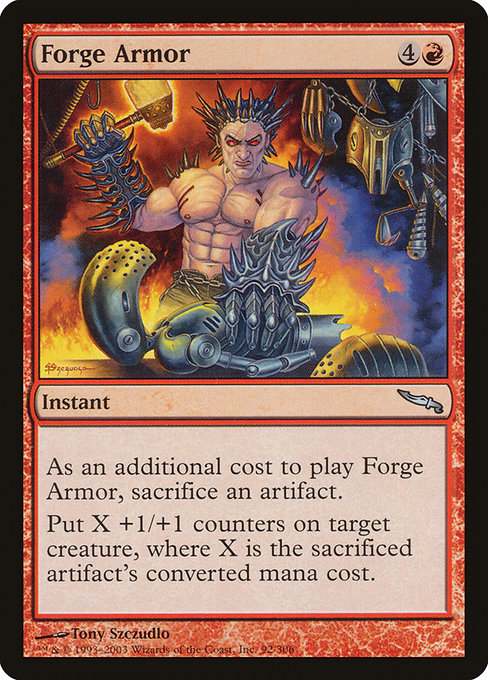
Image courtesy of Scryfall.com
Auction Trends for Signed MTG Copies
If you’ve wandered into MTG auctions lately, you’ve probably noticed something charmingly tangible happening: signed copies of beloved cards aren’t just nostalgia trips—they’re becoming strategic assets in collectors’ portfolios 🧙♂️🔥. The market loves provenance, the artist’s touch, and a well-documented history of ownership. In this landscape, signed copies of more approachable staples can dip into the realm of smart, affordable investments, while still scratching that itch for a coveted piece of the multiverse. Let’s take a close look through the lens of a red instant from the Mirrodin era as a case study for how signed copies navigate value, rarity, and playability in modern auctions 🧭💎.
Consider a card like Forge Armor from the Mirrodin set. It’s a red instant with a distinctive, artifact-themed cost: pay four mana of any color and sacrifice an artifact as an additional cost, then you put X +1/+1 counters on a target creature, where X equals the sacrificed artifact’s mana value. That simple mechanic—turning an artifact into a buff—hums with the era’s love of artifact synergies. The card’s rarity is uncommon, and its artwork by Tony Szczudlo captures a gleaming armor motif that fans remember from the early 2000s magic renaissance. While Forge Armor isn’t the sort of centerpiece mythic hot-ticket item, its signed variants can still command a meaningful premium in the right market conditions, especially when the signature adds to a complete, well-documented artifact-themed collection 🛡️⚔️.
From an auction perspective, signed copies gain traction for several reasons. First, provenance matters: a verified autograph from the artist adds a layer of storytelling to the card, transforming it from a pure play item into a collectible with narrative value. Second, condition and labeling—graded or ungraded, with a clear certificate of authenticity—can dramatically influence upside. Finally, supply and demand dynamics for signed copies of commons and uncommons can surprise collectors. Because Forge Armor sits in the uncommon tier, a signed version may not surge into mythic territory, but it can still achieve a pleasant bump over the unsigned price, especially among players who are drawn to the card’s flavorful red instant identity and its token-friendly versatility in artifact-heavy decks 🔥💎.
Let’s weigh practical factors for investors and players alike. The card’s base market values, as recorded in typical price channels, show modest numbers for nonfoil and foil copies. Scryfall’s data indicate that nonfoil Forge Armor hovers around a few tenths of a dollar, with foils edging higher. In real-world auctions, a signed copy could see a premium that scales with the rarity of the signing, the card’s condition, and whether the signature belongs to a renowned artist associated with Mirrodin-era work. For collectors chasing a cohesive artifact-themed set, a signed Forge Armor becomes a flavorful centerpiece—one that bridges nostalgia with a tangible, physical reminder of a time when artifacts and red spells burned bright on the battlefield 🔥🧩.
“Autographs don’t just certify authenticity; they attach a story to a card—one you can point to when you’re trading or bidding.”
From a gameplay perspective, Forge Armor itself asks a player to think in terms of risk and tempo. The requirement to sacrifice an artifact as a casting cost creates an elegant but vulnerable play pattern: you must have an artifact in play to unleash the spell’s potential for growth. The X in the countering effect scales with mana value, so a higher-cost artifact can kick your creature’s power into overdrive. In tournaments or casual games, those choices interplay with mana acceleration, artifact ramp, and removal-heavy metagames. Signed copies of Forge Armor—especially if they’re part of a larger artifact-themed collection—carry additional social value: they’re conversation starters at a table, memorable mementos that remind players of the card’s history and its artist’s signature style 🎨⚔️.
For buyers eyeing signed copies, a few practical guidelines help maximize value. First, verify the autograph’s authenticity and how it was obtained—some sellers provide certificates or provenance notes. Second, inspect the card’s condition and the signature’s legibility; a faint or smudged signature can depress value more than a minor surface blemish on the card itself. Third, consider the card’s overall context: a signed Forge Armor alongside other signed Mirrodin artifacts or red instants can form a cohesive, spicy collection that’s both playable and display-worthy. Finally, keep an eye on the metagame’s pulse: in a format where red removal and artifact strategies see play, signed copies of core synergy cards can become more desirable as showpieces for a deck’s story arc 🧭💥.
Speaking of stories and armor, there’s a fun synergy to highlight beyond the card itself. In a modern sense, armor-themed merchandise—like the Neon Tough Phone Case 2-Piece Armor for iPhone Samsung—offers a playful nod to the “armored” aesthetics that Forge Armor embodies. When collectors balance MTG nostalgia with everyday gear that echoes their favorite cards, it’s a reminder that the Magic multiverse isn’t just about duels; it’s about culture, style, and a little swagger in the pocket as you carry your devices to Friday night battles 🧙♂️🎮.
As you explore signed copies, remember that the value proposition isn’t just monetary. It’s about curating a tangible gallery of memories—moments when a favorite artist’s signature met a favorite card and a favorite moment on the tabletop. That’s the magic in the margins: provenance, artistry, playability, and a pinch of nostalgia all wrapped into a single card that can still empower a deck—and a collection—today 🧙♂️💎.
Neon Tough Phone Case 2-Piece Armor for iPhone SamsungMore from our network
- https://transparent-paper.shop/blog/post/dr3-data-unlocks-galactic-archaeology-with-a-hot-blue-beacon-in-sagittarius/
- https://blog.digital-vault.xyz/blog/post/version-control-for-solo-founders-a-practical-startup-guide/
- https://blog.rusty-articles.xyz/blog/post/chien-pao-card-design-trends-across-the-sword-and-shield-era/
- https://wiki.digital-vault.xyz/wiki/post/pokemon-tcg-stats-primeape-card-id-ecard2-29/
- https://blog.zero-static.xyz/blog/post/whirler-rogue-thopter-tech-for-control-matchups/
Forge Armor
As an additional cost to cast this spell, sacrifice an artifact.
Put X +1/+1 counters on target creature, where X is the sacrificed artifact's mana value.
ID: 2873b6d5-af76-498c-bc2d-a26c36be3cbd
Oracle ID: 7d4d9bfa-7e85-461b-bd62-1de97690a110
Multiverse IDs: 46577
TCGPlayer ID: 11412
Cardmarket ID: 92
Colors: R
Color Identity: R
Keywords:
Rarity: Uncommon
Released: 2003-10-02
Artist: Tony Szczudlo
Frame: 2003
Border: black
EDHRec Rank: 27431
Set: Mirrodin (mrd)
Collector #: 92
Legalities
- Standard — not_legal
- Future — not_legal
- Historic — not_legal
- Timeless — not_legal
- Gladiator — not_legal
- Pioneer — not_legal
- Modern — legal
- Legacy — legal
- Pauper — not_legal
- Vintage — legal
- Penny — not_legal
- Commander — legal
- Oathbreaker — legal
- Standardbrawl — not_legal
- Brawl — not_legal
- Alchemy — not_legal
- Paupercommander — not_legal
- Duel — legal
- Oldschool — not_legal
- Premodern — not_legal
- Predh — legal
Prices
- USD: 0.23
- USD_FOIL: 0.51
- EUR: 0.06
- EUR_FOIL: 0.30
- TIX: 0.03
More from our network
- https://wiki.digital-vault.xyz/wiki/post/pokemon-tcg-stats-emboar-card-id-bwp-bw21/
- https://crypto-acolytes.xyz/blog/post/nft-stats-sbb-280-from-solana-bonky-business-collection/
- https://wiki.digital-vault.xyz/wiki/post/pokemon-tcg-stats-sunkern-card-id-ecard3-106/
- https://crypto-acolytes.xyz/blog/post/nft-stats-gold-bar-761-from-solana-gold-bars-collection/
- https://transparent-paper.shop/blog/post/digitizing-vintage-paper-restoration-for-digital-use/