
Image courtesy of TCGdex.net
Predicting Spoink's Trajectory in the Pokémon TCG with ML
From a sleepy Psychic pocket monster to a lens for the future of card values, Spoink ex8-76 offers a surprisingly rich canvas for machine learning analysis. The Predictive Roadmap here blends gameplay realities with market dynamics, showing how data-driven models can illuminate the path a single card might walk through the ever-changing Pokémon Trading Card Game ecosystem. ⚡ The lens isn’t just about price ticks or holo fever—it’s about understanding the signals that whisper through rarity, set design, and player strategy.
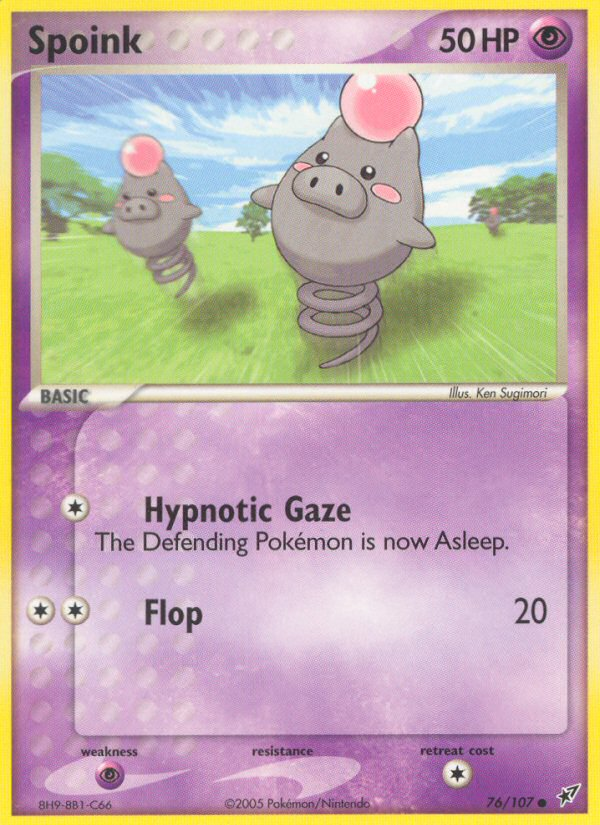
Card snapshot: Spoink ex8-76 at a glance
- Category: Pokémon
- Name: Spoink
- Set: Deoxys (ex8) — 107 official cards in the full print run, 108 total
- Rarity: Common
- HP: 50
- Type: Psychic
- Stage: Basic
- Illustrator: Ken Sugimori
- Attacks: Hypnotic Gaze (Colorless) — The Defending Pokémon is now Asleep. Flop (Colorless, Colorless) — 20 damage.
- Weakness: Psychic ×2
- Variants: Normal and holo (stamp: set logo)
- Legal formats: Not standard or expanded at this moment
Spoink’s art by Ken Sugimori carries that classic early-2000s charm, and the holo variant, when present, adds a collectible shimmer that ripples through market interest. The card sits in a curious spot: a Common with a surprisingly active holo niche, a factor that ML models love to leverage for price forecasting. The price signals captured in market feeds show a spectrum: low prices in the sub-dollar range for the regular card, with holo variants skewing much higher on the rare occasion they appear in the market. This combination of accessibility and rarity is a perfect seed for models that mix scarcity with short-term demand surges. 🔥
ML approaches and what they can illuminate
Forecasting Spoink’s future blends three broad classes of models, each offering distinct insights into gameplay and market behavior:
- Time-series forecasting (e.g., Prophet, ARIMA) to project price trajectories for the non-holo and holo variants over quarterly horizons. Given the data in Cardmarket and TCGPlayer, these models can identify baseline drift (the general upward or downward trend) and seasonality around new set releases, reprint rumors, or meta shifts. For a common card with a holo twin, expect higher volatility in holo pricing and a more muted, slower drift for the normal version. ⚡
- Feature-based regression and gradient boosting (random forest, gradient boosting machines) that take card-level features as inputs. Attributes like HP, type, stage, attacks (requires Colorless energy, status effects like sleep), weakness, and even the illustrator’s name (a proxy for image-driven collectability) can help the model estimate cross-format demand, cross-set carryover, and potential price floors or ceilings. The ex8-76 data points—50 HP, Psychic type, basic stage, two attacks with Sleep on Hypnotic Gaze—provide a compact feature vector that models can leverage to differentiate Spoink from more aggressively costed Psychic staples. 🧠
- Demand and sentiment modeling that fuse price data with external signals (e.g., deck-building trends, tournament results, collector interest in holo variants, and cross-domain signals from art or lore). While Spoink may not be a meta cornerstone, sentiment spikes around cute or iconic Pokémon can lift attention and, temporarily, price. This class also benefits from network-based approaches that explore co-purchasing and card interaction graphs—how Spoink often appears alongside certain Psychic archetypes in real-world decks. 🎴
Of course, any model must respect the card’s current legality: Spoink ex8-76 is not standard or expanded, which means predictions should be contextualized within those constraints. The lack of standard-legal status reduces certain liquidity pressures, yet collectors still chase holo variants and early prints for nostalgia and display value. The ML story here is less about a rocket to the moon and more about a steady, interpretable arc shaped by rarity, presentation, and human interest. 💎
Gameplay implications and collector insights
From a gameplay standpoint, Hypnotic Gaze is a deceptively simple tool: put the Defending Pokémon to sleep, buying a turn or two of breathing space. But a fragile 50 HP and a Psychic ×2 weakness create a delicate tightrope—Spoink shines in hybrid or support-focused loads that leverage status effects, energy acceleration, or trainer cards that leverage small swings in tempo. For a player, that means building around support Pokémon that can capitalize on sleep status—forcing the opponent into misplays or long-term vulnerability as they recover. In a modern meta sense, Spoink’s viability is likely limited, but in casual play or themed decks, its low energy cost and straightforward two-attack kit can still shine. ⚡🎮
For collectors, the holo variant’s appeal remains a strong driver of value. The pricing snapshot shows normal cards are pleasantly affordable (low single-digit EUR/USD equivalents in many markets), while holo variants ride an elevated curve when they surface. The “set logo” holo printing distinguishes it as a fan favorite, and Ken Sugimori’s classic art keeps its shelf appeal high. The takeaway for collectors is to monitor holo availability in the Deoxys-era ex8 print run, while appreciating the nostalgia baked into Sugimori’s design. 💎🎨
Market outlook: what the models may tell us
Looking ahead, probabilistic forecasts suggest a modest, steady demand for Spoink in the non-holo pool, with sporadic spikes tied to holo splash events—whether through new printings or reprints in limited runs. Time-series forecasts may reveal a slight upward drift in holo pricing when supply tightens (a common pattern for holo rares across sets). Feature-based models will likely place Spoink among affordable Psychic staples with a low baseline risk, yet with upside potential for holo variants if collector interest surges. The key caveat is that larger market swings are often driven by external catalysts—new deck-building trends, anime/seasonal hype, or reissues—that no single card can predict alone. 🔮
In short, machine learning can illuminate likely trajectories for Spoink ex8-76, but it also highlights the limits of prediction in a living game and a vibrant hobby. The blend of a cute, early-set character, a straightforward two-attack kit, and the gravity of holo collectability makes Spoink a compelling test case for forecasting—not just in dollars and cents, but in the enduring romance of Pokémon TCG collecting. 🎴⚡
Magsafe Phone Case with Card Holder – Polycarbonate SlimMore from our network
- https://crypto-acolytes.xyz/blog/post/nft-stats-from-the-jazz-players-collection/
- https://wiki.digital-vault.xyz/wiki/post/pokemon-tcg-stats-vigoroth-card-id-ex16-41/
- https://blog.digital-vault.xyz/blog/post/blue-giant-at-2100-parsecs-illuminates-synthetic-populations/
- https://wiki.digital-vault.xyz/wiki/post/pokemon-tcg-stats-chimchar-card-id-sm5-21/
- https://crypto-acolytes.xyz/blog/post/nft-stats-bpw-633-from-bonk-puppets-collection/
Spoink
Set: Deoxys | Card ID: ex8-76
Card Overview
- Category: Pokemon
- HP: 50
- Type: Psychic
- Stage: Basic
- Dex ID: 325
- Rarity: Common
- Regulation Mark: —
- Retreat Cost:
- Legal (Standard): No
- Legal (Expanded): No
Description
Attacks
| Name | Cost | Damage |
|---|---|---|
| Hypnotic Gaze | Colorless | |
| Flop | Colorless, Colorless | 20 |
Pricing (Cardmarket)
- Average: €0.14
- Low: €0.02
- Trend: €0.12
- 7-Day Avg: €0.09
- 30-Day Avg: €0.26
Support Our Decentralized Network
Donate 💠More from our network
- https://crypto-acolytes.xyz/blog/post/nft-stats-from-the-jazz-players-collection/
- https://wiki.digital-vault.xyz/wiki/post/pokemon-tcg-stats-vigoroth-card-id-ex16-41/
- https://blog.digital-vault.xyz/blog/post/blue-giant-at-2100-parsecs-illuminates-synthetic-populations/
- https://wiki.digital-vault.xyz/wiki/post/pokemon-tcg-stats-chimchar-card-id-sm5-21/
- https://crypto-acolytes.xyz/blog/post/nft-stats-bpw-633-from-bonk-puppets-collection/