


Image courtesy of Scryfall.com
Magic: The Gathering is forever a study in cycles—new mechanics, new art, and, yes, new ways to value cards old and new. When you look at era-by-era investment in MTG, you’re really watching the market wrestle with novelty, nostalgia, and scarcity. Our lens today is a playful green spell from the Unfinity set, a card that embodies both the humor of modern printings and the stubborn math of long-term value. The card helps us ask: what actually drives returns across eras, and where do goofy, casual-friendly cards fit into a serious collector’s timeline? 🧙♂️🔥💎
Card at a glance: Finishing Move
- Name: Finishing Move
- Set: Unfinity (funny)
- Type: Sorcery
- Mana cost: {2}{G}
- Rarity: Common
- Color identity: Green
- Oracle text: You get {TK}{TK}, then you may put a sticker on a nonland permanent you own. Target creature you control deals damage equal to its power to target creature you don't control.
- Legalities: Commander legal; many formats not legal
- Flavor & art: Dmitry Burmak’s playful artwork and the flavor line about submission holds reflect Unfinity’s tongue-in-cheek vibe
- Collector detail: foil and nonfoil both exist; prices hover around USD 0.04 nonfoil and USD 0.13 foil; EDHREC rank sits around 20356
“In MTG markets, novelty can spark a spike—yet long-term growth tends to cling to utility, playability, and grip on a popular format.” 🧙♂️
Two things stand out about Finishing Move from an investment perspective. First, it’s a rare of a different sort: a common card from a funny-set that trades in the lower end of the price spectrum. Second, its commander-legal status means there’s a built-in demand within EDH households—people who enjoy experimental effects, sticker mechanics, and the occasional dramatic poke toward an opponent. The card’s ingenuity lies in its mechanic: you generate two TK tokens, then you may sticker a permanent you own, and you force a controlled creature to push damage into an unfamiliar opponent’s creature. That blend of casual playability and collectible potential is exactly the kind of dynamic that can surprise investors decades from now. ⚔️
Era-by-era lens: how value tends to travel
To understand where Finishing Move sits in the grand arc of MTG investment, it helps to frame era-specific drivers: format popularity, reprint pressure, foil distribution, and the staying power of a card’s play pattern. The card from Unfinity embodies a modern-era phenomenon: novelty printings, casual appeal, and a market that loves foils and unique art. Here’s a practical walkthrough across four conceptual eras, with Finishing Move as a touchstone rather than a blueprint for every card. 🎲
Era 1 — The dawn of scarcity-driven growth (1990s to early 2000s)
In the earliest MTG years, scarcity and a sense of discovery drove many prices skyward. Staples—powerful, format-defining cards—could see dramatic appreciation as players sought to complete decks and later as collectors chased pristine condition. Finishing Move is not a relic of that era; its value is anchored in modern printings and a playful modern set, not in vintage scarcity. Still, the principle holds: when older cards truly matter, it’s because they unlock power across formats or carry iconic branding. 🔥
Era 2 — The rise of incremental premium and foil culture (2000s–2010s)
As foil printing exploded, a lot of MTG value migrated toward shinier copies and special treatments. Finishing Move exists in foil and nonfoil, with a foil price of around USD 0.13, relatively modest but meaningful for a common from a novelty set. That foil premium is a modern phenomenon: players love visually striking cards, and foils acquire a cultural sheen that can outlast the underlying gameplay value. In this era, “gimmick” cards—like sticker-enabled effects—also captured the imagination of casual players who help buoy secondary-market demand. 💎
Era 3 — The Master Sets, Battle for Modern, and the format boom (2010s–present)
The 2010s brought mass market revivals of interest in iconic formats, plus a flood of reprints and masters sets. A card’s long-term price often depends on whether it’s coveted in a live format or treasured as a stylish collectible. Finishing Move’s commander viability gives it a niche but steady appeal among EDH players who enjoy offbeat effects and creative deckbuilding. Its price, modest as it may be, benefits from the broader trend of collecting as a lifestyle choice rather than pure arithmetic. In this era, the value is less about raw power and more about play pattern and personality—two factors Finishing Move nails. 🧙♂️🎨
Era 4 — Un-sets, novelty, and the enduring power of playability (2020s onward)
Unfinity is a shining example of how humor and design experimentation influence market perception. The card’s green-blue-ish flavor aside, its practical impact in Commander play adds a long-tail dimension to its value. The set’s themes, the art, and the limited print run of certain promos can create micro-trends that lift foils and certain printings above the base price. It’s not a belt-tightening investment, but it is a reminder that MTG markets reward cards with a clear, repeatable play pattern and a strong fan base. Finishing Move, with its unique two-TK mana and a sticker mechanic, sits comfortably in that category. ⚔️
As you map era-by-era expectations, you’ll notice that a card like Finishing Move is less of a growth engine and more of a cultural artifact: it captures a moment in MTG’s design ethos and a subset of players who love the quirks of Unfinity. If you’re building a future-facing collection, look for foils and condition-sensitive copies in EDH-friendly cards, where playability and display value often converge. And if you’re a nostalgia scout who enjoys the humor of a set that turns slapstick into strategy, Finishing Move is a perfect reminder that MTG markets are as much about story as they are about numbers. 🧙♂️🎲
For readers who want to explore more about the evolving MTG economy and the broader digital-vault ecosystem behind these ideas, here are five related reads across our network. They’re all a click away and open in new tabs for easy browsing. 🔗
More from our network
- https://crypto-acolytes.xyz/blog/post/nft-stats-retardio-traits-s0-retardia-brown-from-retardio-traits-collection/
- https://blog.crypto-articles.xyz/blog/post/nft-data-ryujin-1507-from-ryujin-collection-on-magiceden/
- https://blog.zero-static.xyz/blog/post/gerrard-rarity-scaling-and-set-balance-across-mtg-sets/
- https://blog.crypto-articles.xyz/blog/post/nft-data-xp-1017-from-xp-collection-on-magiceden/
- https://blog.digital-vault.xyz/blog/post/luminous-blue-giant-at-35-kpc-reshapes-astrometry/
Curious about the cross-promotional product we highlighted? Check it out below if you’re in the market for a sleek, pragmatic accessory that travels well with any MTG haul. The shop link gives you a practical, unrelated break from the meta—because every good deck deserves a good case. 🧙♂️💼
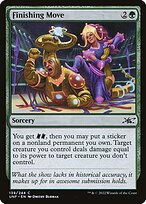
Finishing Move
You get {TK}{TK}, then you may put a sticker on a nonland permanent you own. Target creature you control deals damage equal to its power to target creature you don't control.
ID: cadd9acf-3c42-4be4-bb45-551736535cb7
Oracle ID: d41dc3a5-58e4-444a-b388-5a32ccbed0eb
Multiverse IDs: 580689
TCGPlayer ID: 288028
Cardmarket ID: 677319
Colors: G
Color Identity: G
Keywords:
Rarity: Common
Released: 2022-10-07
Artist: Dmitry Burmak
Frame: 2015
Border: black
EDHRec Rank: 20356
Set: Unfinity (unf)
Collector #: 139
Legalities
- Standard — not_legal
- Future — not_legal
- Historic — not_legal
- Timeless — not_legal
- Gladiator — not_legal
- Pioneer — not_legal
- Modern — not_legal
- Legacy — banned
- Pauper — banned
- Vintage — banned
- Penny — not_legal
- Commander — legal
- Oathbreaker — banned
- Standardbrawl — not_legal
- Brawl — not_legal
- Alchemy — not_legal
- Paupercommander — legal
- Duel — banned
- Oldschool — not_legal
- Premodern — not_legal
- Predh — not_legal
Prices
- USD: 0.04
- USD_FOIL: 0.13
- EUR: 0.08
- EUR_FOIL: 0.12
More from our network
- https://wiki.digital-vault.xyz/wiki/post/pokemon-tcg-stats-torkoal-v-card-id-swsh1-188/
- https://transparent-paper.shop/blog/post/transform-your-greeting-card-design-with-digital-paper/
- https://articles.zero-static.xyz/blog/post/how-to-use-polished-blackstone-bricks-for-item-sorters/
- https://crypto-acolytes.xyz/blog/post/solana-hardware-wallets-a-practical-security-guide/
- https://crypto-acolytes.xyz/blog/post/nft-stats-solidskulls-32-from-solidskulls-collection/