

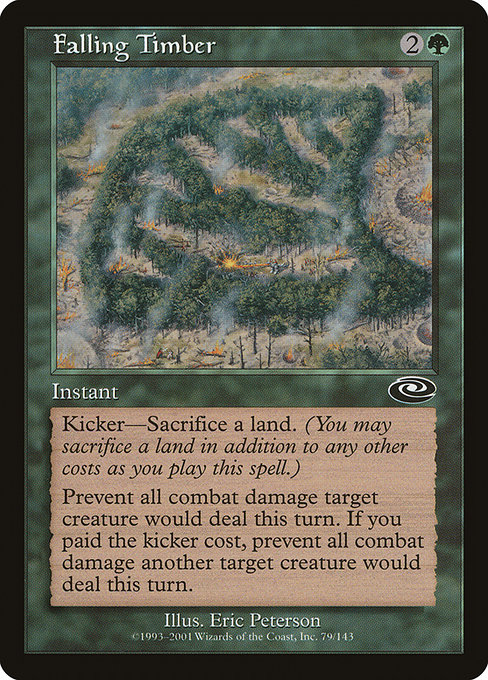
Image courtesy of Scryfall.com
When Green Meets the Arena: Community Reactions to a New Classic
In the long corridor of MTG memory, some reveals arrive with a whisper and others with a roar. The initial drop of Falling Timber—a {2}{G} instant from Planeshift with the unmistakable kicker mechanic—saw the community lean in with a mix of nostalgia and curiosity 🧙♂️🔥. Planeshift, the plane-trekking set in the early days of the 2001 block, carried a vibe of organic growth, lifelike forests, and a kitchen-sink approach to green’s toolbox. The first reactions weren’t a single verdict but a chorus of opinions about timing, tempo, and that curious land-sacrifice kicker decision that could turn a simple save into a two-creature shield parade ⚔️🎲.
Falling Timber’s core is elegant in its restraint: you pay 2 mana and a green, instant-speed, and you get to prevent combat damage that a target creature would deal this turn. But add the kicker—sacrifice a land—and the spell morphs into something closer to a utility fog for green: it not only prevents damage to one creature, it can prevent the damage from another creature as well, turning a one-for-one block into a potential double-dip of protection for the board. The math of it looked clean at first glance: a reliable combat defense in a color that often seeks to weave through battles rather than brute-force them. The kicker, however, forced players to weigh a land resource against staying aggressive or stalling long enough for a deeper plan to gel. That land-sacrifice angle sparked debates that felt timeless: is tempo worth a land drop, or does the land sacrifice undermine the very forest-fueled engine green players cherish? 💎🧭
In the long arc of MTG formats, the card scanned differently depending on your circle. In eternal formats like Legacy or Vintage, the mana curve and the cost of commitment mattered more because the board state can swing on a single draw or a single stall-worthy threat. In Commander, Falling Timber could shine as a flexible save spell that buys a critical turn or two in a pod where multiple players converge on the same battlefield and where lands themselves become an expendable, storied resource. The card’s common rarity meant it showed up in more decks than a rare would, and the evergreen appeal of a reliable green answer resonated with both old-school players and newer fans re-reading the block-era dialogue of Planeshift’s lush forests. The art by Eric Peterson, with its earthy palette and a sense of ancient growth, cemented the flavor: sometimes you hold the line with vines and timber, not swords and sorcery 🔔🎨.
Reaction threads across forums and early MTG community hubs carried a similar heartbeat: excitement about the card’s potential to blank a crucial combat stroke, tempered by the cost of sacrificing a land. Some players imagined it slotted into a tempo-green game plan that valued timely stalling and protected creatures long enough for a bigger threat to emerge. Others worried that the land sacrifice would be a hard sell in quick, aggressive lineups that rely on continuous pressure. The discussion was thick with nostalgia for a time when green’s identity felt less about raw power and more about resilient defense and patient development. It wasn’t about one card changing the metagame; it was about a tool that could shift the tempo of a match if used at precisely the right moment 🧙♂️⚔️.
Beyond mechanics, the reveal sparked conversations about design philosophy. Kicker—sacrificing a land to unlock a second, larger shield—embodied a calibration: you pay a little more now for a bigger payoff later, but the payoff is a conditional one. It’s a microcosm of how green mana engines often function in MTG: invest, wait for the moment, and then leverage the forest-forces to weather the storm. Community members who collect old-school cards or who chase retrofoils appreciated Falling Timber as a tangible piece of a formative era. Even as newer sets push toward dynamic, high-velocity strategies, this little instant reminded players that elegance sometimes hides in a simple, well-timed pause—the pause that says, “Not today, attacker.” 🎲💎
From nostalgia to practical play: what does it mean today?
Though not a Standard pillar in the modern era, Falling Timber remains a fond reference point for players who enjoy the slower, green-heavy games of yesteryear. It invites discussion about decision points—when to pay the land tax, when to hold back, and how to balance defense with the obligation to advance your own board state. In a world where synergy and value are king, this spell is a reminder that timing can be as important as raw power. It also hints at the broader design ethos of Planeshift: a set that wore its green heart on its sleeve, giving players tools that could shape games through subtle protection rather than explosive damage alone. The legend of this card endures in the community’s memory as a tiny lesson in risk-reward calculus and the comfort of a familiar forest’s embrace 🌳🧙♂️.
As you revisit the scan of Falling Timber, you may find it a perfect fit for a casual reunion with a group of friends who grew up with Planeshift—or as a talking point in a modern deck-building session where nostalgia meets new-school synergy. The card’s dual nature—a straightforward defense with a strategic kicker—offers a crisp, evergreen example of how MTG designs can reward careful planning without sacrificing playability. And if you’re feeling inspired to keep your desk as lively as your board, consider pairing MTG reflections with a glow-up for your desk setup—for example, a Gaming Neon Mouse Pad 9x7 Custom Stitched Edges 🌟🎨.
Gaming Neon Mouse Pad 9x7 Custom Stitched EdgesMore from our network
- https://crypto-acolytes.xyz/blog/post/nft-stats-memeverse-517-from-memeverse-collection/
- https://articles.zero-static.xyz/blog/post/no-mans-sky-post-launch-analysis-updates-patches-and-growth/
- https://blog.crypto-articles.xyz/blog/post/nft-data-angel-2784-from-angels-collection-on-magiceden/
- https://crypto-acolytes.xyz/blog/post/nft-decks-redefine-trading-card-games-today/
- https://crypto-acolytes.xyz/blog/post/nft-stats-nft-75-from-cupeys-collection/
Falling Timber
Kicker—Sacrifice a land. (You may sacrifice a land in addition to any other costs as you cast this spell.)
Prevent all combat damage target creature would deal this turn. If this spell was kicked, prevent all combat damage another target creature would deal this turn.
ID: 6e54c84d-ccc9-4c52-b02c-e0392e8fe447
Oracle ID: 4ea19457-97ef-4ac8-b67c-41be1109ca73
Multiverse IDs: 25945
TCGPlayer ID: 7798
Cardmarket ID: 3334
Colors: G
Color Identity: G
Keywords: Kicker
Rarity: Common
Released: 2001-02-05
Artist: Eric Peterson
Frame: 1997
Border: black
EDHRec Rank: 25119
Penny Rank: 15869
Set: Planeshift (pls)
Collector #: 79
Legalities
- Standard — not_legal
- Future — not_legal
- Historic — not_legal
- Timeless — not_legal
- Gladiator — not_legal
- Pioneer — not_legal
- Modern — not_legal
- Legacy — legal
- Pauper — legal
- Vintage — legal
- Penny — legal
- Commander — legal
- Oathbreaker — legal
- Standardbrawl — not_legal
- Brawl — not_legal
- Alchemy — not_legal
- Paupercommander — legal
- Duel — legal
- Oldschool — not_legal
- Premodern — legal
- Predh — legal
Prices
- USD: 0.14
- USD_FOIL: 0.77
- EUR: 0.05
- EUR_FOIL: 0.75
- TIX: 0.05
More from our network
- https://crypto-acolytes.xyz/blog/post/nft-stats-labubi-84-from-labubio-collection/
- https://crypto-acolytes.xyz/blog/post/nft-stats-roguesdead403-from-rogues-dead-collection/
- https://blog.crypto-articles.xyz/blog/post/nft-data-lightios-3-from-lightios-collection-on-magiceden/
- https://blog.crypto-articles.xyz/blog/post/nft-data-neutronex-nft-license-from-neutronex-nft-license-collection-on-magiceden/
- https://wiki.digital-vault.xyz/wiki/post/pokemon-tcg-stats-rockruff-card-id-tk-sm-l-14/