
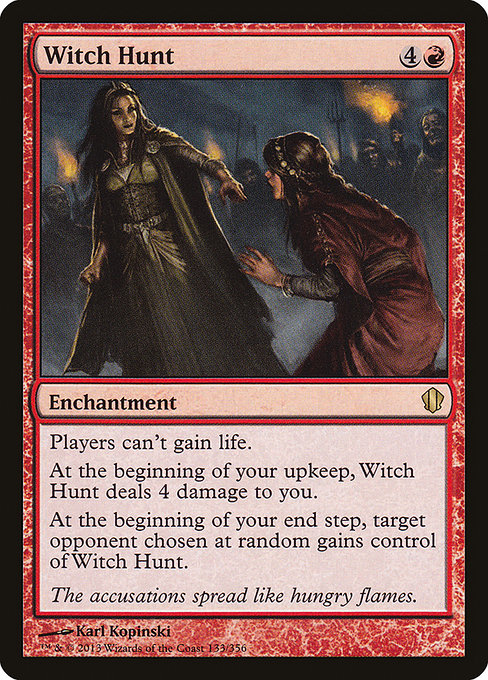
Image courtesy of Scryfall.com
The Philosophy of Fun in MTG Mechanics
Magic: The Gathering thrives on exploring the delicate balance between predictability and surprise. Some players chase pure efficiency, others chase lore, and a fearless few chase the delicious chaos that happens when a card nudges the table in an unexpected direction. Witch Hunt, a red enchantment from Commander 2013, stands as a vivid case study in the philosophy of fun. It isn’t just a card; it’s a social experiment wrapped in fire and scripts, asking a table to adapt to shifting power and shifting loyalties 🧙♂️🔥.
Designed as a rare enchantment for the red-aligned commander crowd, Witch Hunt costs {4}{R} and sits at a comfortable five mana. Its mana is pure red—fast, aggressive, and risky. The first act of fun is blunt: “Players can't gain life.” That single line flips lifegain decks on their heads and forces everyone at the table to rethink how they value life totals in long games. Then, at the beginning of your upkeep, Witch Hunt deals 4 damage to you—a built-in cost that keeps you honest and reminds you that in red’s world, ambition comes at a price. Finally, at the end step, a touch of chaos: a random opponent gains control of the enchantment. The spell’s namesake belongs to a moment of social drama, and the flavor text—“The accusations spread like hungry flames.”—makes the card feel like a fire you both started and must manage 🔥💎.
“The accusations spread like hungry flames.”
In practical terms, Witch Hunt invites a game state where lifegain becomes a liability and control of the enchantment dances between players, not just a single person. That dynamic embodies a broader question: what counts as fun at the table? Is it the satisfaction of assembling a devastating combo, or the shared, unpredictable journey of negotiating, bluffing, and adapting as fortunes swing? Witch Hunt leans into the latter. It turns a straightforward burn-and-blitz playstyle into a social puzzle, where every upkeep and end step reshapes the board’s political landscape 🧙♂️🎲.
Mechanics in Practice: Witch Hunt as a Case Study
- Risk as a design principle: The upkeep damage ensures longevity is costly. Players must weigh the value of keeping Witch Hunt on the battlefield against the ongoing self-damage—an ever-present reminder that red’s thrill comes with a price.
- Life as a resource, not a shield: By disabling life gain, the card punishes lifegain engines that would normally stretch a duel or group game into exponential advantage. This reframes what counts as “economic” in a multiplayer setting 🧙♂️💎.
- Political spice: The end-step hand-off to a random opponent introduces an element of roulette politics. It’s not just about who controls the enchantment, but how others adjust their plans when a beloved tempo play slips into another player’s orbit ⚔️🎨.
- Red’s flavor amplified: Red’s ethos—impulse, chaos, and raw impact—receives a vivid showcase. Witch Hunt embodies the chaos red craves while still requiring tactical restraint to avoid driving the table into organized chaos that backfires on the caster.
From a design perspective, Witch Hunt illustrates how a single card can serve as a social instrument as much as a strategic tool. Its artwork by Karl Kopinski captures that feverish mood of accusation and flame, aligning perfect with the card’s name and text. The Commander 2013 set’s frame and black border keep the moment anchored in a specific era of MTG history, reminding us that fun evolves with the game’s aesthetics as much as with its rules 🧙♂️🎨.
Deckbuilding and Mood: When to Reach for Witch Hunt
Witch Hunt shines in big, rambunctious multiplayer tables where politics and negotiation are as important as a well-timed removal spell. It works best when you want to nudge the table away from lifegain-centric strategies without resorting to pure straight damage. It also makes for memorable moments when a player who has pushed a lifelink engine suddenly finds themselves fading under the enchantment’s own price tag. If your playgroup thrives on table-talk and pivot moments, Witch Hunt is a spicy centerpiece that can calm a runaway engine or ignite a cascade of dramatic decisions.
Know that Witch Hunt is legal in formats like Commander and Duel, but not in many standard or modern traditions. Its red identity anchors a playful, chaotic, and sometimes volatile tempo. If you’re crafting a red-heavy EDH list that prizes social dynamics as much as raw power, this card is a flavorful, value-laden tool—especially for a table that enjoys risk as a feature, not a bug 🧡⚔️.
Gaming Rectangular Mouse Pad Ultra-thin 1.58mm Rubber BaseMore from our network
- https://blog.crypto-articles.xyz/blog/post/nft-data-solidskulls-1809-from-solidskulls-collection-on-magiceden/
- https://blog.crypto-articles.xyz/blog/post/nft-data-chubby-ape-gen2-3426-from-chubby-ape-gen2-collection-on-magiceden/
- https://transparent-paper.shop/blog/post/stellar-evolution-seen-through-color-and-temperature-at-7500-light-years/
- https://blog.crypto-articles.xyz/blog/post/nft-data-sempire-sempire-1068-from-sempiredao-collection-on-magiceden/
- https://wiki.digital-vault.xyz/wiki/post/pokemon-tcg-stats-togekiss-c-card-id-pl3-86/
Witch Hunt
Players can't gain life.
At the beginning of your upkeep, this enchantment deals 4 damage to you.
At the beginning of your end step, target opponent chosen at random gains control of this enchantment.
ID: 1db6d2a4-183e-47ff-bebe-efefd4bcc4be
Oracle ID: e86bd38f-7804-449d-af29-21e96a56ab30
Multiverse IDs: 376590
TCGPlayer ID: 71886
Cardmarket ID: 264750
Colors: R
Color Identity: R
Keywords:
Rarity: Rare
Released: 2013-11-01
Artist: Karl Kopinski
Frame: 2003
Border: black
EDHRec Rank: 15065
Set: Commander 2013 (c13)
Collector #: 133
Legalities
- Standard — not_legal
- Future — not_legal
- Historic — not_legal
- Timeless — not_legal
- Gladiator — not_legal
- Pioneer — not_legal
- Modern — not_legal
- Legacy — legal
- Pauper — not_legal
- Vintage — legal
- Penny — not_legal
- Commander — legal
- Oathbreaker — legal
- Standardbrawl — not_legal
- Brawl — not_legal
- Alchemy — not_legal
- Paupercommander — not_legal
- Duel — legal
- Oldschool — not_legal
- Premodern — not_legal
- Predh — not_legal
Prices
- USD: 0.31
- EUR: 0.29
- TIX: 1.17
More from our network
- https://wiki.digital-vault.xyz/wiki/post/pokemon-tcg-stats-beedrill-card-id-swsh6-3/
- https://blog.rusty-articles.xyz/blog/post/why-chespins-unique-stats-matter-in-the-pokemon-tcg-card/
- https://blog.crypto-articles.xyz/blog/post/nft-data-demian-935-from-dems-empire-collection-on-magiceden/
- https://blog.rusty-articles.xyz/blog/post/budget-deck-builds-with-sokenzan-affordable-mtg-strategies/
- https://articles.zero-static.xyz/blog/post/banished-startup-crashes-pc-troubleshooting-guide/