
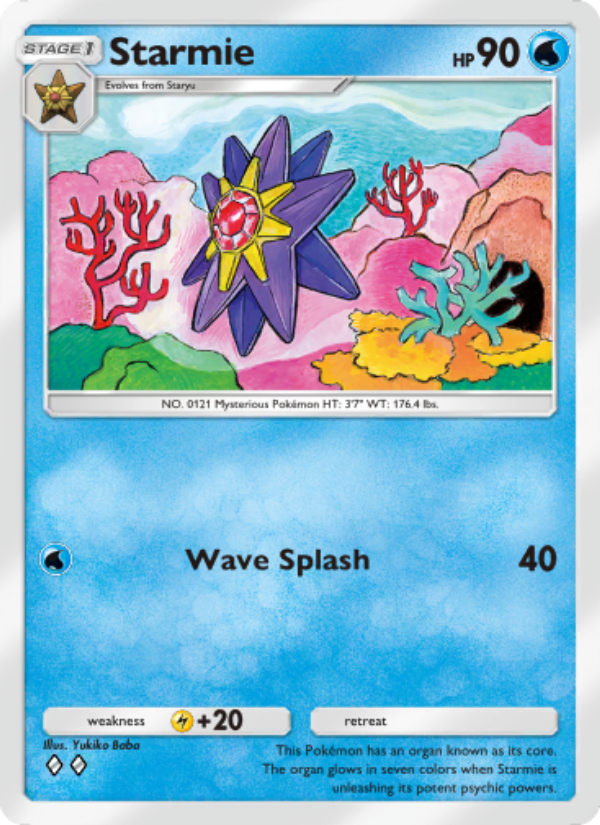
Image courtesy of TCGdex.net
Rarity, Pull Rates, and Starmie in the Genetic Apex Era
Fans of the Pokémon TCG know that rarity isn’t just a badge on a card—it’s a signal about how often a card might appear in packs, how much love it tends to receive from collectors, and how much daredevil flip of a trade you might need to solidify a collection. When we zero in on Starmie, a Water-type Stage 1 from the Genetic Apex set (A1), the conversation becomes especially thrilling. Classified as Two Diamond rarity, this print sits in a fascinating space: it’s not the ultra-rare chase, yet its holo presence carries a certain prestige that invites both players and collectors to chase it with a keen eye. With HP 90 and a single Attack—Wave Splash for 40—they offer a straightforward, piano-key attack line that players can appreciate in a broader Water-type strategy ⚡💎.
Illustrated by Yukiko Baba, Starmie’s artwork breathes life into the Pokémon’s core lore: a luminous organ that glows in seven colors when Starmie unleashes its psychic powers. This flavor text pairs nicely with the card’s mechanics, inviting players to think about how the gem-like core and the star silhouette translate into in-game value. The card’s lineage—evolving from Staryu, boasting a low retreat cost (0), and showing a vulnerability to Lightning (+20)—makes it a compact, reliable option for decks that prize speed and efficiency. The combination of a Stage 1 evolution and a mid-range HP pool makes Starmie a natural but deliberate addition for trainers who favor tempo plays and mid-game stabilization.
From a collector’s standpoint, the Genetic Apex set’s footprint is sizable: 226 official cards and 286 total cards across printings. Starmie’s Two Diamond rarity is not a mere label; it’s a marker of the card’s pull rate expectations in a given print run. Within Genetic Apex, there are holo, normal, and reverse holo variants for Starmie—each print channel representing a different tier of scarcity. The holo version, in particular, tends to be the one sought after by collectors who chase the rainbow shimmer of holo embellishment. For players who only care about gameplay, the utility remains the same across variant appearances, but the market value and long-term collectibility can swing on holo presence and condition. This dual nature—playability and collectibility—helps keep Starmie relevant long after its release.
Understanding Two Diamond in the Genetic Apex Landscape
Two Diamond is a rarity that sits above the most common prints but below the legendary “Ultra” tiers found in other sets. In practice, this means you’ll encounter Starmie less often than core commons and uncommons, but more often than the ultra-rare chase cards. The distribution across normal, reverse holo, and holo prints typically follows a pattern where the holo variant remains the most coveted and the most challenging to pull. The fact that Starmie is available in holo as well as non-holo means collectors can pursue a balance between affordability and splendor, while players who value card art and presentation might specifically target the holo print for display and collection purposes. The two-tier rarity and variant system nudges the market toward steady, ongoing demand rather than explosive price spikes that accompany truly legendary holo staples.
For gameplay, the card’s strength lies in its simplicity. Wave Splash deals 40 damage for a single Water energy, a respectable mid-game option that can chain into more powerful Water-type plays as your bench evolves. The absence of a heavy retreat cost (0) and the Stage 1 evolution from Staryu make it a reliable tempo piece in decks that prioritize quick transitions into the late game. Its Lightning weakness (+20) is a reminder to pair Starmie with supportive Type defenses or energy acceleration to mitigate risk when facing Electric-powered decks. Collectors, meanwhile, weigh the card’s rarity with its visual appeal—the seven-colored core glow of Starmie’s arc, emphasized by Baba’s vibrant art, adds a storytelling layer that resonates beyond raw numbers 🎨🎴.
Pull Rates in Practice: What to Expect
For most players, rarity translates into pull rate: how often a particular card appears in booster packs. In Genetic Apex, a Two Diamond card like Starmie is expected to appear less frequently than common or uncommon prints and likely less frequently than many mid-tier rares. However, the holo variant typically prints with even tighter odds, which is why many collectors pursue complete holo sets as a separate goal from standard play. The presence of normal, reverse holo, and holo variants means that a single pack could yield any of these flavors, with holo often representing the sharpest pull you hope for. Remember that local print runs, distribution changes, and reprint cycles can alter odds, so the exact chance a given booster box holds Starmie holo can vary between printings and regions. In short: patience, trade-ready value, and a bit of luck are all part of the chase 🔎⚡.
From a price and value perspective, rarity correlates with market interest. Two Diamond cards—especially holo prints—tend to command premium prices in online marketplaces and local shops. The set’s overall card count and the inclusion of variants mean supply can feel abundant at a glance, but scarcity emerges when you isolate the holo Two Diamond print among a sea of common and reverse holo cards. For investors and collectors, keeping an eye on card condition, edition notes (first edition status, etc.), and the presence of the holo embellishment can greatly influence long-term value. Starmie’s balance of speed, reliability, and flavor text-laden lore is a compelling mix that keeps this card relevant even as new sets roll out 🔥💎.
Strategically, players who want to maximize their chance of owning this card in holo might consider focusing on trade networks or participating in events that emphasize older sets or complete holo collections. The decision to prioritize play viability versus chase-value is personal, but understanding rarity helps set expectations: you’ll likely see more normal prints in bulk, with holo Two Diamond Starmie appearing sporadically. For those who love the art and story as much as the stats, the pursuit is part of the game’s enduring charm 🎮🎴.
Slim Glossy Phone Case for iPhone 16 (Ultra-thin, Durable Lexan)More from our network
- https://crypto-acolytes.xyz/blog/post/malik-shattered-694-risen-nft-stats/
- https://blog.digital-vault.xyz/blog/post/memorable-tournament-stories-featuring-blazing-archon/
- https://blog.digital-vault.xyz/blog/post/beating-scour-for-scrap-mtg-counterplay-guide/
- https://transparent-paper.shop/blog/post/stable-diffusion-xl-prompt-space-opera-watercolor-bleed-sage-azure-palette-epic-poster-art-cinematic-lighting-techno-organic-dragon/
- https://blog.digital-vault.xyz/blog/post/turn-kpis-into-insights-with-google-data-studio/
Starmie
Set: Genetic Apex | Card ID: A1-075
Card Overview
- Category: Pokemon
- HP: 90
- Type: Water
- Stage: Stage1
- Evolves From: Staryu
- Dex ID:
- Rarity: Two Diamond
- Regulation Mark: —
- Retreat Cost: 0
- Legal (Standard): No
- Legal (Expanded): No
Description
This Pokémon has an organ known as its core. The organ glows in seven colors when Starmie is unleashing its potent psychic powers.
Attacks
| Name | Cost | Damage |
|---|---|---|
| Wave Splash | Water | 40 |
Support Our Decentralized Network
Donate 💠More from our network
- https://crypto-acolytes.xyz/blog/post/malik-shattered-694-risen-nft-stats/
- https://blog.digital-vault.xyz/blog/post/memorable-tournament-stories-featuring-blazing-archon/
- https://blog.digital-vault.xyz/blog/post/beating-scour-for-scrap-mtg-counterplay-guide/
- https://transparent-paper.shop/blog/post/stable-diffusion-xl-prompt-space-opera-watercolor-bleed-sage-azure-palette-epic-poster-art-cinematic-lighting-techno-organic-dragon/
- https://blog.digital-vault.xyz/blog/post/turn-kpis-into-insights-with-google-data-studio/