
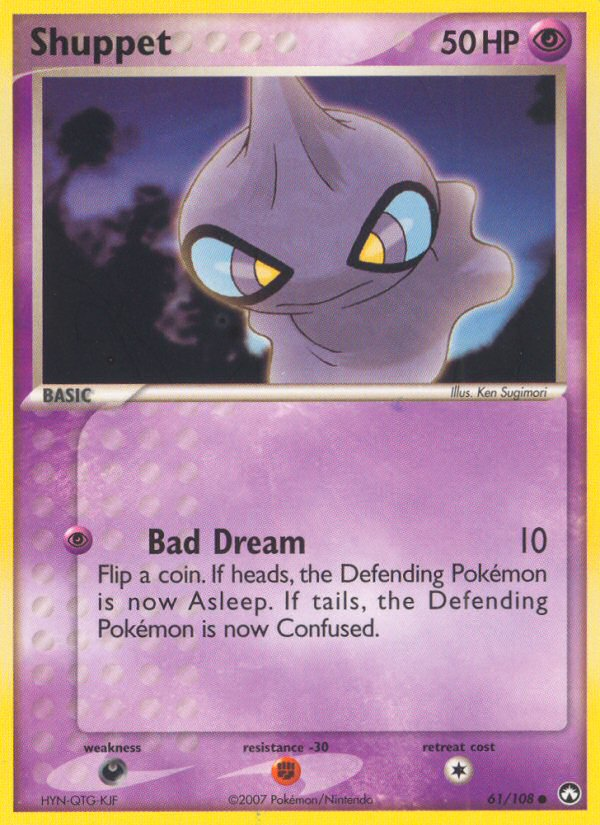
Image courtesy of TCGdex.net
Symbolic Echoes: What the Background Signals For Shuppet in the Pokémon TCG
In the world of Pokémon Trading Card Game art, even a small Basic Pokémon like Shuppet can tell a layered story through its backdrop. The ex16-61 Shuppet, a Common Psychic creature illustrated by the legendary Ken Sugimori, uses its background to whisper about its ghostly origins, its puppet-like nature, and the emotional terrain it inhabits. Set against the moody palette and shadowed ambiance of Power Keepers, the artwork invites players to read the card beyond its numerical stats and consider the mood the background creates. This is where symbolism and gameplay meet in a way that resonates with collectors and battlers alike. ⚡🎴 First, the color language is telling. Shuppet’s background in this piece leans into purples and midnight tones that are a hallmark of Ghost-type energy in classic Pokémon art. Purple hues are often used to convey mystery, intangible energy, and the liminal space between waking life and dreams—the perfect canvas for a Pokémon whose name evokes “shadows plus puppetry.” The soft gradient from deep violet to lighter lavender creates an atmosphere of twilight, a time when fears feel closer and the world feels just a touch more fragile. In collectible terms, those color choices signal to the eye that Shuppet’s power isn’t brute force; it’s a spectral presence that thrives in the margins of perception. Thematically, the background also nods to Shuppet’s puppet-like identity. The creature itself resembles a small, creepy marionette: a tie-in that Sugimori reinforces through the surrounding atmosphere. In the Power Keepers era, the art often leans into stagecraft motifs—strings, silhouettes, and theatrical hints—that imply Shuppet’s role as a subtle energy thief and a harbinger of mischief. While the card’s text outlines a straightforward status effect—Bad Dream can flip a coin to put the Defending Pokémon to sleep or confusion—the backdrop adds a narrative layer: a stage where fear and sleep intertwine, where the audience is the opponent and the performance is life-and-death on a tiny battlefield. The strings of a puppet theater might be imagined in the shadows, a reminder that Shuppet’s existence is a blend of playful misdirection and genuine haunt. Another layer of symbolism lies in the use of negative space. The composition often leaves generous room around Shuppet, allowing the figure to loom rather than overwhelm. This breathes loneliness into the artwork, echoing Shuppet’s ability to feed on negative emotions in the Pokémon lore. The space around the Pokémon mirrors the emptiness that Shuppet is said to thrive in, reinforcing the idea that its power is most potent when emotions are unsettled. In a game sense, this translates into a psychological hint for players: Shuppet’s presence is not just about a numeric attack, but about shaping the tempo of a turn with mood as much as math. Ken Sugimori’s craftsmanship shines in how the lighting frames Shuppet. The soft glow around the puppet’s edge draws the eye to its silhouette while letting the background recede into a smoky abyss. This balance mirrors the card’s practical mechanics: a small HP pool (50) for a Basic Psychic Pokémon, with an attack that punishes unpredictability more than raw durability. The artwork doesn’t need to shout; it nudges the viewer to sense the eerie charm of Shuppet, a common creature that still feels special in the right display case or binder spread. The result is a piece that feels timeless, resonating with both nostalgia and a modern collector’s eye for atmospheric art. For players who value synergy between art and strategy, the background signals a thematic connection to Shuppet’s move set and role in competitive play. Bad Dream’s coin flip outcome—putting the Defending Pokémon to sleep or confusion—maps onto the unsettling, dream-like vibe of the card’s backdrop. The idea is that Shuppet operates in the realm of night terrors rather than direct confrontation; the artwork suggests that the real fight happens in the mind, which makes the card feel especially fitting for a Psychic-type audience that loves mind games and subtle control. From a collecting perspective, Shuppet ex16-61 sits in Power Keepers, a set that contributed to the late-era evolution of base mechanics and artistic expression. The card’s rarity is Common, and its illustration credits go to Ken Sugimori, whose influence across the franchise lends an unmistakable continuity to the art. The background becomes a talking point when assessing condition and presentation in a display-worthy binder page—something many players and collectors appreciate when screening for top-condition, non-holo versus holo variants, and overall aesthetic appeal. Market watchers may notice the fluctuating value tied to non-holo and holo versions in modern markets. While the non-holo ex16-61 Shuppet sits at relatively modest averages (roughly around €0.29 on CardMarket, with even lower direct pricing in some markets), a holo version can fetch noticeably higher within the same set era depending on preservation and demand. The “background story” aspect isn’t a tradable stat, but it does contribute to the card’s desirability: a well-worn binder page featuring Shuppet with a purple, dreamlike backdrop can become a small centerpiece for a Psychic-themed display. For those who are building a Shuppet-focused deck or a Binder of Ghost-type art from the Power Keepers era, this card represents a reliable, approachable option with a recognizable silhouette and a mood-piece background that captures the spirit of the Ghost-type line. Collectors who adore Ken Sugimori’s artwork may also seek this card as a reminder of the classic style that defined generations of Pokémon card art. The piece embodies a quiet elegance—an understated beauty that speaks to strategic depth and visual storytelling in equal measure. 💎🎨 If you’re curious about the broader storytelling thread in card backgrounds, consider how power, fear, and dreamlike states have appeared across other Ghost-type and Psychic cards. The visual language often aligns with in-game mechanics that emphasize status effects, condition tokens, and the tension of remote or deceptive play. Shuppet’s background, with its nuanced use of color, space, and stagecraft motifs, serves as a compact case study in how art and mechanics collaborate to enhance a card’s identity beyond its numerical stats. CTA to explore a related space Custom Neon Rectangular Mouse Pad 9.3x7.8 inMore from our network
- https://rusty-articles.xyz/tmpcm3bb4gi/custom-neon-desk-mouse-pad-one-sided-print-3mm-thick.html
- https://articles.zero-static.xyz/blog/post/a-incriminate-deck-tech-meets-influencer-buzz/
- https://blog.rusty-articles.xyz/blog/post/symbolism-behind-electivires-design-in-the-pokemon-tcg/
- https://crypto-acolytes.xyz/blog/post/masterbot-sparks-solana-meme-coin-trend-with-liquidity-surge/
- https://blog.crypto-articles.xyz/blog/post/nft-data-klout-genesis-hashtag-959-from-klout-genesis-hashtags-collection-on-magiceden/
Shuppet
Set: Power Keepers | Card ID: ex16-61
Card Overview
- Category: Pokemon
- HP: 50
- Type: Psychic
- Stage: Basic
- Dex ID: 353
- Rarity: Common
- Regulation Mark: —
- Retreat Cost:
- Legal (Standard): No
- Legal (Expanded): No
Description
Attacks
| Name | Cost | Damage |
|---|---|---|
| Bad Dream | Psychic | 10 |
Pricing (Cardmarket)
- Average: €0.29
- Low: €0.02
- Trend: €0.32
- 7-Day Avg: €0.26
- 30-Day Avg: €0.28
Support Our Decentralized Network
Donate 💠More from our network
- https://rusty-articles.xyz/tmpcm3bb4gi/custom-neon-desk-mouse-pad-one-sided-print-3mm-thick.html
- https://articles.zero-static.xyz/blog/post/a-incriminate-deck-tech-meets-influencer-buzz/
- https://blog.rusty-articles.xyz/blog/post/symbolism-behind-electivires-design-in-the-pokemon-tcg/
- https://crypto-acolytes.xyz/blog/post/masterbot-sparks-solana-meme-coin-trend-with-liquidity-surge/
- https://blog.crypto-articles.xyz/blog/post/nft-data-klout-genesis-hashtag-959-from-klout-genesis-hashtags-collection-on-magiceden/