
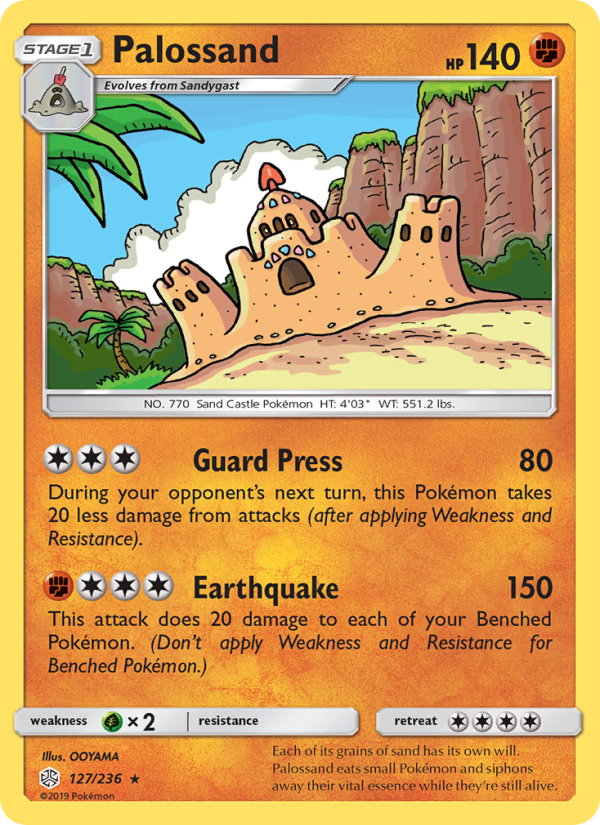
Image courtesy of TCGdex.net
Symbolism and silhouette: what Palossand’s design tells a story beyond stats
Palossand stands as a towering beacon of seaside fortitude, a design that immediately conjures images of sunlit dunes giving way to looming coastal fortresses. In the Cosmic Eclipse era, the illustration by OOYAMA leans into the fortress-as-creature idea: a colossal sandcastle outfitted with a face-like front, crowned parapets, and a sense that the gates themselves might swallow the unwary. This isn’t just a battle-ready Pokémon; it’s a living monument to the sea’s centuries-long power to sculpt, erode, and preserve. The storytelling is clear: in Palossand, memory and fortress fuse into a sentient bastion; the castle isn’t just protection—it’s imprisonment and guardianship, all at once. ⚡🏖️
In the card’s visual language, sand becomes architecture; architecture becomes a guardian. The spires and battlements evoke medieval seaside towns where legends whisper about ships, storms, and the souls of the drowned. Palossand’s color palette—earthy tans and sunlit golds—holds a sun-kissed permanence, as if the structure has stood against countless tides. The design also nods to the evolutionary line. Palossand evolves from Sandygast, a creature that borrows the shore’s grain and grit to fashion its own citadel. The implied backstory—sand recast as a sentient fortress—adds a layer of lore that invites players to imagine a battlefield where the sea itself is a co-conspirator in strategy and fate. 🎴🧱
From a symbolism standpoint, Palossand marries defense with dominion. The card’s stage and HP reflect the fortress’s durability, while the artwork’s looming silhouette communicates that this is a Pokémon built to endure and to protect its domain. The tiny human-scale figure of Sandygast perched atop the hill of sand acts as a reminder that a strong foundation begins with the right predecessor—an echo of the evolutionary chain that turns sand into stone, and stone into a citadel that can tower over a battlefield. The overall impression is less about brute force and more about strategic sovereignty: control the board by building a fortress of momentum, then unleash with seismic authority when the moment is right. 💎🔥
Gameplay symbolism: how the design translates into battle strategy
- HP 140 and Stage 1 lineage: Palossand carries robust staying power for a Stage 1 Pokémon, embodying the fortress’s resilience on the field. Its evolution from Sandygast is a reminder that sometimes the strongest defenses are built step by step, layer by layer. 🛡️
- Attacks reveal the fortress’s dual nature: Guard Press (80) represents the castle’s guard duty—warding off incoming blows, with Palossand taking 20 less damage on the opponent’s next turn after reductions. It’s a defensive bulwark that buys you time to set up the board. Earthquake (150) captures the fortress’s seismic might—an earth-shaking strike that also unsettles your own bench, since it deals 20 damage to each of your Benched Pokémon. The careful balance between self-protection and battlefield disruption highlights the castle’s all-encompassing reach: defend, then destabilize when the moment is right. ⚡🪨
- Weakness and energy costs: a Grass weakness at ×2 nudges players toward synergy with other types or stage mates in a mixed lineup, while the energy costs (Colorless/Colorless/Colorless for Guard Press and Fighting plus three Colorless for Earthquake) encourage thoughtful energy acceleration and retreat management. The Retreat Cost of 4 reinforces Palossand’s role as a late-game fortress that demands time and investment to reposition. 🧰
- Type and terrain appeal: as a Fighting-type, Palossand fits neatly into decks that prize sturdy, mid-to-late-game plays with the prospect of punishing sweeping attacks. The Fighting type motif echoes a knightly fortress defending its shores—an image that resonates with players who savor battlefield control and calculated risks. 🚪⚒️
Collector perspective: rarity, art, and value in Cosmic Eclipse
Palossand from Cosmic Eclipse carries the rarity tag of Rare and is showcased in holo variants, which makes its presentation particularly appealing to collectors who chase the glow of holo foil alongside a dramatic, lore-rich design. OOYAMA’s illustration captures that sense of monumental architecture and coastal mystery, making the card a standout for those who want a strong-looking centerpiece in a Fighting-type-focused deck or a striking display piece in a binder. 🖼️
Market dynamics for this card underscore its approachable cost and steady collectability. On Cardmarket, recent activity shows an average price around €0.16 for non-holo copies, with holo variants averaging higher, around €0.55, reflecting the common tendency for holo options to command a premium in the Cosmic Eclipse era. The price trajectory remains friendly for budget-conscious collectors, while die-hard fans can still chase near-mint holo examples as centerpiece acquisitions. In the US market, TCGPlayer data places the common non-holo range modestly around the $0.10–$0.28 spectrum for the regular print, with holo copies climbing into the $0.55–$1.69 region depending on condition and market timing. It’s a reminder that Palossand is a strong nostalgic pick with practical play value, not a high-cost chase card—making it a smart addition for players and collectors alike. 💎🎮
From a lore and art standpoint, Palossand’s design contributes to the broader mythos of the seas in the Pokémon world. It embodies how coastal environments inspire not just creatures but entire strategic philosophies: fortresses as mobile battlements, guardians as attackers, and memory as a battleground asset. In Cosmic Eclipse, the card stands at the intersection of narrative depth and gameplay potency, a combination that keeps Palossand relevant in both casual battles and showpiece collections. 🎨🏰
Deck-building thoughts: integrating Palossand into a modern lineup
For players, Palossand’s blend of heavy-hitting Earthquake damage and strategic defense via Guard Press makes it an appealing choice for mid- to late-game plays where you’ve established a solid bench and want to threaten an all-out offensive while staying protected. Its Grass weakness is a logistical note: pairing Palossand with teammates that can handle Grass-heavy threats or using dual-type lines can smooth out vulnerabilities. In Cosmic Eclipse’s vast pool, Palossand pairs well with other Fighting-type stage lines and with draw-support that accelerates energy consistency, so you can land the big 150-damage Earthquake when the field is primed. 🧭🪄
As a rare holo, Palossand also shines in binder aesthetics and trade value for the collector who loves the narrative hook of a guardian fortress rising from the sand. The design invites conversations about how the sea shapes Pokémon biology and architecture alike, making it a perfect centerpiece for themed displays or binder pages focused on symbolism in the TCG. 🔎🧱
Clear Silicone Phone Case - Slim, Durable and FlexibleMore from our network
Palossand
Set: Cosmic Eclipse | Card ID: sm12-127
Card Overview
- Category: Pokemon
- HP: 140
- Type: Fighting
- Stage: Stage1
- Evolves From: Sandygast
- Dex ID: 770
- Rarity: Rare
- Regulation Mark: —
- Retreat Cost: 4
- Legal (Standard): No
- Legal (Expanded): Yes
Description
Attacks
| Name | Cost | Damage |
|---|---|---|
| Guard Press | Colorless, Colorless, Colorless | 80 |
| Earthquake | Fighting, Colorless, Colorless, Colorless | 150 |
Pricing (Cardmarket)
- Average: €0.16
- Low: €0.05
- Trend: €0.14
- 7-Day Avg: €0.16
- 30-Day Avg: €0.22
Support Our Decentralized Network
Donate 💠More from our network
- https://blog.crypto-articles.xyz/blog/post/nft-data-homestar-runners-2148-from-homestar-runners-collection-on-magiceden/
- https://wiki.digital-vault.xyz/wiki/post/pokemon-tcg-stats-psychic-energy-card-id-tk-xy-n-9/
- https://blog.crypto-articles.xyz/blog/post/nft-data-george-plays-clash-royale-epic-176-from-gpcr-nft-collection-collection-on-magiceden/
- https://blog.zero-static.xyz/blog/post/gates-ablaze-cosplay-fiery-gatekeeper-armor-for-mtg-fans/
- https://wiki.digital-vault.xyz/wiki/post/pokemon-tcg-stats-lost-blender-card-id-sm8-181/